Transcription of THREE MODES OF COMMUNICATION Interpersonal …
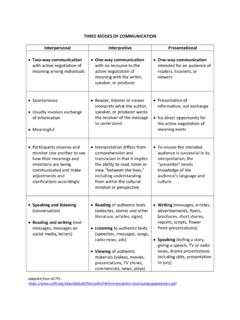
1 THREE MODES OF COMMUNICATION . Interpersonal Interpretive Presentational Two-way COMMUNICATION One-way COMMUNICATION One-way COMMUNICATION with active negotiation of with no recourse to the intended for an audience of meaning among individuals active negotiation of readers, listeners, or meaning with the writer, viewers speaker, or producer Spontaneous Reader, listener or viewer Presentation of interprets what the author, information; not exchange Usually involves exchange speaker, or producer wants of information the receiver of the message No direct opportunity for to understand the active negotiation of Meaningful meaning exists Participants observe and Interpretation differs from To ensure the intended monitor one another to see comprehension and audience is successful in its how their meanings and translation in that it implies interpretation, the intentions are being the ability to read, listen or presenter needs communicated and make view between the lines.
2 Knowledge of the adjustments and including understanding audience's language and clarifications accordingly from within the cultural culture mindset or perspective Speaking and listening Reading of authentic texts Writing (messages, articles, (conversation) (websites, stories and other advertisements, flyers, literature, articles, signs) brochures, short stories, Reading and writing (text reports, scripts, Power messages, messages on Listening to authentic texts Point presentations);. social media, letters) (speeches, messages, songs, radio news, ads) Speaking (telling a story, giving a speech, TV or radio Viewing of authentic news, drama presentations materials (videos, movies, including skits, presentation presentations, TV shows, to jury).)
3 Commercials, news, plays). adapted from ACTFL: Objectives of a communicative approach: to provide activities that require students to go beyond their traditional role as responder to the teacher's questions;. to provide opportunities for students to use the language in meaningful interaction with others, and to negotiate meaning in authentic contexts in Interpersonal COMMUNICATION ;. to provide opportunities for students to engage in self-expression in Interpersonal and presentational COMMUNICATION ;. to provide opportunities for students to hear and read a great deal of comprehensible and authentic language in Interpersonal and interpretive COMMUNICATION ;. to provide opportunities for students to engage in real-life tasks to provide a nonthreatening environment in which students' affective filter is lowered adapted from: Shrum, Judith L.
4 , and Eileen W. Glisan. Teacher's Handbook: Contextualized Language Instruction. 4th ed. Boston: Heinle and Heinle, 2010.