Transcription of Three-way ANOVA
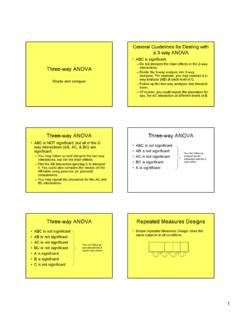
1 1 Three-way ANOVAD ivide and conquerGeneral Guidelines for Dealing with a 3-way ANOVA ABC is significant: Do not interpret the main effects or the 2-way interactions. Divide the 3-way analysis into 2-way analyses. For example, you may conduct a 2-way analysis (AB) at each level of C. Follow up the two-way analyses and interpret them. Of course, you could repeat the procedure for, say, the AC interaction at different levels of ANOVA ABC is NOT significant, but all of the 2-way interactions (AB, AC, & BC) are significant: You may follow up and interpret the two way interactions, but not the main effects. Plot the AB interaction ignoring C to interpret it. You could also compare the means on the AB-table using post-hoc (or planned) comparisons. You may repeat the procedure for the AC and BC ANOVA ABC is not significant AB is not significant AC is not significant BC is significant A is significantYou can follow up interpret the BC interaction and the A main ANOVA ABC is not significant AB is not significant AC is not significant BC is not significant A is significant B is significant C is not significantYou can follow up and interpret the A and B main Measures Designs Simple repeated Measures Design: Uses the same subjects in all conditions.
2 2 Simple Repeated Measures Design The observations are not independent over conditions. It is an extension of the correlated (or paired) t-test. This analysis is also called a within DesignSAS Setup for a Simple Repeated Measures Designdatarepeated;input ss y1-y3;cards;1 22 24 1910 18 17 23;proc print; run;proc means;run;proc glm;model y1-y3= / nouni;repeated repfact3; run;Means and Standard 's Greatest 's ' LambdaPr > FDen DFNum DFF ValueValueStatisticManova Test Criteria and Exact F Statistics for the Hypothesis of no repfact EffectH = Type III SSCP Matrix for repfactE = Error SSCP MatrixS=1M=0N=3 Multivariate TestsThe circularity assumption is not needed for the multivariate tests to be (repfact) Pr > FPr > FF ValueMeanSquareType IIISSDFS ourceCircularity Assumption is Met when epsilon is Epsilon3 Epsilon Epsilon is a (sample) measure of how well the circularity assumption has been met.
3 It ranges from 1/dfrep< < our previous example, the range is1/2 < < epsilon is one, the circularity assumption has been met. If epsilon is 1/dfrep, circularity has been violated in a bad on Epsilon If epsilon is not one, the usual univariate F-test must be adjusted. When considering the univariate F-test we have three possibilities for adjusting the degrees of freedom: Usual Conservative AdjustedAdjusting the df s in the Univariate F-tests Usual F-test: use the usual dfs a-1=2; (a-1)(s-1)=2*9=18; df s=2,18 Conservative F-test (assume that =.5) Then the df s are 1 and 9. ,2,18= ,1,9= Epsilon corrected F-tests Compute the sample epsilon and multiplied the dfsby this Test is Best? Multivariate test makes less assumptions but it is not always more powerful. The e-adjusted test is a good alternative and can be more powerful than the multivariate tests. Ordinarily we look at both tests.
4 If both of them are significant, then report the one. Never rely on the usual univariate ANOVAOne within and One Between Lets say B is the within factor And that A is the between factorsn1+1sn2A2s1sn1A1B4B3B2B1F-test for the Groups by trials (b-1)(s-1)aB*S/A (error for B and B*A)(b-1)(a-1)B*A(b-1)B(n-1)aS/A (error for A)(a-1)AF-testdfSource4 Weight Training Data datawtsmiss; inputsubj program$ s1 s2 s3 s4 s5 s6 s7; datalines; 1 CONT 85 85 86 85 87 86 87 2 CONT 80 79 79 78 78 79 78 3 CONT 78 77 77 77 76 76 77 4 CONT 84 84 85 84 83 84 85 5 CONT 80 81 80 80 79 79 80 6 CONT 76 78 77 78 78 77 74 7 CONT 79 79 80 79 80 79 81 8 CONT 76 76 76 75 75 74 74 9 CONT 77 78 78 80 80 81 80 10 CONT 79 79 79 79 77 78 79 SAS Setup for Groups by Trials /* Test of homogeneity of var-cov matrices for the Multivariate tests */ proc discrimpool=test; classprogram; Var s1-s7; run; /* Obtainin the corrected univariate and multivariate tests */ Proc glmdata=wtsmiss; classprogram; models1-s7= program / nouni.
5 Repeatedtime 7/printe summary; meansprogram; run;Looking at the Programs /* Running the simple main effect tests on the programs*/ proc glmdata=wtsmiss; classprogram; models1-s7= program; meansprogram /tukey; run;Assessing the Homogeneity AssumptionWithin Covariance Matrix InformationprogramCovarianceMatrix RankNatural Log of theDeterminant of theCovariance Chi-square TestChi-SquareDFPr > Test for the Hypothesis of no Time*program EffectH = Type III SSCP Matrix for time*programE = Error SSCP MatrixS=2M= ValueNum DFDen DFPr > FWilks' 's 's Greatest Effect5 Manova Test Criteria and Exact F Statistics for the Hypothesis of no time EffectH = Type III SSCP Matrix for timeE = Error SSCP MatrixS=1M=2N= ValueNum DFDen DFPr > FWilks' <.0001 Pillai's <. <.0001 Roy's Greatest <.0001 Time EffectGreenhouse-Geisser TestsVariablesDFMauchly'sCriterionChi-SquarePr > ChiSqTransformed <.0001 Orthogonal <.
6 0001 Test of Circularity for the Repeated FactorSourceDFType III SSMean SquareF ValuePr > Variable: time_4 SourceDFType III SSMean SquareF ValuePr > Analysis: The Between EffectSourceDFType III SSMean SquareF ValuePr >FAdj Pr > * (time) Tests: Time & Interaction6 SourceDFType III SSMean SquareF ValuePr > EffectContrast Variable: time_1 vs. Time_7 SourceDFType III SSMean SquareF ValuePr > Variable: time_2 vs. Time_7 SourceDFType III SSMean SquareF ValuePr > III SSMean SquareF ValuePr > Variable: time_377787980818283841234567 cWiRIPlot of MeansWIRIContT7T6T5T4T3T2T1 Repeated FactorBetweenAs/ABBAB*s/A Simple Main Effects in Repeated Measures Designs7 Simple Main Effect with Repeated Factors When going across the repeated factor at a level of the between factor: Use the error term for the repeated factor. When going across the between factor at a level of the within factor: Pool the between and within error ++=