Transcription of Time of Flight Diffraction - Oceaneering
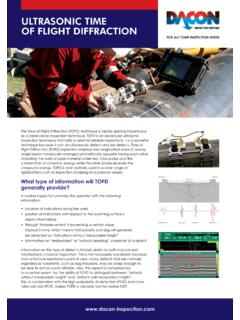
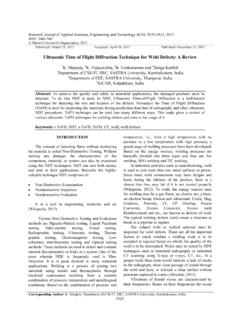
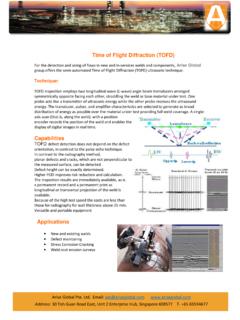
1 DatasheetTime of Flight DiffractionFor the detection and sizing of flaws in new and in-services welds and components Oceaneering offers the semi-automated time of Flight Diffraction (TOFD) ultrasonic technique. FEATURESE xcellent defect monitoring capabilitiesCan be applied on new and existing weldsWill detect Stress Corrosion CrackingIdeal for rapid and reliable weld root erosion inspection employs two longitudinal wave (L-wave) angle beam transducers arranged diametrically opposite each other, straddling the weld or base material under test. One probe acts as a transmitter of ultrasonic energy while the other probe receives the returning signals.
2 The transducer, pulser, and amplifier characteristics are selected to generate a broad distribution of energy allowing for full weld coverage with single scans. An electronic encoder records the probes position along the weld during the scan, which enables a real time display of the digital images and also records the raw ultrasonic information. CAPABILITIES TOFD defect detection does not depend on the defect orientation, in contrast to the pulse echo technique. In contrast to the radiography method, planar defects and cracks, which are not perpendicular to the measured surface, can be detected. Defect height can be accurately determined.
3 Higher POD improves risk reduction and calculation. Inspection data is immediately available in recordable electronic format. Because of the high test speed the costs are less than those for radiography for wall thickness above 25 mm. The inspection can be performed above 200 C. Versatile and portable equipment LIMITATIONS The minimum nominal wall thickness should not be below The paint coating should be adequately bonded and the inspection surface should be in a good condition The quality of the data collected should be suitable to determine the back wall responses and the extent of any corrosion / erosion evident. Accuracy of the technique for measurement of remaining wall loss is estimated typically as + The accuracy of measurement of change of wall thickness within a single scan is estimated at + Shallow flaws and small amounts of corrosion maybe masked by the presence of a large back-wall echo.
4 Corrosion of < in length may not be IntegrityOCEANEERING is a registered trademark of Oceaneering International, Inc. is a world class provider of asset integrity services. For further information on the full range of services provided please visit or email 2012 - 0