Transcription of TIPS%ON%POSTER%PRESENTATIONS%ATPROFESSIONAL …
1 TIPS ON poster PRESENTATIONS AT PROFESSIONAL CONFERENCE SCOTT W. PLUNKETT1 PURPOSES OF CONFERENCE PRESENTATIONS To educate others about your research findings; To get feedback/critique from peers before submitting a manuscript for publication; To network with other scholars who are interested in the same research; and/or To promote one s work and one s self prior to applying to graduate school or going on the job market.
2 ADVANTAGES OF poster PRESENTATIONS OVER ORAL PRESENTATIONS A poster session has potential to reach larger numbers of people than a typical oral presentation . An appealing poster can interest people who walk by who might not be in your specific field of research. A poster presentation allows you to interact one- on- one with people interested in your research. There is more time to present your research at a poster session; versus the 12- 20 minutes allotted in most oral sessions.
3 PURPOSES OF A VISUAL presentation Regardless of whether the visual presentation is part of an oral or poster presentation , the author should keep in mind the following purposes of a visual presentation :2 o To connect with the viewers; o To direct and hold the attention of the viewers; and o To enhance the viewers understanding and memory by providing easily digestible information. Presentations should accentuate the most important information ( , the take away message ).
4 Don t just present information that supports your point while intentionally leaving off conflicting results or non significant results. ETHICAL & PROFESSIONAL BEHAVIOR Do not list your name on a poster as a coauthor/presenter unless you had an active role in the research and development of the content of the presentation . Give citations on a poster when paraphrasing other s work just like you would in a manuscript.
5 O Use an appropriate style ( , APA) when citing. The same poster should not be presented at multiple conferences. Dress professionally when presenting your poster especially if you are a student applying to graduate programs or teaching/research positions. You never know who might stop by to see your poster and to meet you. o Wear comfortable shoes you will be standing for quite awhile. Be on time for your poster , and be sure to take your poster down at the end of the time.
6 Stay close to your poster during the session so that you are available for discussion. Wear your nametag! Smile and make eye contact with people who pass the poster . Greet viewers with hello and offer to answer any questions they may have. o But, allow the viewers time to read the poster without interruption. o If they ask you a question or look like they have a question, then that is your cue to engage them about your research.
7 Don t get too involved with one person and ignore others who might want to discuss your research. Have a rough draft of the paper as a handout ( , hard copy, disc, electronic copy) for interested scholars. o If you run out of handouts, have a sign up sheet so people can get a copy of your poster . o Also, some prefer to leave business cards for their handout requests, so have an envelope in which to put the cards.
8 O Be sure and email them a copy as soon as possible (preferably as soon as you get access to the internet). Don t try to force handouts on people who are not interested. Don t take criticism personally. o One of the purposes of a poster (or oral) presentation is to get critique prior to submitting for publication. o Also, many scholars who attend the poster session are there to mentor novice researchers.
9 So, they may be giving constructive criticism as a way to help enhance your professional development. If you do not know the answer to a question, one option is to mirror the question back. o For example, if a person asks Don t you think the variable A could be related to B because of C? You could respond with, Hm interesting. Could you tell me more about why you think this? 1 Scott W.
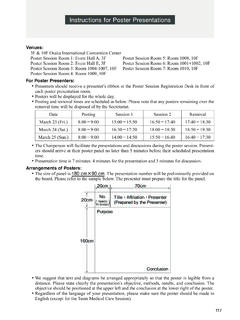
10 Plunkett, , is a professor of psychology, California State University Northridge. 2 Kosslyn, S. M. (2007). Clear and to the point: 8 psychological principles for compelling PowerPoint presentations. New York: Oxford University Press. A poster should not be a research paper tacked on a board! It should be a concise, visually pleasing, illustration of your work. Remember, you are on display as well as your poster !