Transcription of TM - Clifford Power Systems
1 The installation information provided in this information sheet is informational in nature only, and should not be considered the advice of a properly licensed and qualified electrician or used in place of a detailed review of the applicable National Electric Codes and local codes. Specific questions about how this information may affect any particular situation should be addressed to a licensed and qualified electrician. Information Sheet # 59 Above-Ground Sub- base fuel Tanksfor Generator SetsTo fulfill our commitment to be the leading supplier and preferred service provider in the Power Generation Industry, the Clifford Power Systems , Inc. team maintains up-to-date technology and information standards on Power Industry changes, regulations and trends. As a service, our Information Sheets are circulated on a regular basis, to existing and potential Power Customers to maintain awareness of changes and developments in engineering standards, electrical codes, and technology impacting the Power Generation installation information provided in this information sheet is informational in nature only, and should not be considered the advice of a properly licensed and qualified electrician or used in place of a detailed review of the applicable National Electric Codes and local codes.
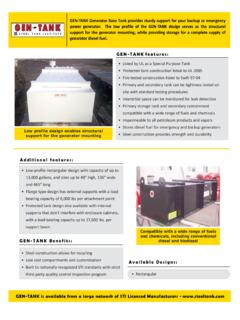
2 Specific questions about how this information may affect any particular situation should be addressed to a licensed and qualified electrician. Your Reliable Guide for Power Introduction:Frequently a generator set system is supplied with a fuel tank built into the package. The arrangement most often supplied from the manufacturer is with the generator set mounted above the fuel tank. (See illustration below) This Information Sheet discusses the variety of codes and regulations pertaining to sub- base fuel tanks for standby generators. fuel tanks come in all shapes and sizes, but often need to comply with certain NFPA Codes Applying to fuel Tanks:The National Fire Protection Agency (NFPA) is the principal body referenced when applying codes for generator set Systems . the following clauses taken from NFPA 37 applies to fuel tanks for inside structures. (Continued over)123451 - Double wall for spill containment2 - Rectangular shape reinforced box structure3 - Containment 110% of fuel tank capacity4 - Direct reading fuel level gauge5 - Vent to be taken through roof on enclosed set6 - Tank fill7 - Normal atmospheric pressure vent8 - Rigid side support to take 5000lbs per genset mount9 - Set enclosed or open depending on location 6789UL 142 Standard Diesel Sub base Tank - Stationary InstallationsAustin4918 Burleson RoadAustin, TX East 46th Street NorthTulsa, OK East US Hwy 80 White Oak, TX City7300 Melrose LaneOklahoma City, OK Antonio5803 Rocky PointSan Antonio, TX Rock 6800 Intersate 30 Little Rock, AR Louis53 Millwell CourtMaryland Heights, MO Box 581807 Tulsa, OK Worth2916 National DriveGarland, TX Industrial BoulevardMansfield, TX City211 E Marley RdKansas City, KS | #59 2014 PLC Enterprises, LLC(Continued from page-one)
3 fuel tanks inside structures shall be securely mounted on non-combustible fuel tanks not in a room by themselves shall not exceed 660 gallons. fuel tanks larger than 660 gallons capacity shall be enclosed in a room in accordance with or Not more than one such 660 gallon capacity tank, or two or more of these tanks with an aggregate capacity of 660 gallons, shall be connected to one fuel tanks of any size shall be permitted within engine rooms or mechanical spaces, provided the eng ine or mechanical room is designed using recognized engineering practices with suitable fire detection, fire suppression, and containment means to prevent the spread of fire beyond the room of origin. The aggregate capacity of all fuel tanks in a structure shall not exceed 1,320 gallons, unless that portion exceeding 1,320 gallons is enclosed in a room in accordance with or fuel tanks of any size shall be permitted within engine rooms or mechanical spaces provided the engine or mechanical room is designed using recognized engineering practices with suitable fire detection, fire suppression, and containment means to prevent the spread of fire beyond the room of origin.
4 Rooms Housing only fuel Tanks with an aggregate capacity of 1,320 gallons or Rooms containing only fuel tanks with an aggregate capacity of 1,320 gallons or less shall be constructed of walls, floor, and ceiling having a fire resistance of not less than one hour with the walls bonded to the floor. Rooms Housing only fuel Tanks with an aggregate capacity of more than Rooms housing only fuel tanks shall be constructed of walls, floor, and ceiling having a fire resistance of not less than three hours with the walls bonded to the floor. UL 142 standard for Diesel fuel Sub base Tank (stationary installations):This calls for the construction be in accordance with NFPA 30 Flammable and Combustible Liquids; NFPA 37 Standard for Installation and Use of Stationary Combustible Engine and Gas Turbines; NFPA the Standard for Emergency and Standby Power to be noted are: This must be rectangular in shape and include a reinforced steel box channel, with load rating of 5,000 lbs.
5 Per genset mounting hole location. Full height gussets shall be provided at genset mounting holes. The tank must be pressure washed with an iron phosphate solution and the interior coated with a solvent-based film rust preventative, providing inter-operational protection. The primary and secondary containment basin shall be pressurized at 3 to 5 psi to ensure leak integrity of the weld seams. Closed top dike primary tank sections to be pressure tested at 3 to 5 psi and leak checked to ensure integrity of weld seams. Containment basin to be leak checked by means of weld penetrant and ultraviolet light. Sub base Tank Fittings to include: appropriately sized NPT fuel supply, fuel return fitting, 2-inch NPT for normal vent, NPT for emergency vent sized as appropriate, 2-inch NPT for manual fill, NPT for level gauge sized as appropriate, 3/8 inch NPT basin drain (tank drain if single wall), 2-inch NPT for level alarm and NPT fitting for leak detection alarm. fuel Level Gauge: Sub- base tank shall include a direct-reading fuel level gauge.
6 fuel Containment Basin: Welded steel containment basin sized a minimum of 110% of the tank capacity to prevent escape of fuel in the event of a tank rupture. Leak Detection System: A fuel containment basin leak detector switch will be provided. Sub base Tank Venting:1. Normal venting shall be sized at 2-inch NPT through 10,000 gallons in accordance with American Petroleum Institute Standard No. 2000, for venting atmospheric and low pressure storage tanks. Tank shall be provided with atmospheric (normal) vent cap and Emergency venting. Emergency vent to be sized to accommodate total capacity of both normal and emergency vents and is not less than derived from NFPA 30, table 2-8, based on wetted surface area of tank. A zinc-plated emergency pressure relief vent cap shall be furnished. This vent to be spring-pressure operated. Opening pressure shall be psi; full opening pressure shall be psi. A secondary emergency vent shall be provided for the secondary containment portion of the tank, if applicable.
7 UL 2085 standard for Protected Above-Ground Tanks for Flammable and Combustible:This subject was covered by Information Sheet # 1. Summary of Applicable Standards and What is Covered:To summarize, this standard covers the ability of the tank to withstand: fire (section 17); vehicle impact resistance (section 20) and projectile resistance (section 21). Withstand fire: With a two-hour liquid pool and furnace fire tests, the primary internal tanks sees an average rise of no more than 260 degrees F. Resist vehicle impact: Maintain fuel containment after an impact of 12,000 lbs. force at 10 mph. Resist projectiles: One manufacturer quotes a test with a 150-grain, 30-caliber bullet having a muzzle velocity of 2,700 feet per second, from a distance of 100 feet. In addition to the above, some states, cities and fire departments have their own standards and regulations that cover aspects of fuel storage tanks. We suggest that you always investigate with the relevant authorities.