Transcription of To: Mathematics and Statistics Teaching Faculty
1 1 To: Mathematics and Statistics Teaching Faculty From: Magda Toda, Department Chair Re: Departmental Handbook for 2017-2018 Date: August 2017 This ha ndbook de scribes the undergraduate and graduate programs offered by our de partment. It also contains syllabi, textbook information and course descriptions of our undergraduate and graduate Mathematics courses. Universi ty and depa rtment policies requires that during the first week of class each instruc tor provide each or ganized class with a syllabus, explaining how final course grades are to be de termine d and listing student outcomes and assessment procedures. Further, compliance with HB 2504 will require the submission of an electronic version of the syllabus (at Texas Tech that submission will be made through Digital Measures) for undergraduate classes by the 7th class day (3 Sep 2014).
2 A sample syllabus and examples of assessment practices and student learning outcomes are provided on pa ges 14-17 of this document. Student learning outcomes and assessment statements must be included in eve ry syllabus. Please note the special statements that ha ve been provided for the courses in the Mathematics Core Curriculum-M1300, M1320, M1321, M1330, M1331, M1350, M1451, M1452, M1550, M2300, M2345, M2370, and M2371. Suggestions for statements regarding ADA, student civility, illness and death notification, and abs ences due to religious observance are also provided. Please include the name of the Course Coordinator as indicated in the sample. Please inform your students about the depa rtment supported Tutoring and Study Center that will operate out of Room 106. Early in the s emester, you will r eceive a notice a bout the hours of operation. Students need to be aware of class progress before the deadline s for dropping a class, declaring Pass/Fail or withdrawing from a class.
3 It is important that you keep your students informed about their progress by administering, grading and returning examina tions and/or quizzes prior to the se deadline s. Do not dismiss classes to extend holida ys and do not give hour exams in the last week of the semester. Unless you are prepa red to deal with the issue of students working collaborative ly together on outside - of -class projects and exams (in spite of instructions to the contrary), do not give take-home exams. Final examina tions must be given at the university sche duled time. You should include information in your syllabus de lineating the sche duled time for your Final Exam, especially if it is a common de pa rtmental final. If you teach a course which has a common de pa rtment al final, you will be assigne d a Course Coordinator for that course. The Course Coordinator will be responsible for constructing the depa rtmental examina tion and establishing the guidelines under which it is to be administered.
4 Suc h guidelines usually include policies regarding calculators, formula sheets, or other aids. In such a course, you are expected to administer the common de pa rtmental final and to follow the guideline s established for it. It is highl y recommended to follow the same guidelines for the mid-semester tests/exams. Whe n you leave Texas Tech Universi ty pe rmanently, you must turn in your Texas Tech Universi ty ke ys, grade books (or a copy), and a c opy of a ll recent Final Exams. Thank you for your professional and conscientious efforts in helping the de pa rtment meet its Teaching mission. 2 Contents Degrees Offered .. 3 Entrance Credit .. 4 Mathematics Placement Examination .. 5 Prerequisite Courses for Undergraduate Mathematics .. 6 Scholarships, Awards, and Financial Support .. 7 Undergraduate Degree Programs .. 8 Mathematics Major Degree Requirements: Bachelor of Arts ( ) (120 hours).
5 8 Mathematics Major Degree Requirements: Bachelor of Science ( ) (120 hours).. 9 Accelerated Bachelors-to-Masters .. 10 Minor in Mathematics .. 11 Minor in Actuarial 11 Selection of Elective Courses .. 12 Course Rotation of Upper Division Courses .. 13 Syllabus Guide .. 14 Undergraduate Course Outlines .. 18 Graduate Degree Programs .. 76 Master s Degree in Mathematics .. 76 Master s Degree in Statistics .. 77 Doctoral Program .. 79 Leveling Coursework for Graduate students .. 83 Graduate Course Outlines .. 84 3 Degrees Offered The department offers five degrees. Undergraduate degree requirements are listed on pages 7 - 13, and graduate degree requirements are listed on pages 42- 46. The Bachelor of Arts Degree: This degree provides traditional liberal arts training with a specialization in Mathematics of at least 21 hours of upper level courses in Mathematics ( , courses numbered 3000 or above). The Bachelor of Science Degree: Placing greater emphasis on scientific training and requiring 27 hours of upper level courses in Mathematics ( , courses numbered 3000 or above).
6 This degree is particularly recommended to students intent upon graduate study. Dual Degree Program (Departments of Mathematics and Statistics and Computer Science): A five-year program leading to a in Mathematics from the College of Arts and Sciences, and a in computer science from the College of Engineering. Students electing any of the above degrees may also complete the requirements for certification as high school teachers. The Master of Arts Degree in Mathematics : The program of study leading to the degree is designed for teachers of pre-university Mathematics . The Master of Science Degree in Mathematics : The program is designed to prepare students for one or more of the following areas: pre-college or junior college Teaching , industrial employment, or further graduate study. A minimum of specific course requirements allows the student a great deal of freedom in his or her program of study and thereby fulfills the purpose of the program.
7 Master of Science in Statistics : This program is a concentrated study in Statistics . Combined Bachelor s and Master s Degree Program in Mathematics : Undergraduate Mathematics majors may apply for admission to the master s degree program during their junior year so that they can begin taking graduate courses during their senior year. This program can result in a BA/MA, BA/MS or BS/MS, depending on the needs of the student. The combined bachelor s and master s degrees in Mathematics differ only in the final two years; the first three years are the same as the standard Bachelor of Science in Mathematics program. See either the Graduate or Undergraduate Advisor for details. The Degree: The principal goal of the program is to train research oriented mathematicians for college or university Teaching , and for governmental and industrial employment. The student has the option of concentrating in one of four specialty areas: Applied Mathematics , Pure Mathematics , Statistics , and Mathematics Education Minimum course requirements have been established in each of these areas in order to ensure that the student obtains a broad based background in Mathematics and in addition, attains depth in his or her specialty area.
8 4 Entrance Credit The Department of Mathematics and Statistics does not award credit on the basis of SAT or ACT (Aptitude) scores. However, credit is available in certain courses through the CEEB Advanced Placement Program and the CEEB College Level Examination Program (CLEP). For example, credit in Math 1451 can be achieved by a score of 4 or better on an AP Calculus Exam. Entrance credit is awarded by the Admissions Office at the time of admission. Please refer to for a complete list of scores accepted. Students who do not present scores of the appropriate tests at the time of admission are not eligible for entrance credit but may elect credit by examination. In the CLEP program, a list of the tests, passing scores, and course equivalents is as follows: CLEP Test Passing Score TTU Course Equivalent College Algebra 52 And Above Math 1320 Precalculus 50 And Above Math 1550 Calculus 50 And Above Math 1451 In the CEEB Advanced Placement (AP) Program the following table is to be consulted: AP Score TTU Course Equivalent 0, 1, 2, or 3 None 4 on Calculus AB Math 1451 4 on Calculus BC Math 1451, 1452 4 on Statistics Math 2300 In the International Baccalaureate (IB) the following table is to be consulted.
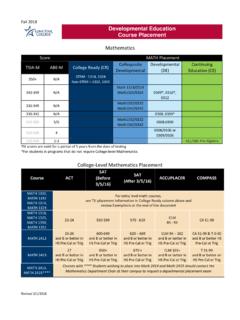
9 IB Score TTU Course Equivalent 0, 1, 2, or 3 None 4, 5, 6, 7 on Math Studies SL Math 1320 4, 5 on Math SL Math 1550 6, 7 on Math SL Math 1451 4 on Math HL Math 1550 5, 6, or 7 on Math HL Math 1451 5 Mathematics Placement Examination University policy states that to be admitted to an entry-level Mathematics course (0301-1451, 1420-2345), a student must meet one of the following prerequisites: 1. Students who have a sufficient high SAT Mathematics score (610 [660 for M1451] or higher) or ACT Mathematics score (26 [29 for M1451] or higher) may enroll in any of the entry-level courses. 2. Students who have collegiate credit for the appropriate prerequisite course from an accredited community college, junior college or university may enroll in the sequential entry-level Mathematics course. 3. Students who satisfactorily pass the Mathematics Placement Examination may enroll in the appropriate entry-level Mathematics course.
10 For many students, achieving a satisfactory score on the Mathematics Placement Examination is the most direct and effective way to satisfy one of these prerequisites. The placement examination has one goal: to place the student in the course which best matches the student s university major and the student s skill level. The examination directs the student (i) to the course he or she wishes to take or (ii) to a course which develops the necessary prerequisite skills for the desired courses. Initial Administration Students matriculating to the university in a Fall semester are typically expected to take the on-line Mathematics Placement Examination prior to attending their summer new student orientation. The examination may be taken on-line twice. Students matriculating to the university in a Spring semester (or a Summer term) are expected to take the placement examination during the week of open registration prior to the start of the semester (or during the day of open registration prior to the start of the term).