Transcription of Tobacco Cessation Change Package
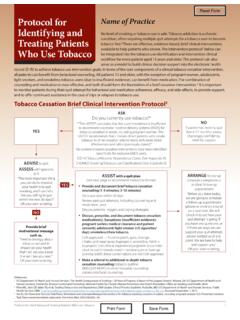
1 Act Plan Study Do A MILLION HEARTS ACTION GUIDE. Tobacco Cessation The Tobacco Cessation Change Package was created by the Centers for Disease Control and Prevention (CDC) with the purpose of helping healthcare professionals in outpatient, inpatient, and behavioral health settings, as well as public health professionals who partner with these groups, to implement systems and strategies that improve care for patients who use Tobacco . Authors This document was conceptualized and authored by Brenna VanFrank, MD, MSPH*; Kaitlin Graff, MSW, MPH*; Gillian Schauer, PhD, MPH (McKing Consulting)* ; Rob Adsit, MEd ; Lauren Owens, MPH (IHRC, Inc.)*; Stephen Babb, MPH*; Danielle McCarthy, PhD ; Anna Schecter, MPH*; and Hilary K. Wall, MPH*. Reviewers The following individuals provided review and feedback on this document: Steven L.
2 Bernstein, MD (Yale Schools of Medicine and Public health ); Carol Essenmacher, DNP, NCTTP (Battle Creek VA Medical Center); Tim McAfee, MD, MPH (University of Washington, School of Public health , Department of health Services; SEED Consulting [Plowshare Group]); Kait Perry, MPH (American Academy of Family Physicians); Sarah Price, MSN-Ed, RN (National Association of Community health Centers); Nancy Rigotti, MD ( Tobacco Research and Treatment Center, Massachusetts General Hospital and Harvard Medical School); and Catherine Saucedo (University of California, San Francisco, Smoking Cessation Leadership Center). Graphic Design and Editorial Assistance Graphic and HTML design support was provided by Shelby Barnes, MPH, CHES*; Booker Daniels, MPH*; Susan Davis (Northrop Grumman Corporation)*; and Jessica Spraggins, MPH*.
3 Website Hosting Assistance Website hosting support of tools and resources was provided by the National Association of Chronic Disease Directors. We would like to extend special thanks to the following organizations for their willingness to share tools and resources to improve smoking Cessation , as further denoted within the Tobacco Cessation Change Package : American Academy of Family Physicians (AAFP) National Cancer Institute (NCI) University of California, San Francisco Schools American College of Cardiology (ACC) National Quality Forum (NQF) of Pharmacy and Medicine (UCSF Schools of American Lung Association Navy and Marine Corps Public health Center Pharmacy & Medicine). Arizona Smokers' Helpline (ASHLine) New York City Department of health and Mental University of California, San Francisco, Smoking California Quits Hygiene (NYC DOHMH) Cessation Leadership Center (UCSF SCLC).
4 California Smokers' Helpline New York City health + Hospitals (NYC health + University of Colorado, Anschutz Medical Campus Cayuga Medical Center Hospitals) (CU Anschutz Medical Campus). Center of Excellence for health Systems Improvement New York State Department of health University of Maryland School of Medicine for a Tobacco -Free New York New York State Smokers' Quitline (UM Medicine). Essentia health North American Quitline Consortium (NAQC) University of Wisconsin health (UW health ). Group health Cooperative of South Central Wisconsin Northern Lakes Community Mental health University of Wisconsin Madison, School of Oklahoma health Care Authority Medicine and Public health (UW-Madison SMPH). HealthyHearts NYC. Oklahoma State Department of health , Center for University of Wisconsin Center for Tobacco Research Heart health Now!
5 Chronic Disease Prevention and health Promotion and Intervention (UW-CTRI). Hospitals Helping Patients Quit Oklahoma Tobacco Settlement Trust (OK TSET) US Department of Veterans Affairs (VA). Institute for Clinical Systems Improvement (ICSI). Oregon health Authority Wisconsin Hospital Association Institute for Healthcare Improvement (IHI). Partnership for Prevention Wisconsin Nicotine Treatment Integration Project Kansas health Foundation (WiNTiP). Legacy (now Truth Initiative ) Plymouth Family Physicians MultiCare health System Substance Abuse and Mental health Services National Alliance on Mental Illness Kansas (NAMI KS) Administration (SAMHSA). National Behavioral health Network for Tobacco & Telligen Cancer Control University of California Quits (UC Quits).
6 For More Information Suggested Citation Brenna VanFrank, MD, MSPH Centers for Disease Control and Prevention. Tobacco Cessation Office on Smoking and health Change Package . Atlanta, GA: Centers for Disease Control and Prevention, US Department of health and Human Services; 2019. *. Centers for Disease Control and Prevention . University of Washington, School of Public health , Department of health Services . University of Wisconsin, Center for Tobacco Research and Intervention Contents Tobacco Cessation Change Package Quick Reference .. 1. The Importance of Treating Tobacco Use and Dependence .. 3. About the Tobacco Cessation Change Package .. 3. Figure 1. Tobacco Cessation Change Package Focus Areas .. 4. How to Use the Tobacco Cessation Change Package .
7 5. Figure 2. Institute for Healthcare Improvement (IHI) Model for Improvement .. 5. How to Measure Quality Improvement Efforts .. 7. Figure 3. Example of a Run Chart .. 7. Change Concepts, Change Ideas, and Tools and Resources .. 8. Table 1. Key Foundations .. 8. Table 2. Equipping Care Teams .. 11. Table 3. Screening .. 14. Table 4. Treatment.. 16. Table 5. Referral and Follow-Up .. 20. Appendix A: Additional Resources for Quality Improvement .. 23. Appendix B: Additional Resources for Electronic health Records Changes .. 24. Appendix C: Case Studies in health Systems Change for Tobacco Cessation Interventions .. 25. Appendix D: Resources for Community-Level Tobacco Prevention and Control Strategies.. 25. Acronyms .. 26. References.
8 27. Website addresses of nonfederal organizations are provided solely as a service to readers. Provision of an address does not constitute an endorsement for this organization by CDC or the federal government, and none should be inferred. CDC is not responsible for the content of other organizations' web pages. Change PACK AGE | 1. Tobacco Cessation Change Package Quick Reference Focus Areas Key Equipping Screening Treatment Referral and Foundations Care Teams Follow-Up Change Concepts and Change Ideas Key Foundations Approaches and tools to assess the current status of Tobacco dependence treatment in your practice or system and to make Tobacco dependence treatment a priority. Make Tobacco Cessation a Practice and System Priority Identify one or two key champions and assemble a multidisciplinary team As a multidisciplinary group, conduct an assessment of your clinic/system and develop an action plan to address the current gaps Adopt or update a unit, practice, or system-wide policy to reflect prioritization of Tobacco treatment Create a Supportive Environment for Cessation Implement and strengthen hospital or clinic-wide Tobacco -free or smoke-free campus policies Leverage mass-reach media campaigns to encourage and normalize quitting ( , with media in waiting rooms, throughout clinic or hospital system).
9 Support employees and their family members in quitting smoking by providing health benefits for Tobacco Cessation Equipping Care Teams Approaches and tools to prepare and motivate healthcare staff to consistently address Tobacco use. Equip All Staff to Engage in Tobacco Cessation Efforts Adopt a clinician/staff training policy to train and retrain staff Conduct onboarding and annual trainings on Tobacco policies, systems, and procedures Optimize billing practices by leveraging existing codes to capture all billable services Provide Clinician and System-Level Feedback on Progress and Impact Set and communicate specific, measureable performance and quality goals Make Tobacco Cessation a quality improvement measure at the clinician or system level Track clinician, clinic, hospital, and system performance to provide feedback to clinicians and decision-makers 2 | Tobacco Cessation .
10 Screening Approaches and tools that promote consistent universal screening for Tobacco use ( , asking about Tobacco use) as a prerequisite for intervening with patients or clients who use Tobacco . Make Tobacco Use a Vital Sign: Screen Every Patient for Tobacco Use at Every Visit Adopt a Tobacco use screening protocol Establish a workflow and determine roles for Tobacco use screening and documentation Embed a Tobacco use status prompt in the EHR or other patient record-keeping system Embed decision support scripts for screening into the EHR or other patient record-keeping system Treatment Approaches and tools to help ensure that patients or clients who use Tobacco are consistently advised to quit, assessed for willingness to make a quit attempt, and offered assistance in quitting Tobacco use.