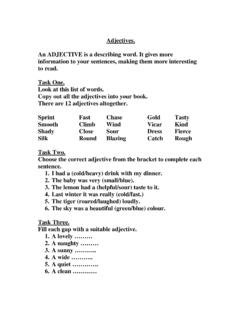
Transcription of TOM NEWBY SCHOOL EXAMINATION
1 1. TOM NEWBY SCHOOL EXAMINATION . Subject English Paper 3: Examiner Mrs Taylor Comprehension, Language and Literature Date 8 June 2015 Total marks 100. Session 1 Duration 2 hours Grade 7 Moderator Mrs A Singh Special No dictionaries allowed. instructions/ Rule off after each question and draw a margin on the right hand Equipment side of each page. This Exam has been compiled using notes and information contained in the Tom NEWBY SCHOOL book. The marking memorandum has been compiled accordingly. While alternative responses will be given due acknowledgement, the official memorandum will be considered a priority document to ensure uniformity of marking. Up to 10% of the total mark allocation may be deducted for spelling and grammatical errors, except in the case of Language papers, where deductions are made according to a memorandum. Time allocation on this EXAMINATION includes provision for concession.
2 Name & Surname: _____ Class: _____. Instructions Number all of your answers according to the questions on your question paper. Answer all questions on the folio paper provided. Read carefully and write your answers neat and legibly. Dictionaries are NOT allowed, but spelling will count. Please rule off after each question and remember to draw a margin on the right-hand side of the paper. Check your work thoroughly. Enjoy the paper! 2. Section A: Comprehension (35 marks). Question 1. Read Text A and answer the questions that follow in full sentences. Text A. 1 A certain man went through a forest seeking any bird of interest he might find. He caught a young eagle, brought it home and put it among his fowls and ducks and turkeys, and gave it chicken's food to eat even though it was an eagle, the king of birds. 2 Five years later, a naturalist came to see him, and after passing through his garden, said, That bird is an eagle, not a chicken.
3 Yes, said its owner, but I have trained it to be a chicken even though it measures fifteen feet from wing tip to wing tip.. No, said the naturalist, It is an eagle still: it has the heart of an eagle, and I. will make it soar to the heavens.. That's impossible! said the owner. It is a chicken and it will never fly.. They agreed to test it. 3 The naturalist picked up the eagle, held it up with great intensity, Eagle, you are an eagle; you belong to the sky and not to this earth. Stretch your wings and fly.. The eagle turned this way and that, and then looking down, saw the chickens eating their food, and down it jumped. 4 The owner said, I told you it was a chicken.. I still disagree, said the naturalist, It is an eagle. Give it another chance tomorrow! . 5 The next morning he rose early and took the eagle outside the city, away from the houses to the foot of a high mountain.
4 He picked up the eagle and said to it, Eagle, you are an eagle; you belong to the sky and not to this earth. Stretch your wings and fly. The eagle looked around and trembled as if new life were flowing in to it. It stretched out its wings and flapped them a few times. Suddenly, with the screech of an eagle, it lifted itself into the air. 6 At first it was clumsy and it wobbled as it flew. But soon it became more graceful and confident. It mounted higher and higher into the sky until it was just a tiny dot in the distance. It never returned. It was an eagle, though it had been kept as a chicken! 7 My people of Africa, people may say you are chickens, but you are eagles. Stretch your wings and fly! ~Unknown author 3. Questions: Provide a suitable title for Text A. (1). Is the main objective of this text to inform, entertain or persuade? (1). What type of story is this?
5 (1). Give two characteristics of the type of story that you have mentioned in Question (2). Explain the moral of this story in your own words? (3). Quote from the text, how the naturalist persuades the owner that the bird is not a chicken? (2). Which characteristic of the eagle, mentioned in this story, is a sure sign of its ability to soar the heavens? (2). During the first opportunity the eagle was given to fly away, he never left. Give two reasons why the eagle stayed. (2). How do you think the eagle felt at first, when the naturalist tried to convince it to fly? Provide 2 emotions that the eagle may have experienced. (2). Why would someone, who was a naturalist, prefer for the eagle to behave as an eagle and not a chicken? (2). Eagles are birds of prey. Explain what this statement means. (1). Each of these words in Column A are used in the text. Match these words with the correct definitions in Column B.
6 (6). Column A Column B. 1) naturalist a) in extreme force or strength 2) intensity b) ascend or to climb 3) screech c) shake involuntary due to anxiety 4) trembled d) an expert in natural history 5) mounted e) to move unsteadily from side to side 6) wobbled f) a loud, harsh, piercing cry Why did the naturalist take the eagle out of the city to set it free? (2). 4. Write a short descriptive paragraph of 5-6 sentences of what an eagle looks like. Use at least 2 Figures of Speech. Underline or Highlight your Figures of Speech. (8). Criteria 2 1 0. Figures of At least 2 well Fair use of No figures of written figures of figures of speech used/. Speech speech speech/Only one Figures of well written speech used figure of speech incorrectly Spelling 0-1 errors 2-4 errors 5 errors or more Content Excellent use of Fair use of Paragraph is not descriptive descriptive descriptive language language Punctuation 0-1 errors 2-4 errors 5 errors or more and Language Total: 35.
7 5. Section B: Language (20 marks). Question 2. Read Text A and answer the questions that follow. Spelling counts, so be careful. You do not need to write in full sentences for this question. Questions: Find a synonym in Paragraph 1 for the word: poultry. (1). Find a synonym in Paragraph 2 for the word: possessor. (1). The word clumsy is used in Paragraph 6. Find an antonym for this word used in the same paragraph. (1). Complete the following sentence using a comparison of the adjective in bold. You only need to write the letter and the missing word. When the naturalist came to visit, the situation was good. Once he attempted to make the eagle fly, the situation was a). _____ and the situation was at its b). _____ when the eagle was able to fly away. (2). The first line of Paragraph 2 reads: Five years later, a naturalist came to see him, and after passing through his garden, said, That bird is an eagle, not a chicken.
8 Write a homophone for the word through' and write a sentence using each word. (3). Are the following nouns countable or non-countable nouns? a) Paragraph 1 - man b) Paragraph 5 - city c) Paragraph 5 - air (3). 6. Are the following nouns abstract or concrete nouns? a) Paragraph 1 - interest b) Paragraph 4 - chance c) Paragraph 5 - mountain (3). Remove the suffix from the word naturalist', to create the root word. (1). Rewrite the following sentences. Circle the subject and underline the predicate. a) A certain man went through a forest seeking any bird of interest he might find. b) Give it another chance tomorrow! (4). When the eagle flew, at first, it was described as clumsy - Paragraph 6. What idiom could be used which means the same (1). thing? Total: 20. 7. Question 3: Figures of Speech (15 marks). Read Text B and answer the questions that follow in full sentences.
9 Text B. The Toaster William Jay Smith A silver scaled Dragon with jaws flaming red Sits at my elbow and toasts my bread. I hand him fat slices, and then, one by one, He hands them back when he sees they are done. Questions Quote the metaphor used in this poem? Explain what it means. (4). Show how you could change the metaphor mentioned in into a simile? (1). The toaster has been given three different human traits in this poem that are physically impossible for a toaster to perform. State three of the human traits that are given to the toaster. Which Figure of Speech is used? (4). b) metaphor alliteration simile a). kettle c). Using the word kettle', a) create a sentence that uses alliteration, b) create a sentence using a metaphor and c) create a sentence using a simile. Each sentence must have the word kettle in it. (6). TOTAL: 15. 8. Section C: Literature (30 marks).
10 Question 4: Visual Literacy Read Text C and D and answer the questions that follow in FULL. SENTENCES. Text C. Text D. 9. Questions: Look carefully at Text C and D? What is the main difference between these two advertisements? (2). In Text C, it reads, Every child deserves the bear necessities. The word bear' is used incorrectly. What should this sentence read and explain why they used this play on the word bear'? (3). What slogan is used in Text D? (1). Who is the target market for Text C? Explain (2). Who is the target market for Text D? (2). Total: 10. 10. Question 5: Seen Poem Read the following poem and answer the questions which follow in full sentences. Text E. Men in chains by Oswald Mtshali The train stopped 1. at a country station, Through sleep curtained eyes I peered through the frosty window, and saw six men: 5. men shorn of all human honour like sheep after shearing bleating at the blistering wind, Go away!