Transcription of TOOLING ALLOYS DATA SHEET CPM - 梧濟工業股 …
1 P A G E 1/4 T O O LI N G A L L O Y S | C P M 4 2 0 V CHEMICAL COMPOSITION Carbon % Chromium % Vanadium % Molybdenum % Manganese % Silicon % cpm 420 v is a newly developed highly corrosion resistant tool steel produced by the special Crucible Particle Metallurgy Process. cpm 420 v is a martensitic stainless steel, which contains a large constituent volume of extremely small and finely dispersed particles of highly wear-resistant vanadium carbide. cpm 420 v combines the effectual properties of stainless steel with the high wear resistance of tool steels.
2 The material is well suited for applications which demand corrosion resistance, whilst also affording a high level of wear resistance. TYPICAL APPLICATIONS _ use in the food and plastic industry _ chemical processing industry _ fields of pumping systems _ rubber processing _ palletizing tools _ bearings, bearing shells _ valves, shafts, rollers PHYSICAL PROPERTIES Modulus of elasticity E [kN/mm ] 215 Specific weight [kg/dm ] Thermal conductivity at 65 C [W/mk] Coefficient of thermal expansion over temperature range of [mm/mm C]
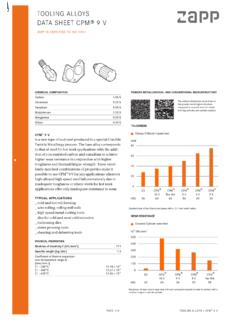
3 20 - 200 C 20 - 315 C x 10-6 x 10 -6 POWDER METALLURGICAL AND CONVENTIONAL MICROSTRUCTURE The uniform distribution of carbides in the powder-metallurgical structure compared to conventional tool steels with big carbides and carbide clusters. TOUGHNESS / ABRASIVE WEAR RESISTANCE Charpy C-Notch impact test Abrasive wear resistance Qualitative comparison CORROSION RESISTANCE Number of corrosion spots per sq. inch for 5 % NaCl, T. = 35 C Material loss in mm/month 5% HNO3 + 1 % HCl, T = 25 C = Qualitative comparison 0100200300D259440C57 CPM420 V55 CPM420 V57 HRc 0204060 CPM420 V440 CCPM420 V440C TOOLING ALLOYS data SHEET cpm 420 v ZAPP IS CERTIFIED TO ISO 9001 P A G E 2/4 T O O LI N G A L L O Y S | C P M 4 2 0 V HEAT TREATMENT ANNEALING SOFT ANNEALING cpm 420 v is heated uniformly at a temperature of 900 C; maintain the temperature for 2 hours and allow to cool slowly to 600 C in the furnace at a cooling rate of max.
4 15 C per hour. It is then further cooled in still air. The hardness achieved by soft annealing is approx. HB 275. STRESS RELIEVING After machining it is recommended to subject the work piece to a stress relieving process at a temperature of 600 700 C for a thermal holding period of 2 hours du-ration. HARDENING cpm 420 v is to be preheated slowly and thoroughly to a temperature of 840 - 870 C. Further heating in the furnace continues until an austenitizing temperature of 1150 1180 C is reached. The holding time after com-plete penetration amounts to 10 30 minutes (lower temperatures require longer soaking times).
5 The lower end of the austenitizing temperature range should be selected to attain maximum toughness, whilst the top end of the range produces maximum wear and corrosion resistance. For cpm 420 v we recommend hardening to be carried out in a vacuum or a protective gas. QUENCHING cpm 420 v can be cooled in air, in protective gas, in hot bath or in oil. To achieve maximum toughness salt bath quenching at a temperature of approx. 540 C, followed by immediate residual quenching in still air down to less than 50 C is recommended. In the case of heat treat-ment in a vacuum, quenching must be undertaken at a pressure of at least 5 bar down to below 40 C.
6 TEMPERING Immediately temper after the material has cooled down below 40 C. cpm 420 v is normally tempered through two tempering stages, each of 2 hours duration at 200 C to 400 C. If required, cooling to sub-zero temperatures can be carried out between the first and the second tem-pering cycle to fully destroy any reaustenitic formation. The first tempering process should always be concluded prior to any sub-zero cooling process. HEAT TREATMENT INSTRUCTIONS 1st preheating 450 500 C 2nd preheating 850 900 C Hardening as specified in table Tempering 3 x each 2 hours as specified in table Quenching after hardening in hot bath at approx.
7 550 C or in vacuum at least at 5 bar overpressure. A vacuum furnace is recommended. Required hardness HRc 1 Austenit-izing tempe-rature C Holding time at austenit-izing tempe-rature minutes* Tempering tempera-ture[ C] 56 1150 30 320** 57 1150 30 260 58 1150 30 200 5 58 1180 20 260 59 1180 20 200 * Previous preheating at 870 C. The data referred to 13 mm round bar samples. The holding times at austenitizing temperature should be correspondingly adapted for large and very thin profile dimensions. The maximum permissible austenitizing temperature of 1180 C must not be exceeded.
8 **Tempering temperatures over 400 C are not allowed, because the corrosion resistance will be reduced. P A G E 3/4 T O O LI N G A L L O Y S | C P M 4 2 0 V MACHINING data TURNING Cutting parameter Turning with cemented carbide medium turning finish turning HSS Cutting speed (VC) m/min. 70-100 100-120 8-10 Feed (f) mm/U Cutting depth (ap) mm 2 4 2 3 Tools according ISO P 10 P 20* P 10* * Use wear resistant coated cemented carbide, Coromant 4015 or Seco TP 100. MILLING FACE- AND EDGEMILLING Cutting parameter Milling with cemented carbide medium turning finish turning HSS Cutting speed (VC) m/min.
9 50-70 70-100 15 Feed (f) mm/U Cutting depth (ap) mm 2 4 1 2 1 2 Tools according ISO K 15* K 15* * Use wear resistant coated cemented carbide, e. g. Coromant 4015 or Seco TP 100. END MILLING Cutting parameter Solid carbide Milling cutter w. indexable tips Coated HSS Cutting speed (VC) m/min. 20 35 60-80 12* Feed (f) mm/U ** ** ** Tools according ISO K 20 P 25** * for TiCN-coated end mills made of HSS VC 25-30 m/min. ** depends on radial depth of cut and on milling cutter - diameter ** Use wear resistant coated cemented carbide, e.
10 G. Coromant 3015 or SECO T15M. DRILLING SPIRAL DRILL MADE OF HSS Driller- mm Cutting speed (VC) m/min. Feed (f) mm/U 0 5 5 - 8* 5 10 5 - 8* 10 15 5 - 8* 15 20 8 8* * for TiCN-coated end mills made of HSS VC 25-30 m/min. CARBIDE METAL DRILLER Cutting parameter Drill type insert drill Solid carbide tip Coolant bore driller with carbide tip* Cutting speed (VC) m/min. 70-90 40 35 Feed (f) mm/U ** ** ** * driller with coolant bores and a soldered on carbide tip ** depends on driller-diameter GRINDING Grinding method soft annealed hardened Surface grinding.