Transcription of Total Knee Arthroplasty Protocol
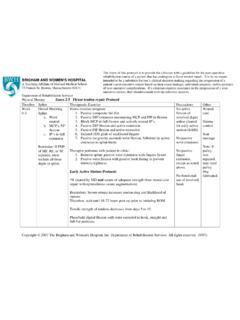
1 Department of Rehabilitation Services Total Knee Arthroplasty Protocol Copyright 2012 The Brigham and Women's Hospital, Inc., Department of Rehabilitation Services. All rights reserved 1 Total Knee Arthroplasty Protocol : The intent of this physical therapy Protocol is to provide the clinician with a guideline of the post-operative rehabilitation course of a patient who has undergone a Total knee Arthroplasty (TKA) at Brigham and Women s Hospital (BWH). It is by no means intended to be a substitute for one s clinical decision making regarding the progression of a patient s post-operative course based on their physical exam/findings, individual progress, and/or the presence of post-operative complications.
2 If a clinician requires assistance in the progression of a post-operative patient, the clinician should consult with the referring surgeon. This physical therapy Protocol applies to primary Total knee Arthroplasty . In a revision Total knee Arthroplasty , or in cases where there is more connective tissue involvement, Phase I and II should be progressed with more caution to ensure adequate healing. Progression to the next phase is based on Clinical Criteria and/or Time Frames as appropriate. Pain Management Adequate pain control after TKA is important in expediting patient progress with mobility and range of motion after surgery. This in turn may result in a shorter hospital stay and improved patient satisfaction.
3 Pain management following TKA at Brigham and Women s Hospital (BWH) is multimodal and may include: Pre-operative dose of medications including Acetaminophen and/or Celebrex. Spinal or epidural analgesia Administered as a continuous infusion or as a one-time dose, lasting 6-8 hours. Intrathecal opioids may be added to the anesthetic cocktail. Side effects of epidural injection may include low blood pressure and decreased motor function. If a continuous infusion is used, it is typically stopped at 6am on post-operative day #1. Peripheral nerve blocks Femoral and/or sciatic nerveblocks may be administered as a continuous infusion for a period following surgery, or as a one-time dose, lasting 6-8 hours.
4 If a continuous infusion is used, it is typically stopped at 6am on post-operative day #1. Potential side-effects may include nerve damage and a lack of muscle control in the immediate post-operative period. IV or oral analgesics This may include use of an opioid Patient-Controlled Analgesia (PCA). Post-operative pain medications may include opiods (short-acting and continuous-release Oxycodone, Dilaudid, Morphine), centrally-acting analgesics (Acetaminophen), anti-inflammatory agents (NSAIDs, COX-2 inhibitors, Ketorolac), -agonists (Gabapentin, Tramadol), and/or transdermal patches (typically an opioid such as Fentanyl, used in conjunction with oral pain regiment).
5 Local analgesics - intra-articular or periarticular injections during TKA surgery may be used for post-operative pain control and to improve range-of-motion (ROM). Department of Rehabilitation Services Total Knee Arthroplasty Protocol Copyright 2012 The Brigham and Women's Hospital, Inc., Department of Rehabilitation Services. All rights reserved 2 Intra-articular injections may include a combination of ropivicaine, epinephrine, Ketorlac, and clonididne. Due to the use of epidural anesthesia and/or peripheral nerve blocks at BWH, it is important to assess the extent of motor and sensory block the first 48 hours after surgery. Patients must demonstrate adequate quadriceps and lower extremity motor control to participate safely in out-of-bed (OOB) activities.
6 Phase I Immediate Post Surgical Phase (Day 0-3): The goal of physical therapy intervention during the early post-operative phase is to decrease swelling, increase range of motion, enhance muscle control and strength in the involved lower extremity and maximize patients mobility with a goal of functional independence. Physical therapy interventions are also directed towards identifying other sensomotor or systemic conditions that may influence a patients rehabilitation potential. Goals: The patient will: 1. Perform bed mobility and transfers with the least amount of assistance while maintaining appropriate weight bearing (WB) precautions. 2. Ambulate with an assistive device for 25-100 feet and ascend/descend stairs to allow for independence with household activities while maintaining appropriate WB.
7 3. Regain at least 80 degrees of passive and active range of motion in the knee to perform sit to stand transfers with minimal compensatory activity. 4. Gain knee extension less than or equal to -10 degrees. 5. Independently perform operative extremity Straight Leg Raise (SLR) exercise. 6. Verbalize understanding of post-operative activity recommendations/precautions including use of proper positioning of the lower extremity, range of motion and strengthening exercises. 7. Patients will also be educated on superficial massage of the knee joint to minimize hypersensitivity following surgery. Use of a Continuous Passive Motion (CPM) machine is not part of the standard of care for patient s s/p TKR at BWH.
8 Use of a CPM may be indicated according to surgeon preference, or in cases where post-operative knee range-of-motion (ROM) is severely restricted due to revision or reconstructive surgery, severe post-operative pain, limb girth and/or edema, or impaired ability to participate in ROM exercises. Observation and Assessment: Observe for any signs of deep vein thrombosis (DVT): increased swelling, erthymia, calf pain. Department of Rehabilitation Services Total Knee Arthroplasty Protocol Copyright 2012 The Brigham and Women's Hospital, Inc., Department of Rehabilitation Services. All rights reserved 3 If a large amount of drainage is present, or there is blistering or frail skin around the knee joint or the lower extremities, discuss with the nurse and decide if notifying the surgical team is indicated.
9 Assess patients pain using the visual analogue scale. Ensure that patients are premedicated with oral/IV pain medication 30-60 minutes prior to treatment. Cryotherapy is recommended following physical therapy treatment to reduce pain, discomfort and swelling in the knee joint. Therapeutic exercise and functional mobility: Active/active assisted/passive (A/AA/PROM) exercises (seated and supine). Patella femoral and tibial femoral joint mobilization and soft tissue mobilization as indicated. Soft tissue massage. Isometric quadriceps, hamstring, and gluteal isometric exercises. Straight leg raises (SLR) Lower extremity range of motion (ROM) and strengthening as indicated based on evaluation findings.
10 Closed chain exercises (if patient demonstrates good pain control, muscle strength and balance). Close-chained exercises should be performed with bilateral upper extremity support while maintaining appropriate WB precautions. Gait training on flat surfaces and on stairs. Transfer training. Modalities: Continuous Cryotherapy for 72 hours after surgery, or at least 5 times/day. Patients are encouraged to use cryotherapy for 20 minutes before and after their independent exercise program. Precautions: Weight bearing as tolerated (WBAT) with assistive device (unless indicated otherwise by the surgeon) to full weight bearing. Monitor wound healing and consult with referring MD if signs and symptoms of excessive bleeding and poor incision integrity are present.