Transcription of Towing Basics - Ram Body Builder
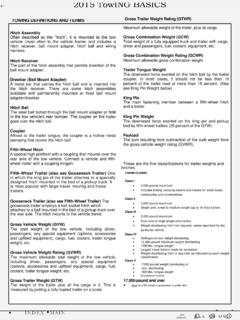
1 Main MenuSite MapALLIN+OUT-PRINTTOWING DEFINITIONS AND TERMS Hitch Assembly Often described as the hitch , it is mounted to the tow vehicle (most often to the vehicle frame) and includes a hitch receiver, ball mount adapter, hitch ball and wiring harness. Hitch Receiver The part of the hitch assembly that permits insertion of the ball mount adapter. Drawbar (Ball Mount Adapter) A metal bar that carries the hitch ball and is inserted into the hitch receiver. There are some hitch assemblies available with permanently mounted or fixed ball mount adapter/drawbar. Hitch Ball The steel ball bolted through the ball mount adapter or hole in the tow vehicle s rear bumper. The coupler on the trailer goes over the hitch ball. Coupler Affixed to the trailer tongue, the coupler is a hollow metal stamping that covers the hitch ball. Fifth-Wheel Hitch A special high platform with a coupling that mounts over the rear axle of the tow vehicle.
2 Connect a vehicle and fifth-wheel trailer with a coupling kingpin. Fifth-Wheel Trailer (also see Gooseneck Trailer) One in which the tongue of the trailer attaches to a specially designed hitch mounted in the bed of a pickup truck. It is most popular with large travel, moving and horse trailers. Gooseneck Trailer (also see Fifth-Wheel Trailer) The gooseneck trailer employs a pivoted coupling arm which attaches to a ball mounted in the bed of a pickup truck. The coupling arm connects to the hitch mounted over the rear axle in the truck bed. Gross Vehicle Weight (GVW) The total weight of the tow vehicle, including driver, passengers, any special equipment (options, accessories and upfitted equipment), cargo, fuel, coolant, etc. Gross Vehicle Weight Rating (GVWR) The maximum allowable total weight of the tow vehicle, including driver, passengers, any special equipment (options, accessories and upfitted equipment), cargo, fuel, coolant, etc.
3 Gross Trailer Weight (GTW) The weight of the trailer plus all the cargo in it. This is measured by putting a fully loaded trailer on a scale. Gross Trailer Weight Rating (GTWR) Maximum allowable weight of the trailer, plus its cargo. Gross Combination Weight (GCW) Total weight of a fully equipped truck and trailer with cargo, driver and passengers, fuel coolant, equipment, etc. Gross Combination Weight Rating (GCWR) Maximum allowable gross combination weight. Trailer Tongue Weight The downward force exerted on the hitch ball by the trailer coupler. In most cases, it should not be less than 10 percent of the trailer load or more than 15 percent. King Pin The main fastening member between a fifth-wheel hitch and a trailer. King Pin Weight The downward force exerted on the king pin and pickup bed by fifth-wheel trailers (25 percent of the GTW) Payload The sum resulting from subtraction of the curb weight from the gross vehicle weight rating (GVWR).
4 Towing CLASSES These are the five classifications for trailer weights and hitches: Class I Light Duty z 2,000-pound maximum z Includes folding camping trailers and trailers for small boats, motorcycles and snowmobiles Class II Medium Duty z 3,500-pound maximum z Single-axle, small to medium length (up to 18 feet) trailers Class III Heavy Duty z 5,000-pound maximum z Dual-axle or large single-axle trailers z Weight-distributing hitch not required, unless specified for the particular vehicle Class IV Extra Heavy Duty z 12,000-pound maximum z Largest travel trailers made for recreation z Weight-distributing hitch is required; as indicated by each weight classification 12,000-pound and over z Must be a fifth-wheel or gooseneck Towing BasicsMain MenuSite MapALLIN+OUT-PRINTT owing BasicsNOTES ON GETTING HITCHED Weight-Carrying Hitch A weight-carrying hitch supports the trailer tongue weight, just as if it were luggage located at a hitch ball or some other connected point of the truck.
5 These kinds of hitches are commonly used to tow small and medium sized trailers. There are two styles of weight-carrying hitches: z Fixed Drawbar in which the ball platform is permanently welded to the hitch z Removable Drawbar in which the ball platform is removable. This hitch is commonly referred to as a utility ball mount for Class III hookups Fixed Drawbar Removable Drawbar Weight-Distributing Hitch A weight-distributing system includes a receiver attached to the tow vehicle, plus a removable hitch head and spring bar assembly that fits into the receiver opening and hook up brackets that connect the spring bars to the trailer frame. This allows Towing of trailers with greater tongue weights typically Class IV categories up to 12,000 pounds. Weight Distributing Hitch Fifth-Wheel HitchA fifth-wheel hitch is a special platform with a coupling that mounts over the rear axle of the tow vehicle.
6 It connects a vehicle and fifth-wheel trailer with a coupling king pin. For a fifth-wheel trailer, the tongue of the trailer attaches to a specially designed hitch mounted in the bed of a pickup truck. It is most popular with large travel, moving, and horse trailers. Fifth-Wheel Hitch Towing AND AXLE RATIOS On rear-wheel-drive vehicles, rear-axle ratio is an important part of a successful Towing equation. It is expressed as a ratio between the driveshaft revolutions per minute and the rear axle's revolutions per minute. It is always given as a numerical expression like :1. This means the small pinion gear at the end of the drive shaft must rotate times for every single rotation of the rear axle. Each rear-axle ratio in the spectrum of those offered has a plus and minus. A ratio that is "low" in the number of drive shaft rotations for every axle rotation results in lower engine rpm and in better fuel economy, longer engine life and quieter running.
7 But it won't be good for quick acceleration, climbing grades, carrying loads or pulling a trailer. A "high" ratio, one with a high number of drive shaft turns like the :1 example above, is better for quick acceleration, climbing grades, carrying loads or pulling a trailer. However, it results in lower fuel economy and is noisier when running at high vehicle speeds. For any application, it is best to determine a ratio that will enable your Dodge vehicle to pull a trailer with the engine operating closest to its optimal power range - where peak torque and peak horsepower meet on the engine power curve chart. This maximizes power, efficiency and fuel economy. It is best to determine a ratio that will give good trailer Towing power without handicapping non- Towing performance too severely. Main MenuSite MapALLIN+OUT-PRINTT owing BasicsTOWING MATH The Towing charts located in the Model Lineup section of each vehicle in the 2004 Body Builder s Guide shows z Model z Engine z Transmission z Axle ratio z GVWR z Payload z Front and rear curb weight z Front and rear GAWR z GCWR z Max allowable trailer weight To use the Towing charts, first calculate the GCW of the Towing vehicle and trailer to make sure that everything falls within the GCWR listed.
8 This is done by adding the GVW to the Max trailer weight. Next, calculate the total weight to be towed. This includes any cargo or fluids. The tongue weight must also be determined. The tongue weight should be more than 10 percent and less than 15 percent of the maximum trailer weight. The King Pin weight should be more than 15 percent and less than 25 percent of the maximum trailer weight. Note: The Maximum Trailer Weight and Payload in the Towing Tables are based on one driver weighing 150 lbs. If there is greater payload (passengers, cargo, vehicle options, accessories, and upfitter equipment), it must be considered. TERMS AND CONDITIONS Compressed natural gas Vehicles equipped with compressed natural gas engines should not be used for Towing . Exhaust brake or "Jake Brake" Requirement An exhaust brake or "Jake Brake" is required for Dodge 3500 Pickup and Chassis Cab models pulling a trailer weight of 10,000 pounds or more.
9 Fifth-wheel Hitch Requirement DaimlerChrysler Corporation requires that for warranty coverage, vehicles Towing trailers with a weight rating of 12,000 pounds or more must be equipped with a fifth-wheel or gooseneck hitch. Calculation of the GTW ratings is intended to provide acceptable performance for normal conditions of temperature, grade, and altitude. Extreme conditions will require selection of a higher axle ratio and/or a higher powered engine. Dodge trucks equipped with Cummins Intercooled Turbo Diesel engines will have a minimal power loss at high altitude. These ratings must be decreased by the weight of any optional equipment, trailer hitch, cargo in the tow vehicle, and passengers other than the driver. To determine the GTW, subtract the curb weight and 150 pounds (allowance for the driver) from the GCWR. The maximum allowable trailer weight for vehicles with max option content are listed in the Model Lineup sections of each vehicle in the 2004 Body Builder s Guide.
10 A maximum engine cooling option may be required to achieve the maximum trailer weight rating and GCWR. Synthetic axle lubricant with Trailer Tow Group Tow vehicles equipped with the Trailer Tow Group option should use synthetic axle lubricant, which is standard on all 2004 Ram Pickup Trucks. For all trailer Towing or heavy duty applications replace the factory fill rear axle lubricant with an SAE 75W-140 synthetic gear lubricant. Mopar Synthetic Gear Lubricant (MS-8985) is of this type. When Towing a trailer, never exceed the Gross Axle Weight Rating (GAWR). Caution: When hauling cargo or Towing a trailer, do not overload thevehicle or trailer. Overloading can cause a loss of control, poor performance or damage to brakes, axle, engine, transmission, steering, suspension, body structure or tires. Tongue weight To determine the maximum trailer tongue weight, multiply the gross trailer weight (GTW) by 15 percent.