Transcription of Tracking learning - Early Childhood Australia
1 1 EYLFPLP e-Newsletter No. 26 2011 Tracking learningSetting the sceneThe hot topic over 2011 raised in conversations, on the Forum and Facebook, at workshops and in-field visits has been How can we best record evidence of children s learning ? E-News Issue 6 this year focused on learning Outcomes; Issues 8 and 14 were on planning for learning ; and e-News 9 and 10 talked about documenting , it s time to dig a bit deeper into issues around documentation and Early Years learning Framework (EYLF) reminds us (p. 17) that:Assessment for children s learning .. is part of an ongoing cycle that includes planning, documenting and evaluating children s assessment in Early Childhood settings emphasises the distance each child has travelled and educators have a responsibility to gather the evidence that demonstrates children are learning .The National Quality Standard (NQS), which will be applied in many Early Childhood settings from 1 January, 2012 is quite explicit about these responsibilities (Guide to the National Quality Standard, October 2011 p.)
2 19):Quality Area 1: Educational program and : Each child s learning and development is assessed as part of an ongoing cycle of planning, documenting and : Critical reflection on children s learning and development, both as individuals and in groups, is regularly used to implement the : The documentation about each child s program and progress is available to EYLF advises (p. 17) that the five learning Outcomes:Provide Early Childhood educators with key reference points against which children s learning can be identified, documented and communicated to families, other Early Childhood professionals and , the Educators Guide to the EYLF (p. 37) further explains that:Assessment includes interpreting children s learning against learning outcomes in order to plan for further learning and to report to parents and others about children s is evident from these quotes, both the EYLF and the NQS talk quite definitely about assessing children s perspectivesSome Early Childhood educators might not initially be comfortable with the term assessment.
3 As Sally points out on the Forum:One of the problems with the word assessment is that it invokes thoughts of tests and worksheets. I think people are fearful of making judgements , but that s something we ve always done .. What is different about the EYLF is that we are asking people to make judgements against a set of outcomes. And, as Anne K notes:The EYLF is focused on learning outcomes and this is a shift from an age-stage developmental focus which has the potential to limit what we see. Where once we might have noticed that a child was using a palmar grip to hold a pencil, and encouraged the development of a pincer grip, for example, we now ask additional questions: What is the child learning as he scribbles? What is motivating his learning ? What helps or hinders? How far has he travelled from showing little interest in making marks, to wanting to have a go, to showing a sense of achievement as he conveys meaning through his drawings?
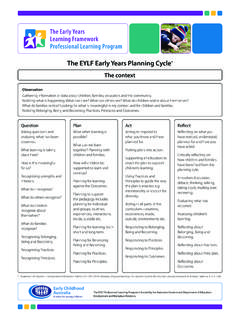
4 What will I plan? Why?We did track children s learning over time in the past, but I don t think we tracked them as learners in the same for learningThe New Zealand Ministry of Education (please refer to link in reference list for more information) suggests that assessment that supports children s learning requires educators to notice , recognise and respond .They stress that educators need to move beyond observing that a child is engaged in an activity, to interpreting the learning and recording what is being learned, rather than just what happens. By recognising the learning , educators can respond to enrich and extend that learning or support the child to take it in different 1: Supporting Olivia s art journeyStarry, starry nightAs children s interest in art was apparent, we decided to explore a variety of art. We introduced Vincent van Gogh and some of his works to the children.
5 Olivia showed an immediate interest in this and we read the book Vincent s colours to her. After discussing some of the techniques that Vincent may have used in his paintings and the title of these works, we provided a number of images for Olivia to observe and attempt on her own. I want to do the Starry Night one Olivia responded. Olivia spent time looking at the swirls of the stars, the strokes in the sky and houses at the bottom. Over a number of weeks Olivia would always ask to do the Starry Night one while at the easel or at the art table inside, at any opportunity. In bringing the interest to an end, we asked Olivia if we should do a group canvas of the paintings we have looked at. A wonderful collection : This process has allowed Olivia and her peers to make discoveries and gain an understanding and appreciation of art. It provided a scaffold for self-expression as they explored with new techniques and mediums.
6 Opportunities to revisit their ideas and to extend on these allowed staff to observe how Olivia became more detailed and had confidence to take new risks each time she painted. 3 Example 2: Feedback to Maddie and her familyMaddie, today you did a drawing of a fairy. The drawing was the size of your hand and had been carefully cut out with scissors (Notice).I was very impressed with your detail and care. You have shown that you are a Confident and involved learner (Outcome 4) and that you have extended your own interests with energy and concentration (Interpret).Over the year, you have moved from drawing two-dimensional pictures to cutting and creating three-dimensional images (Recognise and assess progress).When we talked, I suggested you may like some cardboard boxes to build a fairy house. We investigated the recycle bin and found shapes and sizes you were looking for; you are able to resource your own learning and transfer understanding to new contexts (Respond).
7 To Maddie s family: You may have noticed Maddie s creative abilities. Does she spend lots of time with drawing, pasting, cutting or collage at home? What does she create? How can we support this learning ? (Provide feedback and work in partnership).Example 3: learning from found objectsAt Bayside Family Day Care in Brisbane, the children found a large, black crow s feather and the educator explained how quills were once used for writing. Paint and ink pots were provided and children experimented with dipping the quills and then moved on to using the feathers in their art. The educator shared with families that the children were: Demonstrating growing confidence and involvement in learning Resourcing their own learning Engaging in new forms of expression, including visual art, drama and storytellingThe educator planned with children to find other natural materials to use in visual 4: Reflections at Gowrie VictoriaAt Gowrie Victoria, educators are thinking that: To be worth documenting in some detail and keeping for future reference, it should be a wow moment, indicating a skill acquired or significant progress.
8 The educator s response can be simply sharing the moment with the child and showing you value their work; the educator may already be providing for next stage learning , or they may think what would build on the child s direction here? . A strength-based, child-centred approach doesn t mean you stand back and do nothing; you do what is required to consolidate and extend the learning . Educators Reflections folder should contain interpretations of how children s learning is changing over time and how their provision responds to these changes. Collections of children s work, where they are used, need to be reviewed regularly to ensure they provide an informative history of an individual child s learning NZ article also notes that:One important connection between assessment and learning is feedback. Research tells us that feedback to learners improves learning .
9 Some of this feedback will be through documentation (such as assessments that families and teachers can read back to children and photographs that children can read for themselves). Some of it will be verbal. Some of it will be non-verbal (through a gesture, a nod, or a smile). Feedback tells learners what outcomes are valued .. and it acknowledges the goals that children set for conversation between an educator and a family often occurs informally as they share learning events at the end of a day or a week. 4 Example 5: Vittoria s self-portraitSelf-portraits, July 2011 This week we invited the children to consider themselves; their bodies, faces and physical characteristics, and represent them on paper using coloured markers. Some of the children also added their names to their creations. Many of the portraits share similarities, but at the same time they are wildly different.
10 We wonder how the children will see and represent themselves in 6 months, or a year, or 10 years from now? Who will they see in the mirror? A self-portrait is an intimate, bold declaration of identity. In her self-portrait, a child offers herself as both subject and artist. When we look at her self-portrait, we see a child as she sees herself. Anne Pelo The Language of Art p 83 Reviewing and summarising learning There is always a risk that documentation will become superficial and not necessarily be useful for making curriculum decisions. As Melissa from Gowrie Victoria s Carlton North centre commented there are more photos in the world than bricks! Records can also become so voluminous that it s hard to find the learning in there. It is both a professional responsibility and a practical necessity to sort through children s records regularly, keeping only those that demonstrate learning and progress over time.