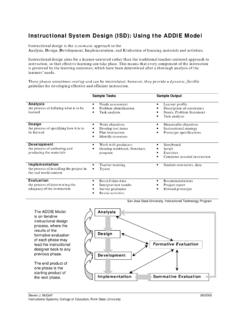
Transcription of Training design, development and implementation
1 Training and development instructor s ManualTraining design , development and implementationBy Myrna L. Gusdorf, MBA, SPHRP roject team Author: Myrna L. Gusdorf, MBA, SPHRSHR M project contributor: Bill Schaefer, SPHR Nancy A. Woolever, SPHRE xternal contributors: Lisa Ncube, Sharon H. LeonardCopy editing: Katya Scanlan, copy editorDesign: Blair Wright, senior graphic designer 2009 Society for Human Resource Management. Myrna L. Gusdorf, MBA, SPHRNote to Hr faculty and instructors: SHR M cases and modules are intended for use in HR classrooms at universities. Teaching notes are included with each. While our current intent is to make the materials available without charge, we reserve the right to impose charges should we deem it necessary to support the program.
2 However, currently, these resources are available free of charge to all. Please duplicate only the number of copies needed, one for each student in the more information, please contact: SHR M Academic Initiatives 1800 Duke Street, Alexandria, VA 22314, USA Phone: +1-800-283-7476 Fax: +1-703-535-6432 Web: 2009 Society for Human resource management. myrna l. gusdorf, mBa, SpHr 1introductionabout tHis LearNiNg moduLeThis learning module is intended to teach HR students the skills necessary to design , develop and implement a Training program. This is a full-term module comprised of 10 units. It is anticipated that one unit is completed each week in two class periods, with class periods ranging from 50 to 90 minutes each.
3 The module is segmented into five parts. Part one, Introduction to Training and development , is completed in the first class period. Part two, Understanding the Organization, begins at the second class period of the first week and runs through the completion of unit two. Part three, Training design and the Learner, is the longest segment, starting at unit three and running through unit seven. Units eight and nine comprise the segment on Conducting the Training and the last unit, number 10, concludes the module with Evaluation and Return on Investment. The basic structure of the class follows the ADDIE method of instructional design . audieNceThis learning module is appropriate for undergraduate LearNiNg objectivesStudents will learn to:Analyze an organization by conducting a SWOT analysis.
4 NConduct a needs assessment to determine the Training needs of the organization. nUse the ADDIE method of instructional design to design Training that meets the norganization s strategic learning activities that incorporate adult learning principles and methods nof experiential a Training budget. nConduct a Training program. n2 2009 Society for Human resource management. myrna l. gusdorf, mBa, SpHrEvaluate the Training program in light of the Training objectives established in the nneeds assessment process and the strategic goals of the the organization s return on investment for the completed Training textsNoe, R. (2008). Employee Training and development .
5 New York: McGraw-Hill, Irwin. Silberman, M. (2006). Active Training : A handbook of techniques, designs, case examples, and tips. San Francisco: Pfeiffer/John Wiley & Sons, Inc. PowerPoiNt sLidesPowerPoint slides for the 10 units of the learning module are included with comments for the Project Instructions are included for a student team project. The project is designed to be completed by a team of three to four students, but if the class is small and time allows, it could be done as an individual student project. The project requires students to select an organization, then design , develop and implement a Training program for that organization. Students will submit periodic written assignments based on the development of their project and present their Training project to the class.
6 Each unit includes instructions for the corresponding segment of the project. In addition, there is a Team Training Project handout for students, with project instructions included. It is suggested that students be allowed as much class time as possible to work with their teams, but the instructor must remind students that they should expect to meet regularly with their teams outside of class since it is unlikely they will be able to complete the project without additional meetings outside of class time. 2009 Society for Human resource management. myrna l. gusdorf, mBa, SpHr 3part i: i ntroduction to Training Unit 1: Introduction to the Class and Overview of Training and development In the first class, the instructor should introduce students to the course and outline expectations regarding attendance, assignments, academic integrity, etc.
7 The first unit introduces basic information regarding Training and development (T&D) and discusses how T&D has changed since businesses began to recognize the value of human capital and started placing more emphasis on employee Training . Students should be introduced to the group process model because they will be assigned to a group project for the duration of the class. By the end of this first unit, students should have established their teams and identified the organizations they will use for their Training project. Unit 1: Learning Objectives By the end of Unit 1, students will:Distinguish the difference between Training and development . nSummarize factors that have changed the emphasis of Training in organizations.
8 NActively participate in a team project. nIdentify an organization for application of their team project. nUnit 1: Content OutlineI. Introduction to the course:Course Parameters and II. The Training and development process:ADDIE III. Group development :Group Group IV. What gives value to an organization:Financial Physical Human 4 2009 Society for Human resource management. myrna l. gusdorf, mBa, SpHrV. Traditional Training vs. contemporary Team project:Establish Select a business organization for team Unit 1: Assigned ReadingNoe: Chapter 1. Silberman: Introduction. Unit 1: Student ProjectIn this class, students will work with a group of three to four students to develop and present a Training module to the class.
9 Groups will be formed during the first week of class, and the first assignment is to select an organization for the project. Students should assume that they are independent Training consultants and that the organization has contacted them to conduct an assessment of Training needs and to design and provide the necessary Training to its employees. By the end of the first week, students should submit the names of their team members and the name of their selected organization. Web sites with information on group formation and group process:George Mason University, nChimaera Consulting, n 2009 Society for Human resource management. myrna l. gusdorf, mBa, SpHr 5part ii: Understanding the organization Unit 2: Training and the Organization s Strategic PlanEffective Training is not an isolated event in an organization.
10 Training must be strategic in that it is designed to improve the knowledge, skills and abilities of employees to help them achieve the organization s strategic plan. Therefore, effective Training cannot be designed until we first understand the organization. This is done by conducting a SWOT analysis to determine the strengths, weaknesses, opportunities and threats to the organization. With this information and an understanding of the organization s vision, effective Training creates a competitive advantage for the organization. After completing the SWOT analysis, a Training needs assessment is conducted to identify the gaps between the employees actual performance and desired performance.