Transcription of TRANSCUTANEOUS ELECTRICAL NERVE STIMULATION …
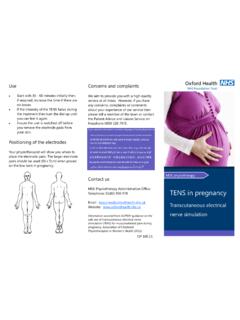
1 TENS Tim Watson (2016) Page 1 TRANSCUTANEOUS ELECTRICAL NERVE STIMULATION (TENS) INTRODUCTION TENS is a method of ELECTRICAL STIMULATION which primarily aims to provide a degree of symptomatic pain relief by exciting sensory nerves and thereby stimulating either the pain gate mechanism and/or the opioid system. The different methods of applying TENS relate to these different physiological mechanisms. The effectiveness of TENS varies with the clinical pain being treated, but research would suggest that when used well it provides significantly greater pain relief than a placebo intervention. There is an extensive research base for TENS in both the clinical and laboratory settings and whilst this summary does not provide a full review of the literature, the key papers are referenced. It is worth noting that the term TENS could represent the use of ANY ELECTRICAL STIMULATION using skin surface electrodes which has the intention of stimulating nerves.
2 In the clinical context, it is most commonly assumed to refer to the use of ELECTRICAL STIMULATION with the specific intention of providing symptomatic pain relief. If you do a literature search on the term TENS, do not be surprised if you come across a whole lot of other types of STIMULATION which technically fall into this grouping. TENS is most commonly delivered from small, hand held, battery powered devices. They can be purchased 'over the counter' in many (but not all) countries. In some locations, they need to be 'prescribed' by a therapist, doctor or other healthcare practitioner. Most multi-modal clinic based stimulators include TENS as an option, though its use in the clinic is less well supported than its use as a home based, patient delivered therapy. Examples of typical TENS units are illustrated below. Analogue TENS devices Digital TENS devices Maternity TENS devices (top) and Multi modal device which includes TENS (bottom) It is interesting that in therapy practice, the majority of practitioners consider TENS as a treatment options in circumstances when a patient is experiencing CHRONIC pain.
3 This is not a problem as there is a significant evidence base to support this mode of application. There is however, a significant and growing body of evidence that supports the use of TENS as a valid and effective intervention in a ACUTE pain conditions. TENS Tim Watson (2016) Page 2 Examples would include : Desantana et al (2009); Sbruzzi et al (2012); Silva et al (2012); Solak et al (2007) and Unterrainer et al (2010). TENS as a treatment technique is non invasive and has few side effects when compared with drug therapy. The most common complaint is an allergic type skin reaction (about 2-3% of patients) and this is almost always due to the material of the electrodes, the conductive gel or the tape employed to hold the electrodes in place. Most TENS applications are now made using self adhesive, pre gelled electrodes which have several advantages including reduced cross infection risk, ease of application, lower allergy incidence rates and lower overall cost.
4 Garment based electrodes are becoming more widely available (examples illustrated) and for some patients provide an excellent method of application. Like the pre gelled electrodes they are supposed to be multi-use but for single patient should not be shared . Digital TENS machines are becoming more widely available and extra features (like automated frequency sweeps and more complex STIMULATION patterns) are emerging, though there remains little clinical evidence for enhanced efficacy at the present time. Some of these devices do offer pre-programmed and/or automated treatment settings. MACHINE PARAMETERS: Before attempting to describe how TENS can be employed to achieve pain relief, the main treatment variables which are available on modern machines will be outlined. The location of these controls on a typical (analogue) TENS machine is illustrated in the diagram below. The CURRENT INTENSITY (A) (strength) will typically be in the range of 0 - 80 mA, though some machines may provide outputs up to 100mA.
5 Although this is a small current, it is sufficient because the primary target for the therapy is the sensory nerves, and so long as sufficient current is passed through the tissues to depolarise these nerves, the modality can be effective. The machine will deliver discrete pulses of ELECTRICAL energy, and the rate of delivery of these pulses (the PULSE RATE or FREQUENCY (B) will normally be variable from about 1 or 2 pulses per second (pps) up to 200 or 250 pps (sometimes the term Hertz or Hz is used here). To be clinically effective, it is suggested that the TENS machine should cover a range from about 2 150 pps (or Hz). In addition to the STIMULATION rate, the DURATION (OR WIDTH) OF EACH PULSE (C) may be varied from about 40 to 250 micro seconds ( s). (a micro second is a millionth of a second). Recent evidence would suggest that this is possibly a less important control that the intensity or the frequency and the most effective setting in the clinical environment is probably around 200 s.)
6 The reason that such short duration pulses can be used to achieve these effects is that the targets are the sensory nerves which tend to have relatively low thresholds ( they are quite easy to excite) and that TENS Tim Watson (2016) Page 3 they will respond to a rapid change of ELECTRICAL state. There is generally no need to apply a prolonged pulse in order to force a sensory NERVE to depolarise, therefore STIMULATION for less than a millisecond is sufficient. In addition, most modern machines will offer a BURST MODE (D) in which the pulses will be allowed out in bursts or trains , usually at a rate of 2 - 3 bursts per second. Finally, a MODULATION MODE (E) may be available which employs a method of making the pulse output less regular and therefore minimising the accommodation effects which are often encountered with this type of STIMULATION . Both the burst and modulation modes will be discussed in more detail in the following sections.
7 Most machines offer a DUAL CHANNEL OUTPUT - two pairs of electrodes can be used simultaneously. In some circumstances this can be a distinct advantage, though it is interesting that most patients and therapists tend to use just a single channel application. Widespread and diffuse pain presentations can be usefully treated with a 4 electrode (2 channel) system, as can a combined treatment for local and referred pain (see later). The pulses delivered by TENS stimulators vary (minimally) between manufacturers, but tend to be asymmetrical biphasic modified square wave pulses. The biphasic nature of the pulse means that there is usually no net DC component (often described in the manufacturers blurb as zero net DC ), thus minimising any skin reactions due to the build up of electrolytes under the electrodes. MECHANISM OF ACTION : The type of STIMULATION delivered by the TENS unit aims to excite (stimulate) the sensory nerves, and by so doing, activate specific natural pain relief mechanisms.
8 For convenience, if one considers that there are two primary pain relief mechanisms which can be activated : the Pain Gate Mechanism and the Endogenous Opioid System, the variation in STIMULATION parameters used to activate these two systems will be briefly considered. Pain relief by means of the pain gate mechanism involves activation (excitation) of the A beta (A ) sensory fibres, and by doing so, reduces the transmission of the noxious stimulus from the c fibres, through the spinal cord and hence on to the higher centres. The A fibres appear to appreciate being stimulated at a relatively high rate (in the order of 80 - 130 Hz or pps). It is difficult to find support for the concept that there is a single frequency that works best for every patient, but this range appears to cover the majority of individuals. Clinically it is important to enable the patient to find their optimal treatment frequency which will almost certainly vary between individuals.
9 Setting the machine and telling the patient that this is the right setting is almost certainly not going to be the maximally effective treatment, though of course, some pain relief may well be achieved. An alternative approach is to stimulate the A delta (A ) fibres which respond preferentially to a much lower rate of STIMULATION (in the order of 2 - 5 Hz, though some authors consider a wider range of 2 - 10Hz), which will activate the opioid mechanisms, and provide pain relief by causing the release of an endogenous opiate (encephalin) in the spinal cord which will reduce the activation of the noxious sensory pathways. In a similar way to the pain gate physiology, it is unlikely that there is a single (magic) frequency in this range that works best for everybody patients should be encouraged to explore the options where possible. A third possibility is to stimulate both NERVE types at the same time by employing a burst mode STIMULATION .
10 In this instance, the higher frequency STIMULATION output (typically at about 100Hz) is interrupted (or burst) at the rate of about 2 - 3 bursts per second. When the machine is on , it will deliver pulses at the 100Hz rate, thereby activating the A fibres and the pain gate mechanism, but by virtue of the rate of the burst, each burst will produce excitation in the A fibres, therefore stimulating the opioid mechanisms. For some AMPLITUDE PULSE DURATION TENS Tim Watson (2016) Page 4 patients this is by far the most effective approach to pain relief, though as a sensation, numerous patients find it less acceptable than some other forms of TENS as there is more of a grabbing , clawing type sensation and usually more by way of muscle twitching than with the high or low frequency modes. TRADITIONAL TENS (HI TENS, NORMAL TENS) Usually uses STIMULATION at a relatively high frequency (80 - 130Hz) and employ a relatively narrow (short duration) pulses though as mentioned above, there is less support for manipulation of the pulse width in the current research literature.