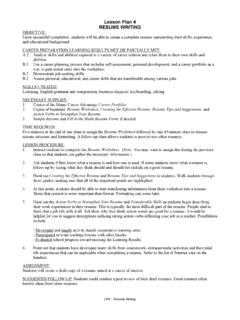
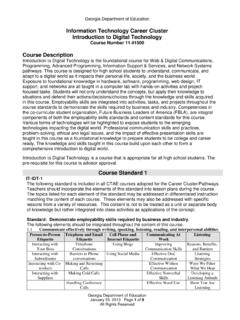
Transcription of Transferable Skills Checklist
1 Page 1 of 5 Transferable Skills Worksheet 1. Place a check next to the Skills you possess. 2. Circle those Skills which you enjoy using and would like to use in your future career /job/volunteer position. 3. Place a star beside the Skills you would like to learn or gain more experience in. Verbal Communication o Perform and entertain before groups o Speak well in public appearances o Confront and express opinions without offending o Interview people to obtain information o Handle complaints ___in person ___over phone o Present ideas effectively in speeches or lecture o Persuade/influence others to a certain point of view o Sell ideas, products or services o Debate ideas with others o Participate in group discussions and teams Nonverbal Communication o Listen carefully and attentively o Convey a positive self image o Use body language that makes others comfortable o Develop rapport easily with groups of people o Establish culture to support learning o Express feelings through body language o Promote concepts through a variety of media o Believe in self worth o Respond to non-verbal cues o Model behavior or concepts for others Written Communication o Write technical language, reports, manuals o Write poetry.
2 Fiction plays o Write grant proposals o Prepare and write logically written reports o Write copy for sales and advertising o Edit and proofread written material o Prepare revisions of written material o Utilize all forms of technology for writing o Write case studies and treatment plans o Demonstrate expertise in grammar and style Page 2 of 5 Train/Consult o Teach, advise, coach, empower o Conduct needs assessments o Use a variety of media for presentation o Develop educational curriculum and materials o Create and administer evaluation plan o Facilitate a group o Explain difficult ideas, complex topics o Assess learning styles and respond accordingly o Consult and recommend solutions o Write well organized and documented reports Analyze o Study data or behavior for meaning and solutions o Analyze quantitative, physical and/or scientific data o Write analysis of study and research o Compare and evaluate information o Systematize information and results o Apply curiosity o Investigate clues o Formulate insightful and relevant questions o Use technology for statistical analysis Research o Identify appropriate information sources o Search written.
3 Oral and technological information o Interview primary sources o Hypothesize and test for results o Compile numerical and statistical data o Classify and sort information into categories o Gather information from a number of sources o Patiently search for hard-to-find information o Utilize electronic search methods Page 3 of 5 Plan and Organize o Identify and organize tasks or information o Coordinate people, activities and details o Develop a plan and set objectives o Set up and keep time schedules o Anticipate problems and respond with solutions o Develop realistic goals and action to attain them o Arrange correct sequence of information and actions o Create guidelines for implementing an action o Create efficient systems o Follow through, insure completion of a task Counsel and Serve o Counsel, advise, consult, guide others o Care for and serve people.
4 Rehabilitate, heal o Demonstrate empathy, sensitivity and patience o Help people make their own decisions o Help others improve health and welfare o Listen empathically and with objectivity o Coach, guide, encourage individuals to achieve goals o Mediate peace between conflicting parties o Knowledge of self-help theories and programs o Facilitate self-awareness in others Interpersonal Relations o Convey a sense of humor o Anticipate people's needs and reactions o Express feelings appropriately o Process human interactions, understand others o Encourage, empower, advocate for people o Create positive, hospitable environment o Adjust plans for the unexpected o Facilitate conflict management o Communicate well with diverse groups o Listen carefully to communication Page 4 of 5 Leadership o Envision the future and lead change o Establish policy o Set goals and determine courses of action o Motivate/inspire others to achieve common goals o Create innovative solutions to complex problems o Communicate well with all levels of the organization o Develop and mentor talent o Negotiate terms and conditions o Take risks, make hard decisions, be decisive o Encourage the use of technology at all levels Management o Manage personnel.
5 Projects and time o Foster a sense of ownership in employees o Delegate responsibility and review performance o Increase productivity and efficiency to achieve goals o Develop and facilitate work teams o Provide training for development of staff o Adjust plans/procedures for the unexpected o Facilitate conflict management o Communicate well with diverse groups o Utilize technology to facilitate management Financial o Calculate, perform mathematical computations o Work with precision with numerical data o Keep accurate and complete financial records o Perform accounting functions and procedures o Compile data and apply statistical analysis o Create computer generated charts for presentation o Use computer software for records and analysis o Forecast, estimate expenses and income o Appraise and analyze costs o Create and justify organization's budget to others Page 5 of 5 Administrative o Communicate well with key people in organization o Identify and purchase necessary resource materials o Utilize computer software and equipment o Organize, improve, adapt office systems o Track progress of projects and troubleshoot o Achieve goals within budget and time schedule o Assign tasks and sets standards for support staff o Hire and supervise temporary personnel as needed o Demonstrate flexibility during crisis o Oversee communication, email and telephones Create and Innovate o Visualize concepts and results o Intuit strategies and solutions o Execute color.
6 Shape and form o Brainstorm and make use of group synergy o Communicate with metaphors o Invent products through experimentation o Express ideas through art form o Remember faces, accurate spatial memory o Create images through, sketches, sculpture, etc. o Utilize computer software for artistic creations Transferable Skills Resources Definition: Skill, ability, natural talent individuals can carry with them and readily apply to a new job or work environment Soft vs. Hard Skills Transferable Skills fall into two areas: soft and hard Skills . Hard Skills consist of working with things ( , computers, carpentry, painting, keyboarding, etc.) or understanding technology and technical Skills ( , physical processing, cataloging, research Skills , e-resources, etc.).
7 Soft Skills help balance professional and technical abilities. Three categories: People, Things, and Information/Data From Making the Shift: Using Transferable Skills to Change career Paths Area People Things Director supervising, motivating, delegating, etc. selling, computer Skills , etc. communication, analyzing, planning, etc. Cataloging keyboarding, software Skills , constructing, etc. analyzing, organizing, gathering data, etc. Reference teaching, customer service, advising, etc. Computer Skills , keyboarding, etc. researching, gathering data, communication, etc. Interlibrary Loan customer service working with computers, computer software, etc. researching, gathering data, analyzing, etc. E-Resources/Webmaster assembling parts, designing, repairing, etc.
8 Developing databases, analyzing, etc. Acquisitions negotiating, translating, advising, etc. constructing, keyboarding, working with computers, etc. working with spreadsheets, computing, budgeting, analyzing, etc. Instructor teaching, training, advising, organizing, motivating, etc. designing, constructing, etc. writing, researching, gathering data, et Track your Skills use this link for the following worksheets: OSP Tracker (Ontario Skills Passport) Use the OSP Tracker to track your Essential Skills and work habits demonstrations and plan further Skills development. Two versions of the OSP Tracker: Fillable and savable form; Print version OSP Reflection Worksheet Complete the OSP Reflection Worksheet as part of your Individual Pathways Planning process.
9 This worksheet can be used after every experience in which you have demonstrated your Essential Skills and work habits. Track Your Essential Skills and Work Habits in Learning Activities Experiential Learning Worksheet Community Involvement Worksheet Volunteer Worksheet Education and career /life planning inquiry questions: Who am I? What are my opportunities? Who do I want to become? What is my plan for achieving my goals? For every item on your resume think: How can I portray this skill so that it supports the idea of doing what I want to do in my next job/opportunity? Ontario Ministry of Education Occupational Profile: Library & Archive Technicians #5 Skills Assessment Worksheet (Handout provided) Also see: Skills Inventory Worksheet (5 pages) Accessed 24 Apr 2016 Explore Skills by Essential career Accessed 24 Apr 2016 Brown, Mary.
10 Librarians at large: transferrable Skills -spelling bee judge. International Librarians Network. 31 Mar 2016. Web. 17 Apr 2016. Taylor, Deborah. Making the Shift: Using Transferable Skills to Change career Paths . career Strategies for Librarians. Mar 2010. 22 Apr 2016.