Transcription of Transportation Vessels - Henry County
1 Page 1 of 6 Transportation Vessels MC-306 (DOT-406) Non (low) pressure bulk liquid cargo tank MC 306--Maximum operating pressure of up to 3 psi DOT 406--Maximum operating pressure of up to 4 psi Oval or egg shaped cross section Flat or nearly flat ends Aluminum primary material of construction Usually multi-compartmented Separate manhole for each compartment Emergency shutoff drivers side front Rollover protection to prevent manholes from opening up on rollover Average maximum capacity--9, 000 gallons Contents.
2 NORMALLY petroleum products, however, may be water or milk MC-307 (DOT-407) Low-pressure bulk liquid cargo tank Pressure up to 40 psi @ 70 F Horse shaped shaped cross section Flat or slightly rounded ends Stainless steel is primary material of construction May be insulated. Insulation may hide tank shape may not appear to be horseshoe shaped. Manway usually center (top) of tank Discharge valves usually center (bottom) of tank If multi-compartmented, will have a separate manhole for each compartment Emergency shutoff drivers side front Rollover protection to prevent manholes from opening up on rollover, normally center of tank top Average maximum capacity--6, 000 gallons Contents.
3 NORMALLY mild acids, however, may be water, milk, or combustible liquids MC-312 (DOT-412) Corrosives Cargo Tank Pressure 5 to 25 psiExterior strengthening (stiffener) rings often visible Lined tank usually lined with rubber or plastic Round cross section Stainless steel is primary material of construction May be insulated, insulation may hide tank shape Manway usually rear (top) of tank Discharge valves usually rear (bottom) of tank If multi-compartmented, will have a separate manhole for each compartment Emergency shutoff drivers side front Page 2 of 6 Cigar shaped tank long, small diameter Average maximum capacity 4,000 to 6,000 gallons Contents.
4 Corrosives High weight (specific gravity) liquids MC-331 Gasses that are liquefied by pressure application only Circular cross section Rounded ends Single shell carbon steel construction All valves, gauges, piping protected against damage from rollovers Painted white for reflecting suns UV light rays Pressure 100 to 500 psi Gases that are liquefied by pressure application Capacity from 2,500 gallons for bobtail to 11,500 gallons for highway transport truck Contents: Propane (LPG) Butane Chlorine Anhydrous ammonia MC-338 Cryogenic Cargo Tank Cryogenic liquids (DOT definition of cryogenic states that substance must be at least -130 F Cylindrical shape with box cabinet on rear of tank, door for loading/unloading operations are usually within these doors Thermos bottle design.)
5 2 cylinders, cylinder-within-a-cylinder Area between 2 cylinders evacuated of air (vacuum) It is normal to see vapors escaping from the vent stack on rear cabinet area of container Pressures from to 500 psi normally low pressure Contents: Substances which cannot be liquefied by pressure application alone, these substances must be super cooled to become a liquid Liquid oxygen, hydrogen, carbon dioxide High-Pressure Tube - Gasses that cannot be liquefied with pressure application Each tube is a separate container Each tube is thermally protected with a thermal plug that is designed to melt out under fire conditions to relieve internal pressure Tubes are individually controlled in rear compartment Off-loaded by cascade style (same method as used to fill SCBA bottles)
6 Page 3 of 6 Pressures of 4,000 to 6,000 psi per tube Usually 9 to 12 tubes per trailer High-pressure tube rail cars are of the same design as these style of highway cargo tanks Contents: Gases that cannot be liquefied by only pressure application Helium, nitrogen, argon Emergency Shut-Offs May be one of three types - Pneumatic--Flip lever to shut-off Hydraulic shear nut to shut-off Cable pull handle, paddle, or shear- nut (break-off) to shut-off Dry Bulk Also known as pneumatically off-loaded hopper trailer Capacity up to 1,500 cubic feet of dry product Uses air pressure to off-load product is blown out of the bottom discharges Need to ground and bond when transferring product.
7 Movement of product through hoses causes a buildup of static electricity Contents: Ammonium nitrate fertilizer Cement Plastic pellets Caustic soda in powdered form Specification (Spec) Plate Located left side of cargo tank on frame rail Type of cargo tank Material of construction Capacity Compartmented Test date Design pressure Lining material Test pressure Other information The spec plate is the only way to tell exactly what type of cargo tank you have Fixed Dry Bulk Found at facilities that use dry goods.
8 Contents: Plastic pellets Soda ash Grain Flour Page 4 of 6 Pressure Intermodal IMO Type 5 Pressures 100 to 500 psi Contents: Liquefied gases liquefied by pressure application alone. LPG, anhydrous ammonia Non-Pressure Intermodal IM 101 (IMO Type 1) Pressure usually to 100 psi IM 102 (IMO Type 2) Pressure usually to psi Safety Relief Valves are a combination valve pressure/vacuum Contents: Solvents, corrosives, fertilizers Cryogenic Intermodal IMO Type 7 Tank-within-a-tank design, area between tanks under a vacuum for best insulation Pressures normally psi and up Cryogenic DOT definition, at least 130 degrees F Contents.
9 Gases that cannot be liquefied by pressure application alone they must be super-cooled Liquid argon, liquid nitrogen, liquid oxygen High-Pressure Tube Intermodal Usually made up of 9 12 individual tubes Pressures of 5,000 to 6,000 psi Each tube is thermal protected against over pressurization Contents: Gases that cannot be liquefied by pressure application Helium, nitrogen, oxygen Intermodal Markings There are a number of markings on intermodal containers that can be used to assist the first responder in identifying the type of container and the product within the container.
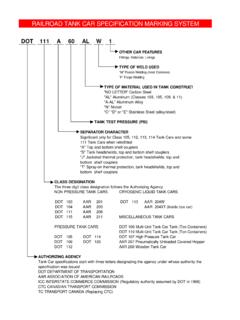
10 These markings are: Reporting Marks and Number. These markings indicate tank ownership, and the tank number identifies the specific tank. These markings are normally found on the right side and both ends of the tank. Page 5 of 6 Specification Marking. The specification marking indicates the standards to which the tank was built. ( IM-101, IM 102, Spec 51) These markings are normally found on the sides of the container. DOT Exemption Marking. If any exemptions have been authorized by the DOT, they must be clearly displayed on the outside of the container in two-inch letters and must be marked DOT-E.