Transcription of Trauma Policy Template - Michigan
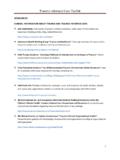
1 E X A M P L E E X A M P L E Trauma Policy PURPOSE STATEMENT The purpose of this Policy is to address the Trauma in the lives of the children and families served by _____. The Policy is promulgated to promote the understanding of Trauma and its impact, ensure the development of a Trauma informed system and the availability of Trauma specific services for (whom). Purpose statement should include who is impacted by the Policy . DEFINITIONS Trauma is defined as: Individual Trauma results from an event, series of events, or set of circumstances that is experienced by an individual as physically or emotionally harmful or threatening and that has lasting adverse effects on the individual's functioning and physical, social, emotional, or spiritual Other definitions as applicable for the organization ( , secondary Trauma , Trauma -specific services, Trauma -informed services, etc.)
2 Policy (Example) It is the Policy of (organization) that (who) shall develop a Trauma -informed system for all (population) and shall ensure that the following elements are provided: I. Adoption of Trauma informed culture: values, principles and development of a Trauma informed system of care ensuring safety and preventing re-traumatization. II. Engagement in organizational self-assessment of Trauma informed care III. Adoption of approaches that prevent and address secondary Trauma of staff IV. Screening for Trauma exposure and related symptoms for (whom) V. Trauma -specific assessment for (whom) VI.
3 Trauma -specific services for (whom) using evidence based practice(s) (EBPs); or evidence informed practice(s) are provided in addition to EBPs VII. (who) shall join with community organizations to support the development of a Trauma informed community that promotes healthy development of children and reduces the likelihood of adverse childhood 3 Other Policy statements? 1 Substance Abuse Mental Health Services Administration (SAMHSA), 2 Substance Abuse and Mental Health Services Administration, Leading Change: SAMHSA s Role and Actions 2011-2012.
4 3 SAMHSA s Initiatives, Preventing Substance Abuse and Mental Illness, 2010. E X A M P L E E X A M P L E STANDARDS To ensure a Trauma informed behavioral health system, standards have been developed and are required to meet the stated Policy . Policy Standards - Requirements I. Adoption of Trauma informed Culture: values, principles and development of a Trauma informed system of care ensuring safety and preventing re-traumatization. (a.) The (organization) develops and supports a committee to include representatives from (what) services and consumers. The committee s primary focus is to ensure the building and maintaining of Trauma informed care within the (organization).
5 (b.) The (organization) shall ensure that all staff, including direct care staff, is trained/has ongoing training in Trauma informed care. Training needs to be updated on a regular basis due to changes in the research and/or evidence based approaches. Staff trained in Trauma informed care should (1.) understand what Trauma is and the principles of Trauma informed care; (2.) know the impact of Trauma on a child s life; (3.) know strategies to mitigate the impact of the Trauma (s); and (4) understand re-traumatization and its impact. (c.) Policies and procedures shall ensure a Trauma informed system of care is supported and that the policies address Trauma issues, re-traumatization and secondary Trauma of staff.
6 (d.) The (organization) shall address Trauma informed principles hiring practices and staff performance reviews ( , interview questions include Trauma related questions, etc.).4 II. Engagement in organizational self-assessment of Trauma informed care (a.) The (organization) conducts an organizational self-assessment to evaluate the extent to which current organization s policies are Trauma -informed, identify organizational strengths and barriers, including an environmental scan to ensure that the environment does not re-traumatize. The self-assessment is updated every three (3) years. (b.) The (organization) shall conduct self-assessment and their self-assessment is updated every three (3) years.
7 III. Adoption of approaches that prevent and address (a.) The (organization) shall adopt approaches that prevent and address secondary traumatic stress of all staff, including, but not limited to: Opportunity for supervision Trauma -specific incident debriefing 4 Fallot, PhD, Roger, Harris, PhD, Maxine. Creating Cultures of Trauma Informed Care. Community Connections, Inc., March 2009. Page 59. E X A M P L E E X A M P L E Policy Standards - Requirements Secondary Trauma of staff Training Self-care Other organizational support ( , employee assistance program).
8 IV. Screening for Trauma exposure and related symptoms for each population (a.) (Organization) shall use a culturally competent, standardized and validated screening tool appropriate for (whom) during the intake process and other points as appropriate. Examples of standardized, validated screening tools are provided on the website V. Trauma -specific assessment for each population (a.) (Organization) uses a culturally competent, standardized and validated assessment instrument appropriate for (whom). Trauma assessment is administered based on the outcome of the Trauma screening. Examples of standardized, validated assessment tools are provided on the website VI.
9 Trauma -specific services for (whom) using evidence based practice(s) (EBPs) or evidence informed practice(s) are provided in addition to EBPs (a.) The (organization) shall use evidence based Trauma specific services for (whom) in sufficient capacity to meet the need. The services are delivered within a Trauma informed environment. Examples of Trauma specific services are provided on the website VII. (Organization) shall join with other community organizations to support the development of a Trauma informed community that promotes healthy development and reduces the likelihood of adverse childhood experiences.
10 (a.) (Organization) shall join with community organizations, agencies, faith-based organizations, community collaboratives ( , MPCBs) and coalitions ( , Substance Abuse Coalitions, Child Abuse and Neglect Councils, Great Start Collaboratives, neighborhood coalitions, etc.) to support the development of a Trauma informed community that promotes healthy environments for children, adults and their families. (b.) Substance abuse prevention programming is provided using a SAMHSA approved, evidence based and Trauma informed approach.