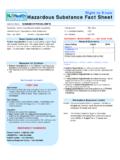
Transcription of TRIETHYL ALUMINUM HAZARD SUMMARY …
1 Common Name: TRIETHYL ALUMINUM CAS Number: 97-93-8 DOT Number: UN 3051 ---------------------------------------- --------------------------------- HAZARD SUMMARY * TRIETHYL ALUMINUM can affect you when breathed in. * TRIETHYL ALUMINUM can cause severe eye and skin irritation and burns. * Breathing TRIETHYL ALUMINUM can irritate the nose, throat and lungs causing coughing, wheezing and/or shortness of breath. * TRIETHYL ALUMINUM is a HIGHLY FLAMMABLE and REACTIVE chemical and a DANGEROUS FIRE and EXPLOSION HAZARD . IDENTIFICATION TRIETHYL ALUMINUM is a colorless liquid. It is used as a catalyst in making Ethylene, in the plating of ALUMINUM , as an intermediate, and as an additive to rocket propellants. It is generally found in a solution with a solvent (such as Hexane or Toluene) to lessen its reactivity.
2 REASON FOR CITATION * TRIETHYL ALUMINUM is on the Hazardous Substance List because it is cited by ACGIH, DOT, NIOSH and NFPA. * This chemical is on the Special Health HAZARD Substance List because it is FLAMMABLE and REACTIVE. * Definitions are provided on page 5. HOW TO DETERMINE IF YOU ARE BEING EXPOSED The New Jersey Right to Know Act requires most employers to label chemicals in the workplace and requires public employers to provide their employees with information and training concerning chemical hazards and controls. The federal OSHA HAZARD Communication Standard, , requires private employers to provide similar training and information to their employees. * Exposure to hazardous substances should be routinely evaluated. This may include collecting personal and area air samples.
3 You can obtain copies of sampling results from your employer. You have a legal right to this information under OSHA * If you think you are experiencing any work-related health problems, see a doctor trained to recognize occupational diseases. Take this Fact Sheet with you. RTK Substance number: 1906 Date: December 1996 Revision: June 2003 ---------------------------------------- -------------------------------- WORKPLACE EXPOSURE LIMITS The following exposure limits are recommended for ALUMINUM Alkyls: NIOSH: The recommended airborne exposure limit is 2 mg/m3 averaged over a 10-hour workshift. ACGIH: The recommended airborne exposure limit is 2 mg/m3 averaged over an 8-hour workshift. WAYS OF REDUCING EXPOSURE * Where possible, enclose operations and use local exhaust ventilation at the site of chemical release.
4 If local exhaust ventilation or enclosure is not used, respirators should be worn. * Wear protective work clothing. * Wash thoroughly immediately after exposure to TRIETHYL ALUMINUM and at the end of the workshift. * Post HAZARD and warning information in the work area. In addition, as part of an ongoing education and training effort, communicate all information on the health and safety hazards of TRIETHYL ALUMINUM to potentially exposed workers. TRIETHYL ALUMINUM page 2 of 6 This Fact Sheet is a SUMMARY source of information of all potential and most severe health hazards that may result from exposure. Duration of exposure, concentration of the substance and other factors will affect your susceptibility to any of the potential effects described below.
5 ---------------------------------------- ----------------------------------- HEALTH HAZARD INFORMATION Acute Health Effects The following acute (short-term) health effects may occur immediately or shortly after exposure to TRIETHYL ALUMINUM : * TRIETHYL ALUMINUM can cause severe eye and skin irritation and burns. * Breathing TRIETHYL ALUMINUM can irritate the nose and throat causing coughing and wheezing. Chronic Health Effects The following chronic (long-term) health effects can occur at some time after exposure to TRIETHYL ALUMINUM and can last for months or years: Cancer HAZARD * According to the information presently available to the New Jersey Department of Health and Senior Services, TRIETHYL ALUMINUM has not been tested for its ability to cause cancer in animals.
6 Reproductive HAZARD * According to the information presently available to the New Jersey Department of Health and Senior Services, TRIETHYL ALUMINUM has not been tested for its ability to affect reproduction. Other Long-Term Effects * Breathing TRIETHYL ALUMINUM can irritate the lungs causing coughing and/or shortness of breath. MEDICAL Medical Testing If symptoms develop or overexposure is suspected, the following are recommended: * Lung function tests. Any evaluation should include a careful history of past and present symptoms with an exam. Medical tests that look for damage already done are not a substitute for controlling exposure. Request copies of your medical testing. You have a legal right to this information under OSHA Mixed Exposures * Because smoking can cause heart disease, as well as lung cancer, emphysema, and other respiratory problems, it may worsen respiratory conditions caused by chemical exposure.
7 Even if you have smoked for a long time, stopping now will reduce your risk of developing health problems. WORKPLACE CONTROLS AND PRACTICES Unless a less toxic chemical can be substituted for a hazardous substance, ENGINEERING CONTROLS are the most effective way of reducing exposure. The best protection is to enclose operations and/or provide local exhaust ventilation at the site of chemical release. Isolating operations can also reduce exposure. Using respirators or protective equipment is less effective than the controls mentioned above, but is sometimes necessary. In evaluating the controls present in your workplace, consider: (1) how hazardous the substance is, (2) how much of the substance is released into the workplace and (3) whether harmful skin or eye contact could occur.
8 Special controls should be in place for highly toxic chemicals or when significant skin, eye, or breathing exposures are possible. In addition, the following controls are recommended: * Where possible, automatically pump liquid TRIETHYL ALUMINUM from drums or other storage containers to process containers. * All transfer lines must be free of Water, Oxygen and other substances that react with TRIETHYL ALUMINUM . All vessels must be dry and Oxygen free. * Before entering a confined space where TRIETHYL ALUMINUM may be present, check to make sure that an explosive concentration does not exist. Good WORK PRACTICES can help to reduce hazardous exposures. The following work practices are recommended: * Workers whose clothing has been contaminated by TRIETHYL ALUMINUM should change into clean clothing promptly.
9 * Contaminated work clothes should be laundered by individuals who have been informed of the hazards of exposure to TRIETHYL ALUMINUM . * Eye wash fountains should be provided in the immediate work area for emergency use. * If there is the possibility of skin exposure, emergency shower facilities should be provided. * On skin contact with TRIETHYL ALUMINUM , immediately wash or shower to remove the chemical. At the end of the workshift, wash any areas of the body that may have contacted TRIETHYL ALUMINUM , whether or not known skin contact has occurred. TRIETHYL ALUMINUM page 3 of 6 * Do not eat, smoke, or drink where TRIETHYL ALUMINUM is handled, processed, or stored, since the chemical can be swallowed. Wash hands carefully before eating, drinking, applying cosmetics, smoking, or using the toilet.
10 PERSONAL PROTECTIVE EQUIPMENT WORKPLACE CONTROLS ARE BETTER THAN PERSONAL PROTECTIVE EQUIPMENT. However, for some jobs (such as outside work, confined space entry, jobs done only once in a while, or jobs done while workplace controls are being installed), personal protective equipment may be appropriate. OSHA requires employers to determine the appropriate personal protective equipment for each HAZARD and to train employees on how and when to use protective equipment. The following recommendations are only guidelines and may not apply to every situation. Clothing * Avoid skin contact with TRIETHYL ALUMINUM . Wear protective gloves and clothing. Safety equipment suppliers/ manufacturers can provide recommendations on the most protective glove/clothing material for your operation.