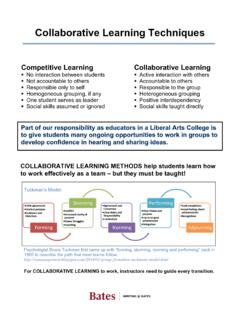
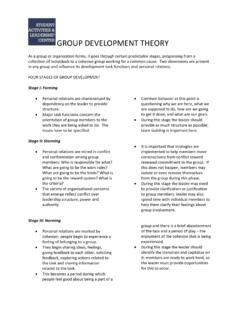
Transcription of Tuckman’s Team Development Model
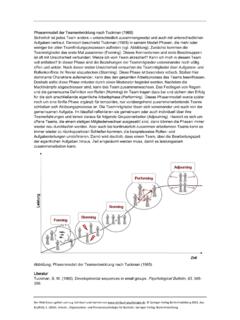
1 tuckman s Team Development Model FORMING Establish basic expectations Identify similarities Agree on common goals Members start to make contact and bond Start to develop trust Members dependent upon leader STORMING Identifying power & control issues Improving communication Identifying resources Expressing differences of ideas and opinions Reacting to leadership Members independent or counter dependent NORMING Members agree about roles & processes for solving problems Decisions are made through negotiation and consensus building PERFORMING Achieving effective & satisfying results Members find solutions to problems members work collaboratively The team members are interdependent Members care about one another There is a progression through the stages as the team develops Each stage prepares the team for performance By-passing any stage will affect performance Any changes to the group a member joins or leaves - results in a new team and the process is repeated.
2 Forming Storming Norming Performing Team members lack clarity what they are to do The mission isn t owned by the team There is a lack of direction Trust has not been established No relationships exist within the team The team has not established the way they work There is no commitment to the team Roles and responsibilities are stated Agendas are displayed Problem solving doesn t happen People are anxious There is a lot of competition between team members There is a lack of team spirit People try different ideas Cliques and splinter groups form Trust has been established and team members appreciate one another There is clarity of purpose There are no hidden agendas Team members are confident Creativity is displayed Motivation is high All team members are committed to the team mission Team members are highly motivated Team needs take precedence over individual objectives The team is highly effective Team members display pride in the team There is a high degree of trust Team members are supportive of one another The team achieves outstanding performance Moving teams through the stages of team Development Forming to Storming Storming to Norming Norming to Performing Establish and communicate the reason for the team the mission Set goals Identify roles within the team Establish ways to build trust within the team Leader needs to be directive at this stage and assert their position Bring the team together on a regular basis to
3 Work on joint projects The leader must set expectations with the team and should expect the team to deliver results Leader should support positive team behaviour Team leader should create a positive environment in which to work Achievements must be recognised and celebrated Team members respect and listen to each other Team members recognise individuals roles and expertise Everyone works to create a supportive environment Feedback is requested, accepted and acted upon Praise each other Share responsibility Delegate freely within the team Communicate and keep every team member up-to-date Share success Commit time to the team Evaluate their performance and strive to achieve more challenging objectives Share leadership based upon individual skills sets Are selective when recruiting new team members Work to maintain team spirit.
4