Transcription of Tutorial 4 SOLUTION STOICHIOMETRY - EIU
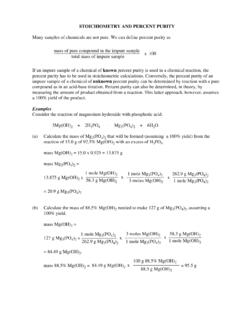
1 T-27 Tutorial 4 SOLUTION STOICHIOMETRYS olution STOICHIOMETRY calculations involve chemical reactions taking place in the various methods of expressing SOLUTION concentration the most convenient for generallaboratory use is molarity, which is defined: Moles of solute nsoluteMolarity = or M = Liters of SOLUTION LsolnChemical reactions are written in terms of moles of reactants and products; this molarityconcentration unit relates moles of solute to volume of SOLUTION . Thus, easily measured solutionvolumes provide a simple method of measuring moles of : What is the molarity of a SOLUTION made by dissolving g of potassium chloridein enough water to make mL of SOLUTION ?This data gives a relationship between amount of solute and volume of SOLUTION : g KCl mL.
2 To find molarity we must convert grams KCl to moles KCl and mL SOLUTION to g KCl 1 mol KCl 1000 mL mol KCl x x = or M KCl mL g KCl L LWhenever the SOLUTION concentration is given in molarity, M, you must change to the equivalentunits, mol/L or mol/1000 mL, to use as a conversion : What mass of solute is contained in mL of a M KCl SOLUTION ?The conversion sequence is:mL SOLUTION L SOLUTION mol KCl g KCl 1 L mol KCl g mL x x x = g KCl 1000 mL L mol KCl T-28OR, use the conversion sequence:mL SOLUTION mol KCl g KCl mol KCl g mL x x = g KCl 1000 mL mol KCl EXAMPLE: What mass of potassium chloride would be needed to prepare mL of a SOLUTION ?
3 1 L mol KCl g mL x x x = g KCl (needed) 1000 mL L mol KCl OR mol KCl g mL x x = g KCl (needed) 1000 mL mol KCl Please note: the preceding two EXAMPLES are the same kind of problem worded differently: conversion from volume of SOLUTION to mass of : Silver nitrate SOLUTION is added to mL of a M potassium chloridesolution until no more precipitate forms. What mass of silver chloride will be formed?The chemical equation for the reaction is:KCl (aq) + AgNO3 (aq) AgCl (s) + KNO3 (aq)Since the concentration and volume of silver nitrate SOLUTION are not specified, we can assume itis in excess.
4 First find the number of moles of KCl in the mL of M SOLUTION : mol KCl(A) mL x = mol KCl 1000 mL T-29 From the mole ratio in the balanced chemical equation: 1 mol AgCl(B) mol KCl x = mol AgCl formed 1 mol KCl Then convert to grams of AgCl: g AgCl(C) mol AgCl x = g AgCl formed mol AgCl Steps (A), (B), and (C) may be combined: mol KCl 1 mol AgCl g mL x x x = g AgCl 1000 mL 1 mol KCl mol AgCL Please note: the steps in solving this problem are essentially the same as used in Tutorial 3;the only difference is the method of first finding moles: thereafter they are identical volume and concentration of both reactant solutions are given then you are dealing with alimiting reagent problem.
5 The first step is to find the moles of each reactant from the volumeand concentration of the SOLUTION . Once moles are found the process is the same as shown inTutorial 3, p following equations are needed for some of the problems in this (aq) + BaCl2 (aq) BaSO4 (s) + 2 NaCl (aq)BaCl2 (aq) + 2 AgNO3 (aq) 2 AgCl (s) + Ba(NO3)2 (aq)Ca(OH)2 (aq) + 2 HCl (aq) CaCl2 (aq) + 2H2O (l)2Al(OH)3 (s) + 3H2SO4 (aq) Al2(SO4)3 (aq) + 6H2O (l)AlCl3 (aq) + 3 NaOH (aq) Al(OH)3 (s) + 3 NaCl (aq)3 KOH (aq) + H3PO4 (aq) K3PO4 (aq) + 3H2O (l)T-30 1)Calculate the molarity of the following solutions: a) g of potassium chloride in mL of ) x 10 2 g of silver nitrate in mL of ) g of barium chloride in mL of ) mg of calcium hydroxide in mL of ) g of aluminum chloride in mL of ) g of potassium hydroxide in L of ) g of sodium carbonate in mL of SOLUTION .
6 H) x 10 6 kg of potassium phosphate in mL of SOLUTION . 2)What mass of solute is contained in mL of a M sodium hydroxide SOLUTION ? 3)What mass of solute is needed to prepare mL of a M potassium nitratesolution? 4)What mass of solute is contained in mL of a M barium nitrate SOLUTION ? 5)What volume of M silver nitrate contains gram of silver nitrate? 6)What volume of M aluminum chloride SOLUTION contains g of solute? 7) mL of a M sodium chloride SOLUTION was evaporated to dryness. What massof solid remained? 8)In what total volume must g of sodium nitrate be dissolved to make a Msolution? 9)Barium chloride SOLUTION is added to mL of a M sodium sulfate SOLUTION untilno more precipitate forms. What mass of barium sulfate forms?10)Excess barium chloride SOLUTION is added to mL of M silver nitrate SOLUTION . What mass of silver chloride is formed?
7 11)What mass of aluminum hydroxide is required to completely react with mL of sulfuric acid SOLUTION ?12)Excess sodium hydroxide SOLUTION is added to mL of M aluminum chloridesolution. What mass of aluminum hydroxide is formed?T-3113)What volume of M sulfuric acid is needed to dissolve g of aluminumhydroxide? What is the molarity of the resulting SOLUTION of aluminum sulfate? (Assumefinal SOLUTION volume = volume of sulfuric acid used.)14)Silver chloride is formed by mixing silver nitrate and barium chloride solutions. Whatvolume of M barium chloride SOLUTION is needed to form g of silver chloride?15)What volume of M potassium hydroxide SOLUTION is needed to react completely witha SOLUTION containing g of phosphoric acid?16)What volume of M hydrochloric acid is needed to react completely with a solutioncontaining g of calcium hydroxide?
8 17) mL of M barium chloride SOLUTION is mixed with mL of silvernitrate SOLUTION . What mass of silver chloride will be formed?18) mL of M barium chloride SOLUTION is mixed with mL of M silvernitrate SOLUTION . What mass of silver chloride will be formed?19) mL of M aluminum chloride SOLUTION is mixed with mL of Msodium hydroxide SOLUTION . What mass of aluminum hydroxide will be formed?20) mL of a SOLUTION containing g of potassium hydroxide is mixed with mLof a M phosphoric acid SOLUTION . Will the resulting mixture be acidic or basic? Whatwill be the molarity of the potassium phosphate formed? (Assume the volumes areadditive.)21) mL of M phosphoric acid SOLUTION is titrated with M potassium hydroxidesolution. What volume of base SOLUTION is needed for complete neutralization?22) mL of a barium chloride SOLUTION is titrated with M silver nitrate SOLUTION .
9 ML of the silver nitrate SOLUTION is required to completely precipitate the chloride ionas silver chloride. What is the molarity of the barium chloride SOLUTION ?23) mL of a phosphoric acid SOLUTION required mL of a M potassiumhydroxide SOLUTION for neutralization. What is the molarity of the acid?24) mL of a M calcium hydroxide SOLUTION is titrated with M hydrochloricacid SOLUTION . What volume of acid is needed for complete neutralization?25) mL of M hydrochloric acid is titrated with a calcium hydroxide SOLUTION , and mL of the base is required for complete neutralization. What is the molarity of thecalcium hydroxide SOLUTION ?T-32 Answers to Problems 1)a) M KCl10) g AgCl b) x 10 4 M AgNO311) g Al(OH)3 c) x 10 4 M BaCl212) g Al(OH)3 d) x 10 3 M Ca(OH)213) mL H2SO4; M Al2(SO4)3 e) M AlCl314) mL BaCl2 f) M KOH15)122 mL KOH g) M Na2CO316) mL HCl h) x 10 5 M K3PO417)AgNO3 limiting; g AgCl 2) g NaOH18)BaCl2 limiting; g AgCl 3) g KNO319)NaCl limiting; g Al(OH)3 4) g Ba(NO3)220)acidic; M K3PO4 5) mL AgNO321)247 mL KOH 6)166 mL AlCl322) M BaCl2 7) g NaCl23) M H3PO4 8)235 mL24) mL HCl 9) g BaSO425) M Ca(OH)2