Transcription of UK Spec Fourth Edition Summary of Key Changes
1 Page 1 of 10 UK Standard of Professional Engineering competence (UK-SPEC) Fourth Edition : Summary of key Changes Overall approach 1. The overall approach in redrafting UK-SPEC was to aim for greater clarity, making the requirements, ie the Standard itself, more obvious, while providing better examples of how applicants might provide evidence of having met the Standard. We also aimed to make the new Edition more informative, particularly with respect to assessment, and tried to reduce duplication of information throughout. An emphasis was placed on accessible language, clarity of structure and internal consistency with other standards documents. The text was drafted with accessible language principles in mind: sentences under 25 words where possible, with active tenses, while aiming to not alter the precise meaning of technical, engineering and regulatory terms.
2 Wording Changes . 2. For the sake of consistency and clarity, a number of terms were slightly altered. a) Applicant Potential registrants were referred to as both candidates and applicants. Applicant was the term used in the tables, so it was applied consistently in place of candidate . B) Recognised Qualifications and Individual Assessment These terms replace Standard Route and Individual Route . These terms were selected in order to convey the sense that both routes are equal in status. c) Annex This term was removed as it seemed an inappropriate name for key sections of this document. d) Previous editions of UK-SPEC alternated between the terms PEI , Professional Engineering Institution , licensed PEI , and Institution.
3 In this Edition we have used Licensee to provide consistency with the term used in the revised Engineering Council Bye-laws. Revised body text 3. Key Changes are as follows: a) Inclusion of a diagram setting out the relationship of the Standards documents to each other. b) Separation of Why register? section into Benefits for individuals and Benefits for employers . c) New section, How to become professionally registered , containing an overview of the requirements for registration and an overview of assessment methods. d) New section Routes to registration: meeting the requirements . e) The Routes to registration section is illustrated with a new flowchart on the assessment process. Page 2 of 10 f) Table 2 is entitled Recognised qualifications instead of Exemplifying qualifications g) The individual route section is now entitled individual assessment.
4 H) The Preparing for registration section has been edited to reduce repetition. i) The Assessment of competence and commitment section is now entitled; Professional review: assessing competence and commitment . This section has been broken down into sections on scrutiny of qualifications and the professional review itself. j) The section on maintaining and enhancing competence has been retitled; Retention of the title requires: ; this section has been shortened substantially to avoid repetition on Continuing Professional Development (CPD). To avoid out-of-date information on CPD policy being included, a link is now provided. k) The comparison table of EngTech, IEng and CEng competences does not now contain the examples of evidence, as the previous version was very difficult to read for people with visual impairment and incompatible with screen-readers.
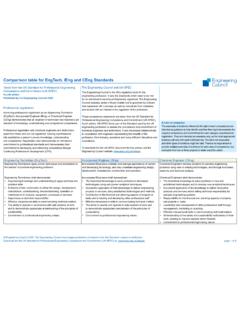
5 It was also difficult to compare across registration categories. There was also undue repetition of information from elsewhere in the document. The comparison table now precedes the information on professional and ethical behaviour. A full table of competences and examples of evidence has been made available as a stand-alone pdf document. l) The CPD section has been rewritten by the Professional Development Steering Group to include updated information on the CPD Code and sampling. A link to the CPD policy statement is now included. m) Guidance for Licensed Member Codes of Professional Conduct. This section has been shortened to remove all information that is intended for PEIs, rather than for potential registrants. A new link to the latest information is provided.
6 N) Glossary. This has been extended to provide greater clarity on all terms used in UK-SPEC. Competences update Overall approach 4. Each competence was reviewed in detail, to ensure that the Standard is inclusive and achievable, particularly for earlier-career applicants, while maintaining the same level. New examples of evidence were drafted to support this aim. The main areas of enhancement are shown below. Key Changes 5. Added clarity. a) Clearer distinction is made between the requirements (the specification) and the examples that are intended as evidence to demonstrate competence . The 4th Edition incorporates the following Changes : use of BSI standards language (for example: shall to denote a requirement that must be met) separation of requirements and examples into different columns Page 3 of 10 inclusion of new examples of evidence inclusion of a description for each competence , intended to provide more information and to set the requirements of the competences in context b) Examples of evidence have been rewritten so that they are in the same style irrespective of whether they refer to EngTech, IEng or CEng.
7 As a consequence, they are now more specific and consistent when referring to instructions, examples and definitions. 6. Greater inclusivity. a) Requirements are illustrated in a way that helps less experienced applicants draw out their relevant experience, as many younger engineers perceive that the requirements for CEng are pitched at a level which they have difficulty matching. As a result, some struggle to provide relevant evidence. Sub-competences are reworded; for example, C4 (CEng) from, bring about continuous improvement through quality management to, bring about continuous improvement and promote best practice . The generic role description for CEng is revised; eg accountability for project, finance and personnel management is replaced with responsibility for the financial and planning aspects of projects, sub-projects or tasks and leadership and development of other professional staff through management, mentoring or coaching.
8 The term accountable has been interpreted as having formal responsibility in an organisational context, eg a line manager or project manager. The Changes in competence C attempt to better reflect the actual level of competence expected, based on current practice in professional review. The reality is that graduates of around 5 years will not be accountable for project, finance or personnel management in any formal sense and will not be regarded by their employer as having this responsibility This also makes it clear that the Standard can be met by those applicants who are operating with significant responsibility in matrix management structures. Examples of evidence are revised to reflect realistic requirements. b) Technical specialism is as well recognised in the Standard as engineering management.
9 Technical specialism is now recognised by changing, for example, C3 (CEng) from lead teams and develop staff to, lead teams or technical specialisms . The examples of evidence have also been strengthened to include examples that are more accessible to academic applicants and technical specialists. 7. Greater clarity between IEng and CEng. The requirements for IEng and CEng have been clarified, specifically: Differentiation between IEng and CEng, principally at competences A and B. For example, A2 (CEng) emphasises technical complexity and level of risk. Closer alignment between the requirements for competence C, recognising that the management/leadership requirements are more similar than they are different. Page 4 of 10 8. Reduced emphasis on technological innovation as the primary way to demonstrate the application of a high level of technical knowledge (CEng, A2).
10 The definition of A2 has been broadened to emphasise complexity and level of risk: developing technology solutions to unusual or challenging problems using their knowledge and understanding and/or dealing with complex technical issues or situations with significant levels of 9. Greater emphasis on diversity and inclusion, which in the 3rd Edition is only included in the requirements for EngTech ( competence D2). This is now also included in IEng and CEng, as D3, demonstrate personal and social skills and awareness of diversity and inclusion issues . For consistency with other categories of registration it is split out into a new competence for EngTech, (D3). 10. Help for applicants to provide evidence on meeting the requirements on ethics ( competence E5).