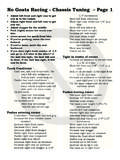
Transcription of UNDERSTANDING CHASSIS ADJUSTMENTS - …
1 1 UNDERSTANDING CHASSIS ADJUSTMENTS There was once a time not so long ago when the "average" racer could arrive at the track with his "average" set-up and with minor ADJUSTMENTS , he could run competitively. The problem is that these days, we have come to the point where this "average" set-up will no longer get you better than mid-pack finish and, with today's competition levels as well as the amount of quality competitors out there, you might not even make the show. I once had a very good friend of mine say to me, "You can always run midpack if nothing falls off".
2 Now this is true as long as you cover all your bases first. In order to cover all these bases it is important to first understand all the aspects of the CHASSIS and how they affect the way your CHASSIS works. Once you understand this then you can begin applying them to your set-up. The CHASSIS is made up of many components and they all must work together in order for that CHASSIS to achieve its full potential. PERFECT NUMBERS I cannot count the number of times that I have heard someone ask what the ideal or perfect numbers are.
3 What you need to understand is that these numbers simply do not exist. Every kart as well as every driver performs differently and each will require a set-up to suit each individually. Set-up sheets are a prime example of these "perfect" numbers. The key is to understand that these sheets only offer a starting point that will help get you into the ballpark. I have seen many times the situation where a driver relies far too much on these sheets and often for one reason or another; they never try anything outside these numbers.
4 It is important to remember you can NEVER put too much effort into testing and trying new things. This is what makes the good guys better; they are always trying new set-ups and not just relying on what other racers are doing. Similar numbers will work for drivers who are riding the same make of CHASSIS but they will still need fine-tuning and testing to get that CHASSIS to work right for their own situation. I am not saying that you should close your eyes and ears to what others are doing. Information is invaluable and you can use information from many sources by pulling it all together to make 2 your racing effort more successful.
5 The idea is to keep notes and listen to all the information out there - just don't be afraid to step outside the lines by trying something new. In this article, I'll try to explain several different points of set-up and demonstrate a little about how they affect your CHASSIS . For instance, when we set up a kart here at our own shop or at the track, we take several points into consideration such as toe, camber, caster, nose weight, left side weight, cross weight and stagger. The first place we head when we are ready to begin setting up the CHASSIS is the scales.
6 This is where the most work is done. There is no specific order in which to check and adjust these points but if you go in a certain order each time, it can save you time and work in the long run. The key point to remember is to check and re-check everything and when you're done with the first run through, it's best that you check it again. When you're done, you should carefully document all of the settings in your notebook (you do have a notebook, right?). ON THE SCALES Once you have made it to the scales, the first thing to check besides making sure that they are zeroed and level (hey, it wouldn't be the first time) is the toe.
7 Toe is probably one of the more simple aspects of the CHASSIS to understand. Just the right amount and it will help the kart turn into and turn out of the corners. Too much toe-in will cause the kart to become 'darty' (this especially applies to pavement racers). A key point to remember is that while toe is a very small part of the set-up, every little bit helps. Toe can be affected by every change you make to the front end, whether it be changing washers to adjust cross weight or changing camber.
8 This is why it is always important to re-check the toe after the set-up is complete. You should also take your weekly maintenance into consideration because bearings and rod-ends will eventually become worn and I have seen karts with up to an eighth of an inch worth of play in the front end. It is extremely difficult to set a sixteenth of an inch toe-in with this much play. Also remember that the toe will change slightly when the driver sits in the kart and this effect becomes worse the more the driver weighs.
9 This is why I use the Accutoe Pro laser system so that I can check the toe with the driver in the kart for the most accurate reading. You will also need to rely on your driver's input for toe because it directly affects the drivability of the kart. 3 CASTER Next let's talk about caster. This is another one that is fairly simple. More caster equals more bite, less caster equals less bite - sounds simple enough? I rarely use caster as a CHASSIS adjustment as it usually is a driver preference.
10 Nearly all CHASSIS manufacturers offer a CHASSIS with adjustable caster and suggestions as to where it should be set. The average racer usually has the "it's set from the factory" attitude about caster and rarely bothers to check it. This works OK on dirt because caster is less important than on pavement, the reason being that the dirt racing surface has less bite and translates less of this to the driver than on pavement. Don't read this as not being important - it's just more critical on pavement tracks.