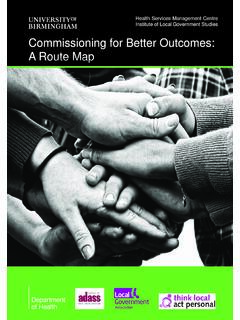
Transcription of Understanding Commissioning
1 Culture and sport Understanding Commissioning A practical guide for the culture and sport sector Contents Introduction and context 1. What is the purpose of the guide? 1. Who is it for? 1. Why now? 1. The changing landscape in public services 2. The changing landscape in culture and sport 2. Overview and how to use this guide 4. Part one: Understanding strategic Commissioning : the process 1. What is strategic Commissioning ? 6. Definition 6. The Commissioning cycle 7. Strategic Commissioning is not to be confused with .. 8. Is all Commissioning strategic?
2 8. What is meant by decommissioning? 10. How is Commissioning organised at the local level? 10. 2. Needs assessment 12. Definition 12. Key words in the definition 13. How to go about a needs assessment 14. Six components of a needs assessment 15. 3. Options appraisal, the business case and procurement 18. Options appraisal: definition 18. 10 steps of an options appraisal 20. Identifying and choosing from the full range of suppliers 21. The business case 22. Procurement 23. 4. Monitoring and managing performance 26. Performance management is.
3 26. Step one: understand the benefits 26. Step two: understand the context 27. Step three: select the right performance measures 29. Step four: gather evidence, collect quality data and set targets 31. Step five: interpret and use the data 32. Part two: building the skills and capacity of those involved in Commissioning : the people 5. Building capacity in culture and sport civil society 35. What do we mean by civil society? 35. The benefits of civil society 36. The challenges for civil society 37. The eight principles of good Commissioning 37.
4 How to build capacity 38. 6. Building capacity through joint working and partnerships 42. Key strategic partnerships 42. The anatomy of a successful partnership 43. What commissioners can do to help other partners engage in the Commissioning process 45. What culture and sport can do to better engage in the Commissioning process 46. 7. Building capacity: developing skills and competencies in Commissioning 49. 11 core competencies 50. 8. The essence of Commissioning 53. To recap on the complexities and simplicities of Commissioning 53. Messages not mysteries': what Beacons have achieved and how 55.
5 Part three: Understanding into action 9. Things that you can do to move this forward 57. Exercise 1: Find out about the other pictures of the Commissioning cycle 57. Exercise 2: Build the Commissioning map for your area 57. Exercise 3: Get hold of the existing needs assessments in your area 58. Exercise 4: Has the needs assessment captured community voices in a way that you think is real and powerful? 58. Exercise 5: Do you know the specific culture and sport needs in the area? 59. Exercise 6: For those involved in procuring services: each time you procure a service, are you opening up the process and thinking things through afresh?
6 59. Exercise 7: For those seeking to be suppliers or providers of services: are you ready? 60. Exercise 8: Is your performance management system up to date and working for you? 61. Exercise 9: What is the council or LSP strategy for building the capacity of civil society? 61. Exercise 10: What additional capacity building needs are there for culture and sport organisations? 62. Exercise 11: Audit your partnership working 62. Exercise 12: Build the competencies into the staff training and development programme for your team 63. Sources of further information and support 64.
7 Glossary of common terms 65. Introduction and context What is the purpose of the Why now? guide? Some people are unsure what strategic The purpose of this guide is to help people in Commissioning is all about, whether it is the culture and sport sector understand the relevant to them, and whether it is just process of strategic Commissioning in public flavour of the month' and will pass. services and how to engage in it to produce In reality, the delivery of public services has better outcomes for communities. changed and developed and the essential It is looking two ways: elements of strategic Commissioning have been building over time.
8 It is not influencing and engaging in strategic something that has suddenly appeared, but Commissioning corporately and within the is a progression of change which has been Local Strategic Partnership in the outcome embodied in legislation and public policy. areas where culture and sport have a significant contribution to make In some services a Commissioning model has been in place for many years. This is Commissioning culture and sport the case in adult social care and health, for services to deliver these outcomes at the example. Its arrival in children's services, operational level.
9 Learning and skills, offender management and other public services is more recent. Who is it for? The next two sections provide a very brief The guide is for individuals and organisations summary of some of the features of the working in the culture and sport sector, both changing landscape in public service and in councils and civil society organisations. the changing landscape in culture and sport over the past two decades. They reinforce It aims to provide culture and sport the point that what we now call strategic organisations with greater Understanding of Commissioning has developed over time and strategic Commissioning , the opportunities is not a new idea that will go away!
10 And challenges, and some tools to operate more effectively in the context of modern It will continue to develop as public policy public service delivery. and practice develops so this guide aims to be a foundation for Understanding the present shape of Commissioning and support culture and sport organisations look to the future. 1 Understanding Commissioning The changing landscape in The sharper focus on outcomes is leading to the continued re-orientation of public public services services around a Commissioning model'. The past two decades has seen a series The necessity to demonstrate evidence of developments in public service that are of impact on better outcomes for local about: people, and that participation in culture and sport reduces the dependency on Efficiency Value for money, best value, other services, has never been more and performance management.