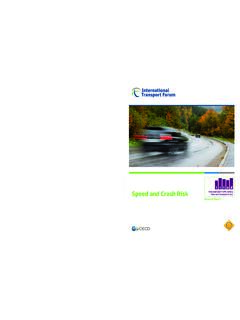
Transcription of Understanding Design, Operating, and Posted Speed
1 Understanding design, operating, and Posted Speed Report No. 1465-1. Sponsored by Texas Department of Transportation in cooperation with Department of Transportation Federal Highway Administration Understand;ng des;gn, operaUng, and Posted Speed Report No. 1465-1. Sponsored by Texas Department of Transportation in cooperation with Department of Transportation Federal Highway Administration Research conducted by Texas Transportation Institute Authors Raymond A. Krammes Kay Fitzpatrick Joseph D. Blaschke Daniel B. Fambro TxDOT Project Committee Project Director Wallace Ewell Project Advisors Gaynor D. Greear T. McCoy R. Neel Editor Kelly West, ITEC.
2 Designer Kim Dobbs, ITEC. March 1996. Acknowledgments This study was performed in cooperation with the Texas Department of Transportation and the Department of Transportation, Federal Highway Administration. Disclaimer The contents of this document reflect the views of the authors who are responsible for the facts and accuracy of the data presented herein. The contents do not necessarily reflect the official views of the FHWA or TxDOT. This document does not constitute a standard, specification, or regulation, nor is it to be used for construction, bidding, or permit purposes. CONTENTS. 4 - - - UST OF FIGURES. 5 - - - INTRODUCTION.
3 6 - - - DEFINING Speed . Design Speed Operating Speed 85th Percentile Speed Posted Speed 8--- Speed AND HIGHWAY DESIGN. Selecting Design Speed for a Highway Applying Design Speed to Highway Design Design Speed and horizontal curves Design Speed and vertical curves 12 . ~- - Posted Speed AND HIGHWAY OPERATIONS. Selecting Posted Speed for a Highway Applying Posted Speed in Highway Operations Exceptions to the 85th percentile procedure Advisory Speed panels on sharp curves 14 - - - Speed RELATIONSHIPS AND ISSUES. Is Design Speed the Maximum Safe Speed ? The theory The reality The answer Summary 16 - - - REFERENCES. 0 UST OF FIGURES.
4 7-- Figure 1 Normal Distribution of Speeds 7-- Figure 2 A Regulatory Speed Limit Sign 9-- Figure 3 A Horizontal Curve 9-- Figure 4 Plan View of a Horizontal Curve 9-- Figure 5 Cross Section of a Banked ( superelevated) Horizontal Curve 1 0 - - Figure 6 The "Seat of the Pants" interaction between centrifugal and gravitational forces 1 0 - - Figure 7 A Crest Vertical Curve 11 Figure 8 A Sag Vertical Curve 11 9 Measurement of Sight Distance over a Crest Vertical Curve 13 Figure 10 A Curve Warning Sign with an Advisory Speed Panel INTRODUCTION [!). How fast you think you can drive safely sometimes differs from what is Posted on the Speed limit sign.]
5 Also, individual drivers often disagree about how fast is "too fast." Questions such as "Should I slow down to 30 mph for that curve?" and "Why should I have to limit my Speed on a four-lane straight and flat roadway with no traffic?" are frequently asked. These are questions and concerns that transporta- tion engineers must consider and often explain as they design and operate our roadways. Research and experience reveal new ways of improving safety and efficiency, and also teach what works best. It's important for engineers and policy makers to have access to the most technically accurate and current information, so they can accurately explain how roadways are designed and operated, as well as ensure that official documents continue to evolve and improve.
6 This document was prepared to aid transportation engineers in explaining Speed -related concepts. It compiles and reviews the current definitions of key Speed -related terms. It also discusses appropriate relationships and practice pertaining to these key Speed measures. [!) DEFINING Speed . Definitions and assumptions about Speed are among the elements of The American Association of State Highway and Transportation Officials' (AASHTO) design policy that have evolved over time. AASHTO. compiles and publishes A Policy on Geometric Des;gn of H;ghways and Streets (1), which individual states either adopt or adapt for use as their design manual.]
7 At present, some of the definitions that have been modified in practice have not yet been adopted as revisions to official document definitions. This natural evolutionary process sometimes puts practicing engineers in an uncomfortable position when they have to explain their decisions to citizens. The follow- ing sections provide an overview of current and past definitions and interpretations of the various types of Speed . Design Speed The original definition of design Speed (coined in 1938) was "the maximum approximately uniform Speed which probably will be adopted by the faster group of drivers but not, necessarily, by the small percent- age of reckless ones" (2).
8 The concept was introduced so that an appropriate Speed , based upon the reasonable desires of the majority of drivers, could be selected, and then all highway geometry features designed to accommodate that Speed . AASHTO's current definition of design Speed is "the maximum safe Speed that can be maintained over a specified section of highway when conditions are so favorable that the design features of the highway govern" (1). The definition has clearly become more abstract, even though the basic concept is the same. As a result, care mu~~t be taken in interpreting the current design Speed definition. Furthermore, geometric design practitioners and researchers are currently discussing possible changes in how design Speed is defined and applied.
9 'Ideally, changes will more accurately reflect our experience and under- standing about the appropriate meaning and use of design Speed . Operating Speed Operating Speed is a good example of a term whose official definition has not kept up with the more relevant definition used in practice. Current design policy documents define operating Speed as "the highest overall Speed at which a driver can travel on a given highway under favorable weather conditions and under prevailing traffic conditions without at any time exceeding the safe Speed as determined by the design Speed on a section-by-section basis" (1). This definition is difficult to interpret and has little practical meaning or use.
10 As a result, it is rarely used in practice. In current practice, the term operating Speed refers to the Speed at which drivers are observed operating their vehicles. The 85th percentile of a sample of observed speeds is the most frequently used descriptive statistic for the operating Speed associated with a particular location or geometric feature. 85th Percentile Speed The 85th percentile Speed is the Speed at or below which 85 percent of drivers are operating their vehicles. Researchers generally perform spot Speed studies to obtain reliable estimates of 85th percentile speeds. In these studies, a Speed measurement location is identified on a highway, and speeds are measured for an adequate sample of free-flowing vehicles (typically 100-125).