Transcription of Understanding End of Year Reading Benchmarks
1 Understanding End of year Reading Benchmarks : A Parent s Guide Montgomery County Public Schools Rockville, Maryland Introduction Learning to read is a complex process. Children develop Reading skills and strategies at different rates and at different times; therefore, students progress through different levels of text as they grow as readers. Within a grade, a student may read a variety of texts depending on the student s strengths and needs and the challenges of the text. This document provides information about Reading targets and how they are reported on the standards-based report card. Included are specific examples and characteristics of texts for the end-of- year Reading Benchmarks in grades K 5. The examples of books used for instruction include both literature and informational text. Literature is narrative in nature and includes stories, poems, and plays. Informational texts convey or explain information which builds students content knowledge and include news articles, magazines, reference materials and books with factual content.
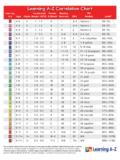
2 The following chart indicates Reading targets for each marking period. Reading Targets Text Level Chart: K 5 Grade level End of First Quarter End of Second Quarter End of Third Quarter End of Fourth Quarter Kindergarten Level 1-2 Level 2-3 Level 3-4 Level 4 -6 First Grade Level 5 7 Level 8 11 Level 12 15 Level 16 Second Grade Level J Level K Level L Level M Third Grade Level M Level N Level O Level P Fourth Grade Level Q R Level S T Fifth Grade Level T U Level V W Text levels Assigning levels to texts assists teachers in selecting books that match a reader s developing skills to the challenges in a text. Text levels indicate a progression from easiest to most challenging material that students can read and are not limited to a specific grade level. Text characteristics determine whether a text is easy or hard for a student to read. There is a degree of variation of challenges within each level.
3 The challenge of one book might be figurative language, while the challenge or complexity of another book at the same level might be sentence length, vocabulary, or advanced concepts. In MCPS, two leveling systems are used: Reading Recovery Text levels 1 16 Guided Reading (Fountas and Pinnell) Text levels J Z The shaded areas on the graph indicate the expected Reading ranges by book level at the end of each marking period for Grades K 2. A dot indicates your child s Reading level at the end of a marking period. A dot within the gray area indicates that your child has met the quarterly Reading target. A dot below the gray area indicates that your child is approaching the quarterly Reading target. A dot above the gray area indicates that your child has exceeded the quarterly Reading target. If your child is Reading above a level P, a statement will appear below the graph indicating the Reading level.
4 Reporting Instructional Reading levels by Marking Period At the end of each marking period, the student s instructional Reading level is included on the report card. The instructional Reading level reported on a student s report card refers to the level of texts read daily in small group guided Reading instruction. A Reading instructional text level is determined by the student s accuracy (90% and above) and comprehension of literary and informational text. Reading Graph on Standards based Report Card Grades K 2 The following graph is included on the report card for Grades K 2 to give parents more information about their child s Reading level. Reading Chart on Standards based Report Card Grades 3 5 The following two tables are included on the report card for Grades 3 5 to give parents more information about their child s Reading level. Students Reading at levels X, Y, and Z are Reading above the end-of- year benchmark for Grade 5.
5 Reading MP1 MP2 MP3 MP4 Instructional Reading Level Office of Curriculum and Instructional Programs, 2013 2 End of year benchmark Kindergarten: Text Level 4 Literary Text Sample text from Little Chimp and Big Chimp by: Jenny Giles Beginning level texts can be previewed at the school. The Book The Student Is Learning simple three-and four-word sentences many familiar high-frequency words that are repeated throughout the book ( , us, up, little) some words with inflectional endings (-s, -ed, -ing) pictures that help tell the story read and write about 25 30 high frequency words ( , us, up, little) check accuracy of familiar words as he/she reads and makes corrections as needed use illustrations and/or photographs to support Understanding think about: Does the word make sense? and Does the word sound right? use beginning consonant sounds to read unknown words ask and answer questions about key details in text retell stories including key details read with appropriate accuracy, rate, and expression Office of Curriculum and Instructional Programs, 2013 3 End of year benchmark Kindergarten: Text Level 4 Informational Text Sample text from What is it Like Today?
6 By: Judy Nayer Beginning level texts can be previewed at the school. The Book The Student Is Learning information that is familiar to students simple three-and four-word sentences many familiar high-frequency words that are repeated throughout the book some words with inflectional endings (-s, -ed, -ing) pictures that help support the facts in informational text read and write about 25 30 high frequency words ( , is, up, little) check accuracy of familiar words as he/she reads and makes corrections as needed use illustrations and/or photographs to support Understanding think about: Does the word make sense? and Does the word sound right? use beginning consonant sounds to read unknown words ask and answer questions about key details in text retell facts that were learned, including key details read with appropriate accuracy, rate, and expression Office of Curriculum and Instructional Programs, 2013 4 Stretch Goal for the End of year Kindergarten: Text Level 6 Literary Text Sample text from Clever Fox by: Claire Llewellyn Beginning level texts can be previewed at the school.
7 The Book The Student Is Learning a variety of sentences with up to eight to ten words many familiar words that students need to read quickly words with basic phonetic patterns, such as beginning and ending consonant sounds, digraphs ( , ch, th), and short vowel sounds ( the a in the word cat) words with inflectional endings (-s, -ed, -ing) some compound words ( , playgroud) some irregular past tense verbs (ran, came) pictures that support a storyline with real problems and solutions in narrative text read and write 40 or more high frequency words ( , is, up, little) check accuracy of familiar words as he/she reads and makes corrections as needed read without pointing to words use illustrations and/or photographs to support Understanding use basic phonetic skills, such as beginning and ending consonant sounds, digraphs ( , ch, th), and short vowel sounds to read unfamiliar words think about, while Reading : Does the word make sense?
8 Does the word sound right? and Does the word look right? reread to self-correct errors use punctuation to read sentences smoothly and accurately ask and answer questions about key details in text retell familiar stories including key details read with appropriate accuracy, rate, and expression Office of Curriculum and Instructional Programs, 2013 5 Stretch Goal for the End of year Kindergarten: Text Level 6 Informational Text Sample text from How Machines Help by: John Sheridan Beginning level texts can be previewed at the school. The Book The Student Is Learning information that is familiar to students a variety of sentences with up to eight to ten words many familiar words that students need to read quickly words with basic phonetic patterns, such as beginning and ending consonant sounds, digraphs ( , ch, th), and short vowel sounds ( the a in the word cat) words with inflectional endings (-s, -ed, -ing) some compound words some irregular past tense verbs (ran, came).
9 Pictures or photographs of facts presented in the text additional text features, such as labels, bold print, headings, or table of contents read and write 40 or more high frequency words check accuracy of familiar words as he/she reads and makes corrections as needed read without pointing to words use illustrations and/or photographs to support Understanding use basic phonetic skills, beginning and ending consonant sounds, digraphs ( , ch, th), and short vowel sounds to read unfamiliar words think about, while Reading : Does the word make sense? Does the word sound right? and Does the word look right? reread to self-correct errors use punctuation to read sentences smoothly and accurately ask and answer questions about key details in text retell facts that were learned, including key details read with appropriate accuracy, rate, and expression Office of Curriculum and Instructional Programs, 2013 6 End of year benchmark Grade 1 Text Level 16 Literary Text Sample text from The Tale of the Turnip by.
10 Jenny Giles The Book The Student Is Learning simple sentences and compound sentences with details a wide range of high frequency words many multisyllable words, generally easy to take apart to decode many words with endings (-s, -ed, -ing), plurals, contractions, compound words, and possessives events that include details read texts independently make the transition from Reading aloud to silent Reading read a variety of materials and genres ask questions about key details to clarify meaning check accuracy of words as he/she reads and makes corrections as needed flexibly use a variety of strategies to independently read unknown words discuss what is stated directly and what is implied in text rely less on illustrations for meaning read with appropriate accuracy, rate, and expression Some examples of Level 16 books include: Angus and the Cat, Marjorie Flack Are You My Mother?