Transcription of UNDERSTANDING ISO CODES - Hy-Pro Filtration
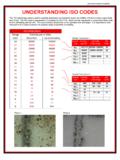
1 UNDERSTANDING ISO CODES . UNDERSTANDING ISO CODES - The ISO cleanliness code (per ISO4406-1999) is used to quantify particulate contamination levels per milliliter of fluid at 3 sizes 4m[c], 6m[c] and 14m[c]. The ISO code is expressed in 3 numbers (example: 19/17/14). Each number represents a contaminant level code for the correlating particle size. The code includes all particles of the specified size and larger. It is important to note that each time a code increases the quantity range of particles is doubling and inversely as a code decreases by one the contaminant level is cut in half. ISO 4406:1999 code Chart Particles Particle ISO 4406 ISO. Particles per Milliliter per Range Size code Range code Milliliter code More Than Up To/Including 4 m[c] 151773 80000~160000 24. 24 80000 160000. 23 40000 80000 m[c] 87210. 22 20000 40000 6 m[c] 38363 20000~40000 22. 21 10000 20000 10 m[c] 8229. 20 5000 10000 14 m[c] 3339 2500~5000 19.
2 19 2500 5000 21 m[c] 1048. 18 1300 2500 38 m[c] 112. 17 640 1300 68 m[c] 2. 16 320 640. Particles 15 160 320 Particle ISO 4406 code ISO. per Size Range code 14 80 160 Milliliter 13 40 80 4 m[c] 69 40~80 13. 12 20 40 m[c] 35. 11 10 20 6 m[c] 7 5~10 10. 10 5 10 10 m[c] 5. 9 5 14 m[c] ~ 6. 8 21 m[c] 7 38 m[c] 6 68 m[c] Succeed with a Total Systems cleanliness Approach Developing a Total System cleanliness approach to control contamination and care for fluids from arrival to disposal will ultimately result in more reliable plant operation and save money. Several steps to achieve Total Systems cleanliness include: evaluate and survey all hydraulic and lubrication systems, establish an oil analysis program and schedule, insist on specific fluid cleanliness levels for all new fluids, establish a baseline and target fluid cleanliness for each system, filter all new fluids upon arrival and during transfer, seal all reservoirs and bulk tanks, install high quality particulate and desiccant breathers, enhance air and liquid Filtration on existing systems wherever suitable, use portable or permanent off-line Filtration to enhance existing Filtration , improve bulk oil storage and handling during transfer, remove water and make a commitment to fluid cleanliness .
3 The visible cost of proper contamination control and total systems cleanliness is less than 3% of the total cost of contamination when not kept under control. Keep your head above the surface and avoid the resource draining costs associated with fluid contamination issues including: Downtime and lost production Root cause analysis meetings Component repair/replacement Maintenance labor costs Reduced useful fluid life Unreliable machine performance Wasted materials and supplies ($) Wasted time and energy ($). TARGET ISO CODES . When setting target ISO fluid cleanliness CODES for hydraulic and lubrication systems it is important to keep in mind the objectives to be achieved. Maximizing equipment reliability and safety, minimizing repair and replacement costs, extending useful fluid life, satisfying warranty requirements, and minimizing production down-time are attainable goals. Once a target ISO cleanliness code is set following a progression of steps to achieve that target, monitor it, and maintain it will yield justifiable rewards for your efforts.
4 Make an impact on reliability by controlling contamination. Recommended* Target ISO cleanliness CODES and media selection for systems using Set the Target. petroleum based fluids per ISO4406:1999 for particle sizes 4 [c] / 6 [c] / 14 [c]. The first step in identifying Pressure Media Pressure Media Pressure Media a target ISO code for a < 138 bar x[c] = 1000 138-207 bar x[c] = 1000 > 207 bar x[c] = 1000. system is to identify the most 2000 - 3000. sensitive component on an Pumps < 2000 psi ( x = 200). psi ( x = 200) > 3000 psi ( x = 200). individual system, or the most Fixed Gear 20/18/15 22m [c]. (25m) 19/17/15 12m [c]. (12m) - - sensitive component supplied Fixed Piston 19/17/14 12m [c]. (12m) 18/16/13 12m [c]. (12m) 17/15/12 7m[c] (6m). by a central reservoir. If a Fixed Vane 20/18/15 22m[c] (25m) 19/17/14 12m[c] (12m) 18/16/13 12m[c] (12m). Variable Piston 18/16/13 7m[c] (6m) 17/15/13 7m[c] (6m) 16/14/12 5m[c] (3m).
5 Central reservoir supplies Variable Vane 18/16/13 7m[c] (6m) 17/15/12 5m[c] (3m) - - several systems the overall cleanliness must Valves be maintained, or the most Cartridge 18/16/13 12m[c] (12m) 17/15/12 7m[c] (6m) 17/15/12 7m[c] (6m). sensitive component must Check Valve 20/18/15 22m[c] (25m) 20/18/15 22m[c] (25m) 19/17/14 12m[c] (12m). be protected by Filtration Directional (solenoid) 20/18/15 22m[c] (25m) 19/17/14 12m[c] (12m) 18/16/13 12m[c] (12m). that cleans the fluid to the Flow Control 19/17/14 12m[c] (12m) 18/16/13 12m[c] (12m) 18/16/13 12m[c] (12m). target before reaching that Pressure Control (modulating) 19/17/14 12m[c] (12m) 18/16/13 12m[c] (12m) 17/15/12 7m[c] (6m). component. Proportional Cartridge Valve 17/15/12 7m[c] (6m) 17/15/12 7m[c] (6m) 16/14/11 5m[c] (3m). Proportional Directional 17/15/12 7m[c] (6m) 17/15/12 7m[c] (6m) 16/14/11 5m[c] (3m). Proportional Flow Control 17/15/12 7m[c] (6m) 17/15/12 7m[c] (6m) 16/14/11 5m[c] (3m).
6 Proportional Pressure Control 17/15/12 7m[c] (6m) 17/15/12 7m[c] (6m) 16/14/11 5m[c] (3m). Other Considerations. Servo Valve 16/14/11 7m[c] (6m) 16/14/11 5m[c] (3m) 15/13/10 5m[c] (3m). Table 1 recommends conservative target ISO Bearings cleanliness CODES based Ball Bearing 15/13/10 5m[c] (3m) - - - - on several component Gearbox (industrial) 17/16/13 12m[c] (12m) - - - - manufacturers guidelines and Journal Bearing (high speed) 17/15/12 7m[c] (6m) - - - - extensive field studies for Journal Bearing (low speed) 17/15/12 7m[c] (6m) - - - - standard industrial operating Roller Bearing 16/14/11 7m[c] (6m) - - - - conditions in systems using petroleum based fluids. If a Actuators non-petroleum based fluid is Cylinders 17/15/12 7m[c] (6m) 16/14/11 5m[c] (3m) 15/13/10 5m[c] (3m). used ( water glycol) the Vane Motors 20/18/15 22m[c] (25m) 19/17/14 12m[c] (12m) 18/16/13 12m[c] (12m). target ISO code should be Axial Piston Motors 19/17/14 12m[c] (12m) 18/16/13 12m[c] (12m) 17/15/12 7m[c] (6m).
7 Set one value lower for each Gear Motors 20/18/14 22m[c] (25m) 19/17/13 12m[c] (12m) 18/16/13 12m[c] (12m). size (4m[c]/6m[c]/14m[c]). If a Radial Piston Motors 20/18/15 22m[c] (25m) 19/17/14 12m[c] (12m) 18/16/13 12m[c] (12m). combination of the following conditions exists in the Test Stands, Hydrostatic system the target ISO code Test Stands 15/13/10 5m[c] (3m) 15/13/10 5m[c] (3m) 15/13/10 5m[c] (3m). should also be set one value Hydrostatic Transmissions 17/15/13 7m[c] (6m) 16/14/11 5m[c] (3m) 16/14/11 5m[c] (3m). lower: *Depending upon system volume and severity of operating conditions a combination of filters with varying degrees of Filtration efficiency might be required ( pressure, return, and off-line filters) to achieve and maintain the desired fluid cleanliness . Component is critical to safety or overall system Example ISO code Comments reliability. Operating Pressure 156 bar, 2200 psi Frequent cold start.
8 Most Sensitive Component Directional Solenoid 19/17/14 Recommended Baseline ISO code Excessive shock or Fluid Type Water Glycol 18/16/13 Adjust Down One Class vibration. Adjust Down One Class, Other severe operation Remote Location, Repair Operating Conditions 17/15/12 Combination of Critical Nature, Difficult, High Ingression Rate conditions. Severe Conditions GLASS UPGRADE. Hy-Pro G8 Dualglass Upgrade from Cellulose Media Glass media has superior fluid compatibility versus cellulose with hydraulic fluids, synthetics, solvents, and high water based fluids. Glass media also has a significant Filtration efficiency advantage over cellulose, and is classified as absolute where cellulose media efficiency is classified as 1. b10m(c)=2 50000. b10m(c)=2 _____. 25000. =2. nominal . Elements of different media with the same micron rating can have substantially different Filtration efficiency. Figure 1. provides a visual representation of the 50,000 particles per ml 25,000 particles per ml difference between absolute and nominal 10m or larger 10m or larger filter efficiency.
9 50000. _____. b10m(c)=1000 b10m(c)=1000 =1000. 50. The illustrated glass element would typically deliver an ISO Fluid cleanliness code of 18/15/8 to 15/13/9 or better depending upon the system conditions and ingression rate. The cellulose element would typically achieve a code no better than 22/20/17. 50,000 particles per ml 50 particles per ml 10m or larger 10m or larger Runaway contamination levels at 4 [c] and 6 [c] are very common when cellulose media is applied where a high population of fine particles exponentially generate more particles in a chain reaction of internally generated contaminate. Inorganic glass fibers are much more uniform in diameter and are smaller than cellulose fibers. Organic cellulose fibers can be unpredictable in size and effective useful life. Smaller fiber size means more fibers and more void volume space to capture and retain contaminate. Upgrading to Hy-Pro G8 Dualglass Glass media has much better dirt holding capacity than cellulose.
10 When upgrading to 2 Cellulose Media Dualglass Media an absolute efficiency glass media element 70. the system cleanliness must be stabilized. Pressure Drop ( P psi). 60. During this clean-up period the glass element halts the runaway contamination as the ISO 50. cleanliness CODES are brought into the target 40. cleanliness range. As the glass element removes years of accumulated fine particles 30. the element life might be temporarily short. 20. 10. Once the system is clean the glass element can last up to 4~5 times longer than the 0. cellulose element that was upgraded as Dirt Capacity (g). shown in figure 2. IMPROVE cleanliness . Cleaner Fluid, Longer Component & Fluid Life, More Uptime! Roller Contact Bearing Current Target Target Target Target ISO code ISO code ISO code ISO code ISO code Laboratory and field tests prove time and 2 x Life 3 x Life 4 x Life 5 x Life again that Hy-Pro filters consistently deliver 28/26/23 25/22/19 22/20/17 20/18/15 19/17/14 lower ISO fluid cleanliness CODES .