Transcription of Understanding the Offender Section Output
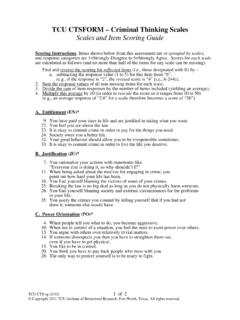
1 General Criminal thinking (GCT):This scale is an overall measure of criminal thinking and is the single best predictor of criminal thinking on the Offender ScalesProactive: Identifies individuals for whom crime is generally goal directed. Offenders who are proactive tend to expect positive things to come from their criminal behavior (money, status, power). Others may describe them as devious, callous, and :Identifies individuals for whom crime is generally more a reaction to a situation than planned behavior. They may view the world suspiciously and misinterpret others as hostile. Others may describe them as impulsive and emotional. thinking StylesMollification/Making Excuses: Individuals displaying this style lay blame for their behavior on external sources and use rationalizations and self-justification to avoid responsibility for their actions.
2 They may talk about inequity and unfairness of : Via cognitive restructuring, help them see that injustices do not excuse, justify, or attenuate their irresponsible or rule-breaking behavior. Encourage them to stop externalizing blame and start taking responsibility for their actions and decisions, including accepting responsibility for the negative consequences of their actions and Responsible Action: Individuals may use phrases such as screw it to eliminate anxiety, fear or other deterrents that may otherwise prevent antisocial or problematic : Via cognitive restructuring and strategies such as stop and think, help them develop such skills as patience, tolerance, and emotional Above the Law: Individuals believe that they are somehow personally exempt from the rules that govern everyone else. They may believe that they are owed whatever they want, and will mislabel wants as needs.
3 They then justify taking whatever steps are necessary to meet their needs. Intervention: Through cognitive restructuring, help distinguish between true needs versus wants. Develop a personal inventory of values and expectancies that can also point out discrepancies between values and behaviors. Understanding the Offender Section OutputUnderstanding the Offender Section OutputThinking styles Orientation/Asserting Power over Others: These individuals may have a simplistic view of the world as made up of strong and weak, with those who are weak being easy to intimidate or otherwise use for their benefit. These individuals try to control their surroundings by dominating activities and people, often as a way to counteract feelings of impotence or : Through cognitive restructuring and problem solving, focus on the development of personal control and self-discipline.
4 Sentimentality/Self-Serving Acts of Kindness: These individuals try to present themselves in as favorable a light as possible, often by expressing feelings and interests in a self-serving manner. They justify their behavior by pointing out their positive qualities or good things they have : Through cognitive restructuring, help them see that good deeds do not erase harmful actions. The officer may also need to raise awareness of how others have been hurt by their criminal actions, whether or not such harm was intended. Super Optimism/Getting Away With Anything: These individuals have unrealistic assessments of themselves and their chances of avoiding the consequences of their antisocial behavior. Unfortunately, the fact that many crimes or rule-breaking behavior may go undetected reinforces this : Through cognitive restructuring, point out the different ways the individual has been unable to escape the negative consequences of his or her behavior ( , jail, prison, probation, loss of family or job).
5 Cognitive Indolence/Lazy thinking : These individuals are generally lazy in both thought and behavior and will take the path of least resistance. They may also be easily bored, and may pursue excitement to compensate for a shallow and under-stimulating inner world. Intervention: Through cognitive restructuring and problem solving, develop and reinforce critical reasoning Sidetracked: These individuals fail to follow through on commitments and lose focus on goals they have set. They may be easily distracted and will quickly give up, often leaving tasks uncompleted. They have difficulty maintaining any commitment to : Discontinuity is the most difficult of the eight thinking styles to confront, because the individual is often oblivious to the inconsistency evident in his or her thinking . Besides giving regular feedback in situations where the client is being discontinuous, the officer can help combat this thinking style by training in goal-setting.
6