Transcription of Understanding the Youth Development Model (Fact Sheet)
1 MENTORING FACT Department of Education Offi ce of Safe and Drug-Free SchoolsMentoring Resource Center#13, January 2007A theoretical connection has always existed between mentoring and what s commonly known as Youth Development . Mentoring is frequently referred to as a Youth Development strategy one that uses posi-tive Youth -adult relationships to provide broad guid-ance and support rather than aiming to fi x a problem or teach a specifi c skill. Mentoring programs often include basic information about adolescent develop-ment during mentor training, encouraging mentors to be developmental rather than prescriptive in their work with young people.
2 But what exactly does it mean to use a developmental approach when serving young people? What specifi c skills do mentors and staff need? And what programmatic goals, activities, and environments are needed to fully implement a positive Youth Development Model ?Because Youth Development is the cornerstone of ef-fective mentoring, the three fact sheets in this series will provide a basic overview of Youth Development theory and practice and describe ways in which these practices can be more fully incorporated into mentor-ing programs. It is hoped that this information will help Offi ce of Safe and Drug-Free Schools (OSDFS) grant-ees enrich the mentoring experience for mentors and mentees and ultimately improve outcomes for is Youth Development ?
3 Youth Development in its broadest sense refers to the stages that all children go through to acquire the attitudes, competencies, values, and social skills they need to become successful adults. As children move through their developmental stages (see Erikson s Stages of Development on page 2), they acquire a set of personal assets, or supports, that help them face the challenges and opportunities ahead. These assets allow Youth to become resilient able to bounce back Understanding the Youth Development Modelfrom adversity. Their ability to develop successfully depends to a great extent on the support and assis-tance they receive from the people and institutions around them.
4 The Youth Development discussed here is an exten-sion of that asset/resiliency process. In this context, Youth Development is a discipline in the fi eld of Youth work, founded on the belief that young people are best able to move through their developmental stages when they are supported across all sectors of the community by individuals, family, schools, Youth agencies, faith organizations, community governance, business, and more. The Youth Development Model focuses on activities that nurture developmental as-sets rather than on reducing particular risks or pre-venting specifi c problems. Its ultimate goal is to help Youth become successful adults not just problem-free, but fully prepared to be responsible, contributing, and healthy : Resiliency research as the foundation for Youth developmentResearchers over the last 25 years have delved into the question of resiliency, examining why and how some children and Youth from challenging environ-ments and circumstances can survive and even thrive while others do not.
5 A number of landmark longitudinal studies on child Development , such as a classic study on the Development of poor children and families on Kauai, Hawaii, identifi ed internal and external factors that helped children overcome risks inherent in their lives (Werner and Smith, 1992). What the studies found was that at least 50 percent and often closer to 70 percent of Youth growing up in high-risk condi-tions developed social competence despite exposure to severe stress, and overcame the odds to lead suc-MENTORING FACT SHEETPage 2cessful lives. They also identifi ed specifi c protective factors, such as strong cognitive and social skills, high self-esteem, connection to family and community, and coping skills, which were believed to be instrumental in helping these children develop suc-cessfully (Benard, 1991).
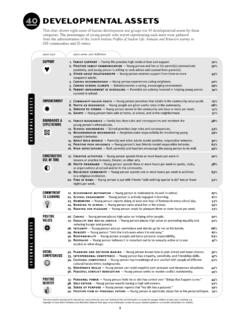
6 These research studies and their fi ndings, along with considerable studies of best practices and lessons learned in the prevention fi eld, have helped theoreti-cians and practitioners defi ne a set of developmental assets that are considered to be the building blocks of successful Youth Development . Probably the best-known work on these assets is the Search Institute s framework of 40 Developmental Assets, an exten-sive list of personal and social assets based on the Institute s research involving over 100,000 children in grades 6 through 12. Over the years, Youth workers have used this re-search into resiliency and assets to develop a com-prehensive set of strategies designed to help young people achieve their developmental goals.
7 It rejects problem-centered interventions and also goes beyond prevention-focused models that are generally based on preventing specifi c behaviors or risks, such as teen pregnancy or delinquency. Youth Development practi-tioners help Youth successfully navigate the develop-mental stages they must all go through, allowing them to develop a rich set of assets that will help them cope with risk, overcome personal and external challenges, and become well-adjusted adults. This approach can require a signifi cant shift in thinking for Youth workers and programs used to dealing with problem solving, risk reduction, delinquency prevention, and other forms of behavior-focused interventions.
8 The basics of the Youth Development approach: The Five Cs and SOSA variety of models has been developed to help practitioners implement Youth Development in their organizations, most of which have similar principles, goals, and strategies. Because Youth Development has the rather broad goal of helping Youth make the transition to healthy adulthood, there is quite a range of what success looks like. Most Youth workers and educators consider economic independence, intellec-tual and social competence, personal satisfaction, and physical and psychological well-being to be signifi cant measures. There is widespread agreement on fi ve key outcomes for Youth that are vital for their transition to adulthood.
9 These are known as the Five Cs :1. Competence: Positive view of one s actions in specifi c areas, including social, academic, cognitive, and vocational. 2. Confi dence: The internal sense of overall positive self-worth and self-effi cacy; positive identity; and belief in the s Stages of DevelopmentPsychologist Eric Erikson (1902 1994) is perhaps the best known theorist in the fi eld of human Development . He proposed a Model of eight stages of Development that all children go through as they move from infant to adult, and built on that theoretical framework to identify critical assets that must be mastered in order for the child to reach successful adulthood.
10 The stages are: Trust, which he linked to positive emotional relationships with caring adults A strong sense of self-suffi ciency Ability to exercise initiative Confi dence in one s ability to master skills and navigate one s world A well-formed sense of personal identity A desire to be productive and contributing for future generations The ability to experience true intimacy A strong sense of personal integrityThe work of Erikson and other human Development theorists has provided important foundations to the positive Youth Development approach to working with young Development Institute: http://www FACT SHEETPage 33. Connection: Positive bonds with people and institutions peers, family, school, and community in which both parties contribute to the Character: Respect for societal and cultural rules, possession of standards for correct behaviors, a sense of right and wrong (morality), spirituality, Caring or Compassion: A sense of sympathy and empathy for others.