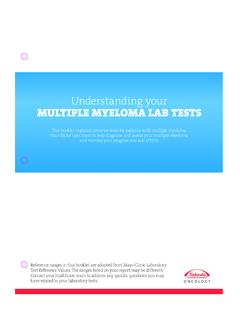
Transcription of Understanding Your Multiple Myeloma Lab Tests
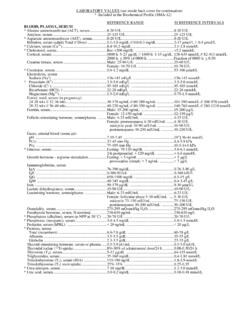
1 This lab tracker booklet explains common Tests for patients with Multiple Myeloma . If you have any questions about your test results, discuss them with your healthcare YOUR Multiple Myeloma LAB Tests 2 Reference rangesMark the test values in the column below each dateCOMPLETE BLOOD COUNT (CBC)1,2 Pages 4-5 White blood cells (WBCs) 2 109/L 2 109/L Red blood cells (RBCs)Males: 2 1012/LFemales: 2 1012/L HematocritMales: : Hemoglobin (Hgb)Males: g/dLFemales: g/dL Platelets150-450 2 109/LCHEMISTRY PROFILE3 8 Pages 6-8 Blood urea nitrogen (BUN), serum7-20 mg/dL Creatinine, serumMales: mg/dLFemales: mg/dL Calcium, total, mg/dL Glucose, serum (fasting) 126 mg/dL Protein, total, g/dL Beta2-microglobulin (B2M), mcg/mLSERUM PROTEIN ELECTROPHORESIS (SPEP)9 Pages 8-9 M spike ( Myeloma gamma globulin)Any M spike presence may be abnormalThis worksheet can serve as a personal record of your lab test results.
2 Reference ranges values that are considered normal in healthy individuals are provided below as guides. Note that ranges vary among laboratories. Unit measures: dL=A deciliter is equal to one tenth of a liter; g=A gram is a unit of measurement of mass, or the total amount of matter in an object; L=A liter is a unit of measurement of volume. Volume is a measurement of the total space occupied by a substance, mainly liquids; mcg=A microgram is equal to one millionth of a gram. May also be expressed as g; mg=A milligram is equal to one thousandth of a of laboratory testLAB TEST TRACKER3 Reference rangesMark the test values in the column below each dateSERUM QUANTITATIVE IMMUNOGLOBULINS (Igs)10-12 Pages 9-10 IgG767-1590 mg/dL IgA61-356 mg/dL IgM37-286 mg/dL IgD 10 mg/dL IgE 214 kU/LSERUM IMMUNOFIXATION (IFE)
3 13 Page 11 IFEN/ASERUM FREE LIGHT CHAIN ASSAY14 Pages 11-12 Kappa free light mg/dL Lambda free light mg/dL Kappa/lambda free light chain URINE ANALYSIS4,15 17 Pages 13-14 24-hour urine total protein<229 mg/24 hours M spike, urine 500 mg/24 hours for asymptomatic patients Urine immunofixationN/A Creatinine clearanceMales: 77-160 mL/min/BSAF emales: 56-131 mL/min/BSAN/A=not laboratory performing the test should provide you with the reference range associated with the test results. To learn more about each test, refer to the sections inside this booklet.
4 If you have any questions about your test results, discuss them with your healthcare of laboratory test4 White blood cells (WBCs)1,21 Normal range: 109/LWBCs help fight infections. A low WBC countreduces your body s ability to fight ,21,22 Normal range: @ 109/L Neutrophils are a type of WBC responsible for much of the body s protection against infection. Neutrophils are produced in the bone marrow and released into the bloodstream to travel to wherever they are needed. Since a reduction in neutrophils increases the risk for infection, a neutrophil count must be closely monitored throughout blood count (CBC)18 20A CBC measures the number of red blood cells, white blood cells, and platelets in the blood.
5 Your body produces blood cells in the bone marrow. The overgrowth of Myeloma plasma cells in the bone marrow can crowd out normal cells, leading to low blood counts. Blood cell counts are carefully monitored to track disease and treatment VESSELPL ATE LETSRED BLOOD CELLSWHITE BLOOD CELLSGLOSSARYThis section provides explanations to help you understand the lab Tests listed in this lab tracker booklet. It also explains what the lab values tell about the progress of the disease, effect of treatment, and indications of possible side blood cells (RBCs)1 RBCs carry oxygen to body tissues.
6 How muchoxygen your body tissues get depends on howmany RBCs you have and how well they work. The RBC count, hematocrit, and hemoglobin are all Tests to measure the amount of RBCs in your count1 Normal range: male: 1012/L; female: 1012/L A low RBC count, also called anemia, can make you have shortness of breath and feel tired. Hematocrit1 Normal range: male: ; female: of RBCs to the fluid (or plasma) in your (Hgb)1,23 Normal range: male: g/dL; female: g/dL Hemoglobin is a protein in RBCs that carries oxygen in the blood to all parts of your ,20 Normal range: 150-450 109/L Platelets help your blood to clot.
7 PL ATE LETSPLATELETS FORM CLOTS TO STOP BLEEDING6 Blood urea nitrogen (BUN) serum3,24 Normal range: 7-20 mg/dL BUN is a measure of the level of urea in your blood. BUN levels must be carefully monitored in Multiple Myeloma . Elevated BUN levels may be a sign of kidney , serum4,25 Normal range: male: mg/dL; female: mg/dL Creatinine is a waste product of creatine a chemical made by the body to supply energy mainly to muscles. If kidney function is not normal, creatinine levels may be increased in your profile18A blood chemistry profile measures the level of different substances in your blood.
8 Blood chemistry levels provide insight to the function of different organs (kidney, liver, etc) that Multiple Myeloma and chemotherapy may BLOOD SAMPLE IS TAKEN FOR A BLOOD CHEMISTRY PROFILEA BLOOD SAMPLE IS TAKEN7 Calcium, total, serum5,26 Normal range: mg/dLAll cells need calcium in order to work. Elevated levels of calcium may be an indicator of bone damage due to Multiple , serum6,27 Normal range: 126 mg/dL when fasting Blood sugar, or glucose, is the main sugar found in your blood. Your blood carries glucose to all of your body s cells to use for , total, serum7, 2 8 Normal range: g/dL The level of protein in the blood is measured by a total serum protein test.
9 If the test results show abnormal protein levels, then Multiple Myeloma , kidney, liver, blood, and other autoimmune diseases may be protein electrophoresis (SPEP)9,19,29,30 Antibodies are part of the immune system, which helps your body fight infection. They are produced by normal plasma cells. Myeloma is a cancer of the plasma cells in the bone marrow. In Multiple Myeloma , one plasma cell goes bad and makes Multiple copies of itself (clones). Each copy makes the same antibody protein or M spike. SPEP is used to separate and identify the presence and levels of M protein in the blood.
10 Each type of plasma cell produces only 1 type of (B2M), serum8 Normal range: mcg/mLB2M is a protein produced by malignant cells. It can be a useful indicator of a patient s prognosis (outlook). High levels mean the disease is more advanced and may indicate a poor spike ( Myeloma gamma globulin)9,16,30 The presence of any M spike is abnormal and shows the presence of an abnormal clone of plasma cells. If the amount of protein is 30 g/L and/or there are other disease symptoms, the patient may have Myeloma . 1 2 ALBUMINM SPIKENORMALM U LTIPLE MYELOMA9 IgG10,31 Normal range: 767-1590 mg/dL IgG antibodies are widespread in the body.