Transcription of UNI-BELL PVC PIPE ASSOCIATION
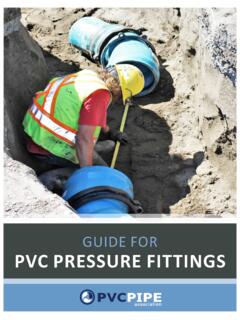
1 UNI-BELL PVC pipe ASSOCIATION UNI-B-15-10 RECOMMENDED STANDARD SPECIFICATION FOR POLYVINYL CHLORIDE (PVC) FABRICATED PRESSURE FITTINGS November 2010 UNI-BELL PVC pipe ASSOCIATION 2711 LBJ Freeway, Suite 1000 Dallas, Texas 75234 972-243-3907 UNI-BELL PVC pipe ASSOCIATION UNI-B-15-10 RECOMMENDED STANDARD SPECIFICATION FOR POLYVINYL CHLORIDE (PVC) FABRICATED PRESSURE FITTINGS November 2010 UNI-BELL PVC pipe ASSOCIATION 2711 LBJ Freeway, Suite 1000 Dallas, Texas 75234 972-243-3907 UNI-B -15-10 Recommended Standard Specification for Polyvinyl Chloride (PVC) Fabricated Pressure Fittings Section 1, Scope This recommended product specification pertains to fabricated PVC pressure fittings made from AWWA C900 or AWWA C905 pipe .
2 The fittings shall be compatible with ductile-iron equivalent size PVC pipe . Section 2, Referenced Standards AWWA C900, Polyvinyl Chloride (PVC) Pressure pipe and Fabricated Fittings, 4-Inch through 12-Inch (100mm through 300mm), For Water Transmission and Distribution AWWA C905, Polyvinyl Chloride (PVC) Pressure pipe and Fabricated Fittings, 14-Inch through 48-Inch (350mm through 1,200mm), For Water Transmission and Distribution ASTM D1598, Standard Test Method for Time-to-Failure of Plastic pipe Under Constant Internal Pressure ASTM D1784, Standard Specification for Rigid Poly(Vinyl Chloride) (PVC)
3 Compounds and Chlorinated Poly(Vinyl Chloride) (CPVC) Compounds ASTM D2241, Standard Specification for Poly(Vinyl Chloride) (PVC) Pressure-Rated pipe (SDR Series) ASTM D2564, Standard Specification for Solvent Cements for Poly (Vinyl Chloride) (PVC) Plastic Piping Systems ASTM D2837, Standard Test Method for Obtaining Hydrostatic Design Basis for Thermoplastic pipe Materials ASTM D2855, Standard Practice for Making Solvent-Cemented Joints with Poly (Vinyl Chloride) (PVC) pipe and Fittings ASTM D3139, Standard Specification for Joints for Plastic Pressure Pipes Using Flexible Elastomeric Seals ASTM F477, Standard Specification for Elastomeric Seals (Gaskets) for Joining Plastic pipe Section 3, Definitions The following definitions shall apply in this recommended standard specification: 1.
4 Constructor: The party that provides the work and materials for placement or installation. 2. Dimension Ratio (DR): The ratio of a pipe s specified average outside diameter to its specified minimum wall thickness. 3. Fabricated Fittings: Fabricated fittings comprise single segments or multiple segments of PVC pipe joined under factory-controlled conditions to form an essentially homogeneous structure. Reinforcement may be applied and permanently bonded to the outside surfaces of the fitting. The different types of fittings are as follows: a. Tees have an outstanding leg that is 90 from the running leg.
5 B. Crosses have two outstanding legs that are opposite each other. c. Bends may be the standard angles ( , , 45 and 90 ) or any custom-built angle. d. Couplings are used to join two similar-diameter pipes. e. Reducers are used to abruptly join two different pipe diameters. f. Adapters are used to join two different pipe diameters when the difference in nominal pipe diameter is one-inch or less. Note: At least one end of the adapter must be compatible with ductile-iron equivalent size PVC pipe g. Tapers are used to reduce hydraulic losses when joining two different pipe diameters.
6 4. Hydrostatic Design Basis: The categorized long-term strength in the circumferential or hoop direction as established from long-term pressure tests in accordance with ASTM D2837. 5. Inspector: The authorized representative of the purchaser who is entrusted with the inspection of products and production records. The inspector may also observe the production operations and quality-control tests to ensure that products comply with the requirements of this recommended standard specification and the purchaser. 6. Manufacturer: The party that manufactures, fabricates, or produces materials or products.
7 7. Purchaser: The person, company, or organization that purchases any materials or work to be performed. Section 4, Materials Fabricated fittings. PVC fabricated fittings shall be made from pipe that was made from PVC resin that has been compounded to provide physical and chemical properties that equal or exceed cell class 12454 as defined in ASTM D1784. Fittings shall be fabricated from pipe materials that qualify for a minimum hydrostatic design basis (HDB) of 4,000 psi in accordance with PPI TR-3. Fittings shall be made only from PVC pipe that meets or exceeds AWWA C900 or AWWA C905 Elastomeric Gaskets: One gasket shall be furnished with each bell of every fitting.
8 Elastomeric gaskets shall meet the requirements of ASTM F477 for high-head (50 feet of head or higher) applications. Fabricated fitting overwrap reinforcement: Optional reinforcement, either PVC or non-PVC, may be applied by the manufacturer to meet the requirements of this recommended standard specification. Resin. Resin used shall be a commercial grade of unsaturated polyester resin or epoxy resin. Glass. Glass reinforcing materials shall be commercial E type glass in the form of mat, continuous roving or roving fabric, or a combination of these, having a coupling agent that bonds the glass reinforcement and the resin.
9 Gaskets and Lubricant: Only gaskets and lubricants that are compatible with PVC shall be used. The gaskets and lubricants shall be compatible with one another when used together. Section 5, Fabricated Fitting Requirements Workmanship: The component pipe segments and the bonds between them shall be free from voids, cracks, inclusions, and other defects which prevent the fitting from meeting the performance requirements of this recommended standard specification. The joining surfaces of spigots and bells shall be free from imperfections that could cause leaks.
10 When component segments are joined using solvent cement, the procedure shall conform with the standard practice for making pressure joints outlined in ASTM D2855. Dimensions: Fitting barrel. Edge-joined segments of fabricated fittings shall have the same dimension ratio. Standard configurations. Standard configurations shall include customary angles for branch connections or bends. Non-standard angles of branch connections or bends may be specified. Leg lengths shall be the minimum practical for the method of fabrication, unless otherwise specified.