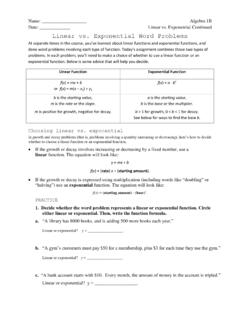
Transcription of UNIT 6 EXPONENTIAL FUNCTIONS Linear vs. Exponential …
1 UNIT 6 EXPONENTIAL FUNCTIONS . Linear vs. EXPONENTIAL FUNCTIONS (Day 1). Complete these tables below, graph each set of points. 1. Key Components x f(x). 0 -5. 1 2. 2 9. 3 16. 4 23. 5. Key Components 2. x f(x). 0 1. 1 2. 2 4. 3 8. 4. 1. Table Pattern shows _____ or _____ by same number: Linear This is pattern is called a _____ _____. FUNCTIONS Rate of Change is _____ between intervals Table Pattern shows _____ or _____ by same number: EXPONENTIAL This is pattern is called a _____ _____. FUNCTIONS Rate of Change is _____ between intervals 3. Use the function g(x) = 2x 3 to fill in the table below and graph. x g(x) a) What type of function is this and why? -3. -2. -1 b) What is the domain? 0. c) What is the range? 1. 2. d) What is the rate of change? 3. 1. 4. Use the function g(x) = ( )x to fill in the table below and graph.
2 2. a) What type of function is this x g(x). and why? -3. -2. -1 b) What is the domain? 0. 1 c) What is the range? 2. 3. d) What is the rate of change? 2. IDENTIFYING TYPES OF FUNCTIONS (DAY 2). Recall Types of FUNCTIONS and their key components: _____ FUNCTIONS have a common _____. With a _____ rate of change _____ FUNCTIONS have a common _____. With a _____ rate of change 1. After graduation, you are offered two jobs. Cedar Grove Associates offered to start you at $30,000 with a 6% increase per year. Maple Grove Associates offered to start you at $40,000 with a $1200 raise per year. Compare the two jobs offered by completing the table below. Answer the following questions? a) Cedar Grove models what type of Year Cedar Grove Maple Grove function? Explain 1 $30,000 $40,000. It has a common_____ of _____.
3 2. b) Maple Grove models what type of 3 function? Explain 4. 5 It has a common_____ of _____. 6 c) If you plan on moving to a different state in 5 years which company would 7 be the better option for you to choose? Explain. 8. 9. 10. 11 d) If your plans change and you don't move, which company would be the 12 better option to choose as a long term career? Explain 13. 14. 3. 2. Given the situations below, identify if it is a Linear or EXPONENTIAL model or neither. Explain your reasoning. a. A savings account that starts with $5000 and receives a deposit of $825 per month. b. The value of a house that starts at $150,000 and increases by per year. c. Tina owns 4 rabbits. She expects them to double each year. d. The cost of operating Jelly's Doughnuts is $1600 per week plus $.10 to make each doughnut.
4 E. The value of John's car that depreciates 20% per year f. The height of a ball that is thrown in the air 3. Which situation could be modeled with an EXPONENTIAL function? (1) the amount of money in Suzy's piggy bank which she adds $10 to each week (2) the amount of money in a certificate of deposit that gets 4% interest each year (3) the amount of money in a savings account where $150 is deducted every month (4) the amount of money in Jaclyn's wallet which increases and decreases by a different amount each week 4. Which statement below is true about Linear FUNCTIONS ? (1) Linear FUNCTIONS grow by equal factors over equal intervals (2) Linear FUNCTIONS grow by equal differences over equal intervals (3) Linear FUNCTIONS grown by equal differences over unequal intervals (4) Linear FUNCTIONS grow by unequal factors over equal intervals 5.
5 Given the tables below, classify them as a Linear model, EXPONENTIAL model, or neither. HOURS MONEY HOURS MONEY HOURS MONEY. 1 100 1 100 1 100. 2 200 2 200 2 250. 3 400 3 300 3 400. 4 800 4 200 4 550. 5 1600 5 100 5 700. 4. EXPLORING EXPONENTIAL FUNCTION. GROWTH & DECAY (DAY 3). Linear FUNCTIONS EXPONENTIAL FUNCTIONS General Equation Function Notation General Equation Function Notation y ax b f(x) ax b y ab x f(x) ab x (recall: variable is the exponent for an EXPONENTIAL function). a= a=. b= b=. x=. EXPONENTIAL Function are able to have both a_____ or _____ rate of change Positive Rate of Change is called an _____ _____. To Get b# : _____. Negative Rate of Change is called an _____ _____. To Get b# : _____. Graphs: This is a graph of a This is a graph of an _____ line EXPONENTIAL _____.
6 _____ from left to right _____ from left to right This is a graph of a _____ line This is a graph of an EXPONENTIAL _____. _____ from left to right _____ from left to right 5. 1. Identify the following equation as either Linear or EXPONENTIAL . a) f(x) = 3x + 2 b) 2y = -5x + 1 c) y = 7 d) C(x) = 16, 332( )x For questions #2 5: a. State whether the function is a growth or decay. b. State the initial value. 2. c(t) = 100(.75)t 3. p(n) = 40( )n 4. t(x) = 10,000( )x 5. f(n) = 50(.1)n Steps for writing and solving FUNCTIONS : Identify the type of function ( Linear : y ax b or EXPONENTIAL : y ab x ). If EXPONENTIAL : o Determine a# - initial amount (start #). o Determine b#: EXPONENTIAL Growth: 1+rate (%). EXPONENTIAL Decay: 1 rate (%). 6. A tennis tournament has 128 competitors. Half of the competitors are eliminated each round.
7 Write a function to represent the number of competitors that will be left after x rounds. Then determine how many players will be left after 5 rounds. 7. A three-bedroom house in Burbville was purchased for $190,000. If housing prices are expected to increase by annually in that town, write a function that models the price of the house in years. Find the price of the house in 6 years. 8. Jonathan makes a weekly allowance of $25. He also makes $ an hour at his job. Write a function for the amount of money he makes each week based on the amount of hours, h, he works. How much will he make if he works 25 hours? 6. EXPONENTIAL APPLICATION WORD PROBLEMS (DAY 4). 1. In 1995, there were 85 rabbits in Central Park. The population increased by 12% each year. How many rabbits were in Central Park in 2005?
8 2. There are 500 rabbits in Lancaster on February 1st. If the amount of rabbits triples every month, write a function that represents the number of rabbits in Lancaster after m . months. How many rabbits are there in Lancaster on August 1st? 3. The value of an early American coin increases in value at the rate of annually. If the purchase price of the coin this year is $1,950, what is the value to the nearest dollar in 15 years? 4. In 1985, there were 285 cell phone subscribers in the small town of Centerville. The number of subscribers increased by 75% per year after 1985. How many cell phone subscribers were in Centerville in 1994? 5. The cost of Bob's house in 2005 was $220,000. If his house appreciates in value at a rate of every year, what will the price of his house be in 2015? 6.
9 Kelli's mom takes a 400 mg dose of aspirin. Each hour, the amount of aspirin in a person's system decreases by about 29%. To the nearest tenth of a milligram, how much aspirin is left in her system after 6 hours? 7. 7. Ryan bought a new computer for $2,100. The value of the computer decreases by 50% each year. After what year will the value drop below $300? 8. Malik bought a new car for $15,000. His best friend, Will, told him that the car's value will drop by 15% every year. What will the car's value be after 5 years, according to Will? 9. In the 2000-2001 school year, the average cost for one year at a four-year college was$16, 332, which was an increase of from the previous year. If this trend were to continue, the equation C(x) = 16, 332( )x could be used to model the cost, C(x), of a college education x years from 2000.
10 A) Find C(4). What does this number represent? b) If this trend continues, how much would parents expect to pay for their new born baby's first year of college? (Assume the child would enter college in 18 years.). 10. In 1993, the population of New Zealand was 3,424,000, with an average annual growth rate of Suppose that this growth rate were to continue. a) Express the population P as a function of n, the number of years after 1993. b) Estimate New Zealand's population in the year 2010. 8. SIMPLE INTEREST AND COMPOUND INTEREST (DAY 5). In some cases, banks pay you money and in other cases, you have to pay the bank. What are these cases? In history, banks calculated interest at the end of each year on the original amount either borrowed or invested (the principal). This type of interest was called simple interest.