Transcription of Universal Design for Learning: Recommendations …
1 Innovation Configuration Universal Design for learning : Recommendations for Teacher Preparation and Professional Development Maya Israel University of Illinois, Urbana-Champaign Cecelia Ribuffo University of Florida Sean Smith University of Kansas July 2014 CEEDAR Document No. IC-7 Page 2 of 38 Disclaimer: This content was produced under Department of Education, Office of Special Education Programs, Award No. H325A120003. Bonnie Jones and David Guardino serve as the project officers. The views expressed herein do not necessarily represent the positions or polices of the Department of Education. No official endorsement by the Department of Education of any product, commodity, service, or enterprise mentioned in this website is intended or should be inferred. Recommended Citation: Israel, M., Ribuffo, C., & Smith, S. (2014). Universal Design for learning : Recommendations for teacher preparation and professional development (Document No.)
2 IC-7). Retrieved from University of Florida, Collaboration for Effective Educator, Development, Accountability, and Reform Center website: Note: There are no copyright restrictions on this document; however, please use the proper citation above. Page 3 of 38 Table of Contents List of Figures .. 4 Innovation Configuration for Universal Design for learning .. 5 Basic Principles of Universal Design for learning .. 7 Importance of Planning From a Universal Design for learning Framework for Instruction and Assessment for Students With Diverse Needs: Historical, Legal, and Policy Foundations of Universal Design for learning .. 10 Components of the Innovation Configuration .. 11 General Understanding of How to Use the Universal Design for learning Framework for Planning Instruction for Diverse Learners .. 12 Planning Instruction Using the Universal Design for learning Framework .. 20 Conclusion.
3 28 References .. 30 Appendix: Innovation Configuration for Universal Design for learning .. 36 Page 4 of 38 List of Figures Figure 1. Universal Design for learning principles and checkpoints.. 9 Page 5 of 38 Innovation Configuration for Universal Design for learning This paper features an innovation configuration (IC) matrix that can guide teacher preparation professionals in the development of appropriate Universal Design for learning (UDL) content. This matrix appears in the Appendix. An IC is a tool that identifies and describes the major components of a practice or innovation. With the implementation of any innovation comes a continuum of configurations of implementation from non-use to the ideal. ICs are organized around two dimensions: essential components and degree of implementation (G. E. Hall & Hord, 1987; Roy & Hord, 2004). Essential components of the IC along with descriptors and examples to guide application of the criteria to course work, standards, and classroom practices are listed in the rows of the far left column of the matrix.
4 Several levels of implementation are defined in the top row of the matrix. For example, no mention of the essential component is the lowest level of implementation and would receive a score of zero. Increasing levels of implementation receive progressively higher scores. ICs have been used in the development and implementation of educational innovations for at least 30 years (G. E. Hall & Hord, 2001; G. E. Hall, Loucks, Rutherford, & Newton, 1975; Hord, Rutherford, Huling-Austin, & Hall, 1987; Roy & Hord, 2004). Experts studying educational change in a national research center originally developed these tools, which are used for professional development (PD) in the Concerns-Based Adoption Model (CBAM). The tools have also been used for program evaluation (G. E. Hall & Hord, 2001; Roy & Hord, 2004). Use of this tool to evaluate course syllabi can help teacher preparation leaders ensure that they emphasize proactive, preventative approaches instead of exclusive reliance on behavior reduction strategies.
5 The IC included in the Appendix of this paper is designed for teacher preparation programs, although it can be modified as an observation tool for PD purposes. The Collaboration for Effective Educator, Development, Accountability, and Reform (CEEDAR) Center ICs are extensions of the seven ICs originally created by the National Comprehensive Center for Teacher Quality (NCCTQ). NCCTQ professionals wrote the above description. Page 6 of 38 UDL is an instructional planning and delivery framework intended to increase meaningful access and reduce barriers to learning for students with diverse learning needs, including, but not limited to, students with disabilities, English language learners, and those from diverse cultural and socioeconomic backgrounds. Educational researchers, policymakers, and practitioners have embraced this instructional framework for meeting the needs of an increasingly diverse student population.
6 The purpose of this IC was to provide Recommendations for embedding UDL in general and special education pre-service teacher preparation programs and including this content in PD for in-service teachers. It is important to note that when we describe UDL, we are not doing so for a specific population of learners; rather, the point of UDL is to meet the needs of the widest range of learners while acknowledging that there will always be students who require individualization related to areas such as explicit strategy instruction, assistive technology (AT), and modifications to the curriculum. However, when teachers use the UDL framework to proactively plan for student diversity, the need for individualization decreases. This IC configuration broadly focuses on UDL implementation and practical Recommendations rather than on the evidence-based practices (EBPs) because UDL should be considered a framework in which EBPs are embedded.
7 When teachers implement instruction using the UDL framework, they make choices regarding how to deliver EBPs within their instruction in a manner consistent with UDL. Consequently, UDL looks different in different settings and results in different implementation models. However, the UDL principles, guidelines, and checkpoints include a wealth of research available through the National Center on Universal Design for learning (2012) website ( ). This website provides citations directly tied Page 7 of 38 to each of the UDL-related principles, guidelines, and checkpoints that we have addressed in this IC. Basic Principles of Universal Design for learning The basis of UDL lies in the conviction that teachers and curriculum developers should identify and ameliorate students learning barriers through effective instructional planning focused on engagement, flexible use of materials, and meaningfully accessible instruction.
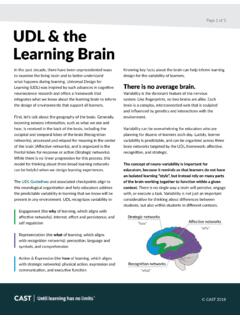
8 UDL is based on foundational research within the neurosciences, developmental psychology, and learning differences (Rose & Gravel, 2010). This research has suggested that to accomplish effective instructional planning, teachers should consider how to integrate three principles into their instruction and assessment practices that are based on three interrelated types of brain networks ( , recognition, strategic, and affective networks). Considering teaching and learning through these three brain networks provides a framework for planning instruction for diverse learners (T. E. Hall, Meyer, & Rose, 2012). The UDL framework is based on the following three principles: Multiple means of representation to support the ways in which we assign meaning to what we see and recognize ( , what we learn): Providing content through multiple channels such as discussion, readings, digital texts, and multimedia presentations.
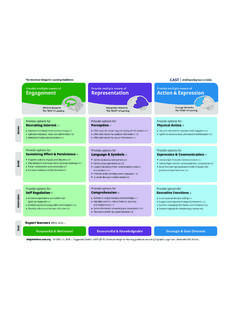
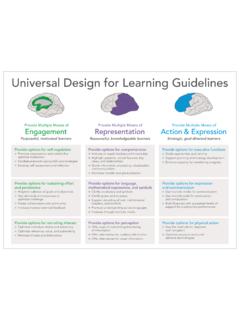
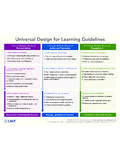
9 Multiple means of action and expression to support strategic ways of learning ( , how we learn): Providing opportunities for students to demonstrate their understanding in multiple ways such as through traditional tests or papers as well as through art, multimedia presentations, and digital recordings. Page 8 of 38 Multiple means of engagement to support affective learning ( , why we learn): Considering how to engage students in learning through activities such as collaborative learning , instructional games and simulations, and real and virtual tours. These three principles expand into more detailed guidelines and checkpoints that teacher educators and PD providers should explicitly introduce, explain, and practice within teacher preparation programs and PD so that new and continuing general and special education teachers can effectively integrate them into their teaching practices (see Figure 1; CAST, 2011).
10 Page 9 of 38 Figure 1. Universal Design for learning principles and checkpoints. Page 10 of 38 Although UDL was conceptualized in special education, the focus is on use in general education classrooms (Edyburn, 2013); therefore, it is critical for both general and special education teachers to have strong foundations in UDL. Thus, in this IC, we have provided a road map for integrating the three principles, guidelines, and accompanying checkpoints into teacher preparation programs and PD to equip all teachers to work with diverse learners. Importance of Planning From a Universal Design for learning Framework for Instruction and Assessment for Students With Diverse Needs: Historical, Legal, and Policy Foundations of Universal Design for learning It is important to consider the foundational elements of UDL, including policy and legislative components. Ron Mace, an architect and disability rights advocate, coined the term Universal Design in 1988 (Courey, Tappe, Siker, & LePage, 2012).