Transcription of Universal Waste - michigan.gov
1 michigan DEPARTMENT OF ENVIRONMENTAL QUALITY Waste AND hazardous MATERIALS DIVISION Jennifer M. Granholm, Governor Steven E. Chester, Director PO BOX 30241 LANSING MI 48909 517-335-2690 Environmental Assistance Center 800-662-9278 Universal Waste 1. What can be handled as Universal Waste ? All facilities, including manufacturing industries, businesses, agencies, health care providers, and other Waste generators, are required to determine if they generate hazardous Waste (see the Waste Characterization guidance). If michigan facilities determine they have hazardous Waste , they may choose to handle the following as Universal Waste : 9 Antifreeze, meaning a mixture containing ethylene glycol or propylene glycol used as a heat transfer or dehydration fluid Batteries, including spent dry cell and lead-acid batteries.
2 Consumer electronics which are devices run by electricity containing circuit boards commonly found in offices and homes such as computers, fax machines, telephones, televisions, and printers (note CRTs may alternatively be managed as electric lamps). Electric lamps, including fluorescent, high intensity discharge, sodium vapor, mercury vapor, neon, and incandescent lamps, and cathode ray tubes (CRTs) from computers and televisions (note CRTs may alternatively be managed as consumer electronics). Devices containing elemental mercury, including thermostats, switches, thermometers, manometers, barometers, anti-locking braking systems (ABS), gas flow regulators, hydrometers, blood pressure cuffs and various medical devices, etc. Pesticides, including certain suspended, canceled, or unused pesticides.
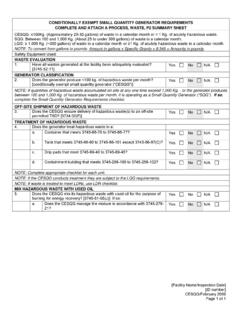
3 Pharmaceuticals, including drugs for both human and veterinary use. hazardous Waste Generator Status Categories In ONE month, the total amount of ALL nonacute hazardous Waste is generated and accumulated at the following volumes: Universal Waste has alternative management requirements identified in R in place of the hazardous Waste requirements. michigan includes additional types of Universal wastes than what is included in the federal Universal Waste regulations and there are a few differences between the state and federal Universal Waste requirements. The management requirements depend on how much Universal Waste is handled at a site and are discussed later in more detail. When households generate these wastes, they are not regulated in the same way (see page 2). If generators do not handle these materials as Universal Waste , they need to manage them under the applicable hazardous Waste regulations when they are listed hazardous Waste or exhibit hazardous Waste characteristics.
4 Those requirements will depend on a company s hazardous Waste generator status large quantity, small quantity, or conditionally exempt small quantity generator. Facilities should keep in mind that if they have spill cleanup wastes, it may affect their generator status and subsequent management requirements. Large Quantity Generator (LQG): more than 2,200 pounds [and/or more than pounds of acutely and severely toxic hazardous Waste is generated.] Small Quantity Generator (SQG): 220 pounds to less than 2,200 pounds. Accumulation never exceeds 13,200 pounds. Conditionally Exempt Small Quantity Generator (CESQG): less than 220 pounds. Accumulation never exceeds 2,200 pounds. There are also storage time limits and other requirements. Contact the DEQ Environmental Assistance Center at 800-662-9278, or your local DEQ Waste and hazardous Materials Division district office, for more hazardous Waste information.
5 See the Waste Characterization guidance about what is hazardous . Universal Waste September 2008 Page 2 of 25 2. How should residents handle these wastes? Although households are exempt from the hazardous Waste regulations, residents are encouraged to recycle these wastes when possible and to always manage them properly: For electronics from home: take devices to community electronics collection programs. For other household wastes including antifreeze and other automotive fluids and household hazardous Waste : contact your local recycling coordinators, or the local household hazardous Waste collection program, or sites listed on to find recycling and disposal options. For unwanted pharmaceuticals from home: see the publication A Remedy for Prescription Drug Disposal. Do not flush medications down the drain.
6 For unwanted pesticides from home: take pesticides to your local household hazardous Waste collection or MDA Clean Sweep Program. Some clean sweep programs will also take devices containing elemental mercury. If no recycling or alternative collection program is currently available, check if your solid Waste hauler and licensed disposal company will accept the items for disposal, and encourage your local officials to support local collection programs. If you have broken thermometers or other devices containing mercury including compact fluorescent bulbs or CFLs, see the Department of Community Health Mercury website or call them at 1-800-648-6942 for cleanup information. 3. What are the advantages for facilities managing Universal Waste ? 9 Universal Waste volume is not included when determining the facility s hazardous Waste generator status [R (5)(i)].
7 This may allow some sites to reduce their generator status level and regulatory requirements. For example, a large quantity generator who manages part of their hazardous Waste stream as Universal Waste may be able to become a conditionally exempt or small quantity generator. 9 Universal Waste can be accumulated up to one year which is a longer accumulation time than allowed for a small quantity and large quantity generator s hazardous Waste [40 CFR and ]. 9 Less labeling is required on Universal Waste [40 CFR and ; and R (4)(c)]. 9 A hazardous Waste manifest is not necessary to ship Universal Waste that is not a liquid in michigan or in other states that recognize it as Universal Waste [40 CFR (a)] 9 A handler may use a Universal Waste transporter to haul the Universal Waste off-site that is not a liquid instead of using a permitted and registered hazardous Waste transporter [40 CFR 273, Subpart D].
8 4. Where are the Universal Waste regulations and what agencies can answer questions? The regulations are designed to encourage proper collection, recycling, treatment, or disposal of these wastes. Universal Waste handlers, transporters, and destination facilities have specific requirements. The michigan Department of Environmental Quality (DEQ) Waste and hazardous Materials Division (WHMD) oversees the following Universal wastes regulations: R of the Part 111 hazardous Waste administrative rules of the Natural Resources and Environmental Protection Act, 1994 PA 451, as amended (Act 451) and 40 CFR Part 273 of the federal Resource Conservation and Recovery Act (RCRA) of 1976 Liquid Universal wastes are also regulated under Part 121, Liquid Industrial Waste , of Act 451 and Act 138 of 1998, hazardous Materials Transportation Act.
9 Contacts: 9 WHMD hazardous Waste inspectors District Office 9 Environmental Assistance Center at 800-662-9278 for general information and referrals Universal Waste September 2008 Page 3 of 25 The michigan State Police Traffic Safety Division and the US Department of Transportation (US DOT) oversee the transportation regulations when Universal wastes is a US DOT regulated hazardous material. For example pesticides, and packages containing one pound or more of mercury, are US DOT regulated. 49 CFR Parts 171 through 180 Federal hazardous Materials Regulations (FHMR) and Federal Motor Carrier Safety Administration (FHMSR) which are adopted by state law. MSP hazardous materials bulletins are at Contacts: 9 michigan State Police, Traffic Safety Division at 517-336-6580 or District Investigators 9 US DOT helpline at 1-800-467-4922 or michigan office at 517-377-1866 9 The michigan Center for Truck Safety at 800-682-4682 or go to 5.
10 What are the Universal Waste handler categories? There are two levels of Universal Waste handlers small quantity handler and large quantity handler. Handlers include Waste generators and facilities consolidating Universal Waste for shipment to a destination facility for recycling, treatment, or disposal. Do not confuse the Universal Waste handler categories with the hazardous Waste generator status levels of small quantity generator and large quantity generator (see summary box on page 1). Small quantity handler of Universal Waste 9 Accumulates less than 5,000 kilograms (11,000 pounds) total of all Universal wastes at any time [R (i)] 9 Is not required to get a site identification number [40 CFR ], unless they generate liquid wastes or other regulated wastes. 9 Is not required to keep a record of Universal Waste shipments under the Universal Waste regulations [40 CFR ], but a Waste manifest or alternative shipping records are required under Part 121 for liquid wastes ( pesticides) and shipping papers are required if it is an US DOT hazardous material.