Transcription of URBP 298 Conducting In-Depth Interviews
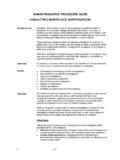
1 URBP 298 Prepared by Shishir Mathur 1 of 6 Conducting In-Depth Interviews Topics Covered: Purpose of Conducting Interviews How to conduct Interviews Sources of errors or bias URBP 298 Prepared by Shishir Mathur 2 of 6 Purpose Generate ideas Develop hypothesis (for example: Do you think people in the Bay Area choose to live in transit oriented developments because they like to use transit?) Gain insight into complex issues (for example: In your opinion, what factors influenced City Council s decision to allow accessory dwelling units?) Seek expert opinion (How do you think AMTRAK s funding cut is going to impact the future of intercity rail in the ) Get people s opinion; learn how they look at world (do you think this park is safe for your kids?) Collect informationURBP 298 Prepared by Shishir Mathur 3 of 6 How to Conduct Interviews Pre- interview Develop a good understanding of the study s objectives and the information to be collected Prepare a list of potential people you would like to interview .
2 Identify the reasons for interviewing each person. Ask an expert to review your list. Prepare a list of questions to be asked of each interviewee. o Phrase questions so that they are simple to understand o To the extent possible, include questions that get the interviewee talking (for example, do not only ask Do you think this park is safe for your kids? ; follow it up with What park features do you think makes the park unsafe? ) Make the initial contact with the interviewee (through phone / email/ post). Initial contact should be used to: a) Introduce yourself, other team members, and the study (including the funding agency) ; b) Explain the purpose of the study; c) Describe the kind of information to be collected; d) Indicate whether the interview will be taped; e) Request permission to conduct the interview ; f) Provide an estimate of the length of the interview ; g) Propose some dates and times when the interview might be conducted; and h) Provide your contact information.
3 URBP 298 Prepared by Shishir Mathur 4 of 6 interview Introduce yourself Thank the interviewee for her time and willingness to share her views Briefly go over the purpose of the study and the scope of the interview Start with a question that is important but not too specific (never ask unimportant questions, or seek information that you can get from somewhere else!) Go from one question to the other once the question has been answered to your satisfaction Be prepared to skip questions if they seem redundant Be prepared to ask supplementary questions Be prepared with neutral probes (for example: Can you please elaborate?) Have a catch all question as your last question (for example: Is there anything else that you would like to add? Or, Do you think that there are other issues/points that I may have missed?) Close the interview by thanking the interviewee and letting her know how you plan on proceeding from here (for example, you might indicate that you will send the draft report or its relevant section to the interviewee so that s/he URBP 298 Prepared by Shishir Mathur 5 of 6 can verify the accuracy of the information.)
4 Also leave the option of a follow-up interview open) Post- interview Follow up with a call/ letter/ email thanking the interviewee/ respondent Let the respondent know how you plan on proceeding from here Sources of Errors or Bias1 Interviewee/ Respondent Induced Bias Faulty memory Exaggeration and Dishonesty Hidden or not so hidden agenda Failure to understand the question correctly Lack of expertise Failure to give complete answer Misunderstanding the purpose of interview Courtesy Bias 1 A fuller explanation of several sources of bias listed in this handout can be found in Chapter 5 of Marketing Research and Information Systems at: (accessed February 01, 2009) URBP 298 Prepared by Shishir Mathur 6 of 6 Interviewer Induced Bias React to interviewee s response Voice inflections Desire to help the respondent Biased questions (For example: A famous researcher has found that the City X s smart growth policy is a failure.
5 Do you agree?) Order of question (ask people first about what they like, then ask them about what they do not like) Dress and appearance (important to look neutral in case of personal Interviews )