Transcription of US Privacy and Data Security Law Overview
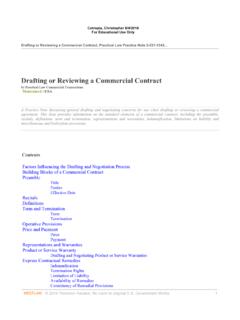
1 US Privacy and data Security Law: Overview , Practical Law Practice Note 2016 Thomson Reuters. No claim to original Government Works. 1 US Privacy and data Security Law: Overview by Ieuan Jolly, Loeb & Loeb LLP Maintained USA This Note provides an Overview of prominent US Privacy and data Security laws relating to the collection, use, processing and disclosure of personal information. It summarizes key federal Privacy and data Security laws, certain state laws, with a focus on California and Massachusetts, and the Mobile Marketing Association and Payment Card Industry data Security Standards, two key industry-specific Privacy and data Security guidelines and requirements.
2 Contents Privacy and data Security Risks Federal Laws Federal Trade Commission Act (FTC Act) Gramm-Leach-Bliley Act (GLBA) Dodd-Frank Wall Street Reform and Consumer Protection Act Health Insurance Portability and Accountability Act (HIPAA) Other Federal Laws State Laws California Laws Massachusetts data Security Regulation Industry Guidelines and Standards Mobile Marketing Association Guidelines Payment Card Industry data Security Standard Cross-border Issues In the US, there is no single, comprehensive federal law regulating Privacy and the collection, use, processing, disclosure and Security of personal information (also known as personally-identifiable information or PII).
3 Instead, there is a system of federal and state laws and regulations, as well as common law principles, that overlap, dovetail and sometimes contradict one another. In addition, government agencies have developed guidelines and industry groups have undertaken self-regulatory efforts that do not have the force of law but are considered best practices. These self-regulatory programs often have accountability and enforcement components and may refer companies to government regulators such as the Federal Trade Commission (FTC) if the companies fail to comply. Recent increases in data Security breaches have led to an expansion of this patchwork system, which is becoming one of the fastest growing areas of legal regulation.
4 The growth in interstate and cross-border data flow, together with new Privacy and data Security -related statutes and regulations, heightens the risk of Privacy violations and creates a significant compliance US Privacy and data Security Law: Overview , Practical Law Practice Note 2016 Thomson Reuters. No claim to original Government Works. 2 challenge. In light of these developments, this Note provides an Overview of certain key Privacy and data Security laws. In particular, the Note looks at: The consequences of failing to comply with Privacy and data Security laws. The key federal laws in this area, with an explanation of the entities and data covered by the law, the obligations and requirements under the legislation and potential sanctions and liability.
5 Certain state laws in California and Massachusetts, where rigorous Privacy and data Security laws have been adopted. Industry guidelines and standards. Privacy and data Security Risks Failure to comply with Privacy and data Security laws can result in significant adverse consequences, including: Government-imposed civil and criminal sanctions, including fines and penalties. Significant fines and damages awards resulting from private lawsuits, including class actions (permitted under some Privacy and data Security laws). Damage to the company s reputation and customers confidence and trust, resulting in lost sales, market share and brand and stockholder value.
6 The adverse consequences of failing to safeguard personal information can be serious, as the following examples demonstrate: Target Corporation. In the largest data breach to ever affect a retailer, Target announced in late 2013 that it was affected by a breach that may have resulted in the disclosure of the payment card information of over 40 million consumers and the personal information of an additional 70 million consumers. To date, Target has been sued by consumers and shareholders in over 70 lawsuits in addition to being the subject of multiple regulatory investigations. TJX Companies, Inc. One of the largest data Security breaches in the US cost TJX Companies, Inc.
7 , the parent company of several retailers including TJ Maxx and Marshalls, at least $256 million and perhaps up to $500 million. The company discovered in December 2006 that credit and debit card numbers of more than 45 million consumers were stolen and used to make purchases and open fictitious accounts. The company settled several class action lawsuits filed by consumers, as well as lawsuits filed by credit card companies and banks that had to reissue millions of cards. Heartland Payment Systems, Inc. In January 2009, Heartland Payment Systems, Inc., which provides bank card payment processing services to merchants, announced that hackers had broken into its systems and stolen payment card data .
8 In possibly the largest data breach involving payment cards, an estimated 130 million credit and debit card numbers were stolen. Federal Laws There are many federal laws that regulate Privacy and the collection, use, processing and disclosure of personal information, including: Broad federal consumer protection laws, such as the Federal Trade Commission Act (FTC Act), that are not specifically Privacy and data Security laws, but are used to prohibit unfair or deceptive practices involving the collection, use, processing, protection and disclosure of personal information. Laws that apply to particular sectors, such as the: Gramm-Leach-Bliley Act (GLBA), which applies to financial institutions; and Health Insurance Portability and Accountability Act (HIPAA), which applies to medical information.
9 Laws that apply to types of activities that use personal information or might otherwise affect individual Privacy , such as the: US Privacy and data Security Law: Overview , Practical Law Practice Note 2016 Thomson Reuters. No claim to original Government Works. 3 Telephone Consumer Protection Act for telemarketing activities; and Controlling the Assault of Non-Solicited Pornography and Marketing (CAN-SPAM) Act for commercial e-mail. In addition, there are many federal Security and law enforcement laws that regulate the use of personal information such as the Uniting and Strengthening America by Providing Appropriate Tools Required to Intercept and Obstruct Terrorism Act of 2001 (USA Patriot Act), and federal and state wiretapping laws, but a discussion of these laws is outside the scope of this Note.
10 This section examines the following key federal Privacy laws in more detail: FTC Act (regulating unfair or deceptive commercial practices). Gramm-Leach-Bliley Act (GLBA) also known as the Financial Services Modernization Act of 1999 (regulating personal information collected or held by financial institutions). Federal Trade Commission s Red Flags Rules issued under the Fair and Accurate Credit Transactions Act (FACTA) (requiring financial institutions and creditors to have written information Security programs). HIPAA, as amended by the Health Information Technology for Economic and Clinical Health Act (HITECH) (regulating protected health information (PHI)).