Transcription of Using Choice and Preference to Promote Improved Behavior
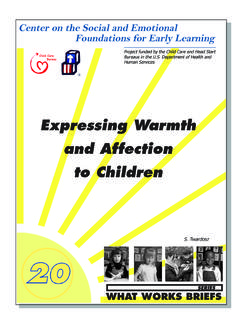
1 Center on the Social and EmotionalFoundations for Early LearningUsing Choice andPreference to Promote Improved BehaviorProject funded by the Child Care and Head StartBureaus in the Department of health andHuman ServicesWHAT WORKS BRIEFSSERIESG. Dunlap D. LisoAlex s StoryAlex is a 4-year-old boy in Mr. Anderson s preschool class who is happiest when he is out on theplayground in the sandbox. Although Mr. Anderson has tried to get Alex to follow directions and usetoys and materials appropriately during small group activities such as art, Alex does not comply withthe classroom rules. He never seems to want to sit down with the rest of the class and participate. Heseems uninterested in every art project, and Mr.
2 Anderson has a difficult time keeping Alex s , Alex prefers to wander around the room. If Mr. Anderson does get him to sit still long enoughto give him the art materials, Alex usually throws or pushes them off the table. Mr. Anderson has triedallowing Alex to play while the other children complete art projects, but he really wants Alex to par-ticipate. Mr. Anderson has also tried sitting behind Alex and helping him use the materials by givinghim hand-over-hand guidance. Alex usually fights the whole time and sometimes hits and kicks Time-out has not worked either; because Alex doesn t want to be at the art table, he ishappy to go sit by himself. Mr. Anderson is ready to give up. Conversations with Alex s parents revealthat similar behaviors occur at Is It Important to Offer Choices toChildren?
3 Children tend to be more cooperative, more engaged,and better behaved when they are involved with activi-ties, materials, and individuals that they enjoy. There-fore, teachers, parents, and other caregivers can pro-mote Improved Behavior by providing children accessto preferred toys, materials, activities, and even socialpartners. If it is difficult to determine a child s prefer-ences, one can ask parents and others who are veryfamiliar with the child, or one can observe the child sreactions and engagement when he or she is usingvarious items or activities and when he or she is playingwith different children. It is also helpful to consider theitems that the child is naturally drawn to or seeks outwhen given the intervention seems to be effective for situationswhen choices are offered both within activities (such aschoosing a color of crayon to use during art or choosingWhat Is the Choice -Making Strategy?)
4 Offering choices to children involves allowing them toindicate their Preference at specific points in time andthroughout their day and then giving them access to theitems or activities they choose. Choices can be offeredin countless settings, including meals, chores, centers,routines, and play. Types of choices may includechoosing materials during an activity, choosing whatactivity will come next, and choosing a friend to sitwith at lunch. The intervention consists of offeringchoices among two or more types of materials oractivities. Depending upon the child s ability level,choices can be offered verbally ( Do you want juice ormilk? ), Using actual objects (showing the child a juicebox or milk carton and asking the question), or usingpicture representations, such as a menu board ofpictures (actual photos or drawings of the milk andjuice cartons) from which the child can make a the above example, Mr.
5 Anderson might offer Alex achoice of colored construction paper and various glitterglue sticks to use on his art Choice and Preference to Promote Improved BehaviorThis What Works Brief is part of a continuing series ofshort, easy-to-read, how to information packets on avariety of evidence-based practices, strategies, andintervention procedures. The Briefs are designed tohelp teachers and other caregivers support youngchildren s social and emotional development. In-serviceproviders and others who conduct staff developmentactivities should find them especially useful in sharinginformation with professionals and parents. The Briefsinclude examples and vignettes that illustrate howpractical strategies might be used in a variety of earlychildhood settings and home 2004 What Resources Are Needed?
6 Few or no additional resources are needed to use thischoice-making intervention. In some cases, it may benecessary to invest in toys or other materials that areespecially attractive to a particular child. It also may benecessary to create a Choice board Using pictures,symbols, or icons. It may be useful to laminate theboard or increase the board s flexibility with fastenersthat can be attached or removed. Photos or other imagesused should depict only the item of interest, with aslittle background distraction as possible. Actual cutoutsfrom boxes (such as the cardboard cereal or toy box)are generally reliable visual sources for children. Thenumber of pictures presented on the Choice boardshould be determined based on the child s skill level;fewer Choice options are preferred for young children orchildren whose cognitive skills are less advanced.
7 Thenumber of choices can be increased over time as thechild becomes familiar with the Are the Children Who Benefit fromThis Intervention?Children who benefit most directly from thisintervention are those who display problem behaviors toescape participation in activities or avoid usingmaterials that they find relatively unappealing,undesirable, or difficult. Much of the research has beenconducted with children who have disabilities, but somestudies demonstrate the effectiveness of Choice makingwith children without disabilities as well. Generally,any child with or without disabilities who has lowlevels of engagement or motivation is a good candidatefor the Choice -making strategy. Children who have fewinterests may also benefit from the opportunity to makechoices.
8 Most of the relevant research has been donewith 4- and 5-year-olds in classrooms (elementary andpreschool), but some of the research was conducted ina peer to sit next to during group) and between activities(such as choosing between two centers). Althoughseveral explanations for the effectiveness of this strat-egy have been suggested, evidence suggests that choicemaking is effective because it allows the child to feelthat he or she has some control or power over theenvironment. This control, in turn, motivates the childto participate and remain engaged s Story RevisitedA later look in Mr. Anderson s classroomshows that Alex has made good progress. Nowthat Mr. Anderson gives him choices withinactivities, such as what color clay to use orwhich scissors to cut with, Alex is more inter-ested in working.
9 Alex feels that he has a bitmore control over his environment, so he ismore motivated to stay on task. Makingchoices also helps Alex better understand whatis expected of him during activities. As aresult, he is wandering less and is rarelydisruptive. Mr. Anderson plans to continueoffering choices to all of his students in avariety of classroom 2004homes and clinics. The importance of adapting thisstrategy to meet the unique needs of the children andfamilies in a teacher s care cannot be Behavioral Changes Can BeExpected?Decreases in the amount of acting-out Behavior andincreases in engagement can be expected, and oftenthese changes happen relatively quickly after theintervention has been implemented. Research has alsoshown that other challenging behaviors, includingaggression and disruption, have been positivelyaffected by the Choice -making strategy.
10 Other benefitsinclude positive effects on: compliance independence initiations in work and social situations social interactions communication motivationAs with most strategies, the overall effectiveness of thisstrategy will be different for each child. For somechildren, the effects may be great, and for others, itmay be somewhat less who have few interests may alsobenefit from the opportunity to in the amount of acting-outbehavior and increases in engagementcan be expected, and often these changeshappen relatively quickly after theintervention has been on the Social and Emotional Foundations for Early welcome your feedback on this What Works Brief. Please go to the CSEFEL Web site( ) or call us at (217) 333-4123 to offer material was developed by the Center on the Social and Emotional Foundations for Early Learning with federal funds from the Department of Healthand Human Services, Administration for Children and Families (Cooperative Agreement N.)