Transcription of Using Inquiry Based Lessons in Middle School Mathematics
1 Using Inquiry Based Lessons in Middle School Mathematics (Team 6) Jackie Wolf, Pat Canterbury, Joyce Soranno, Katie Jones 1/20/04 Teacher s lesson Plan 1. lesson Title: square Roots 2. Description: This lesson will lead students through finding square roots by starting with squaring a number and finding the area of a square and then working backwards. Students will recognize perfect squares and be able to estimate the square root of a number that is not a perfect square . 3. Key Words: square root , perfect square 4. Background Knowledge: Students are presumed to know how to square a number, how to find the area of a square , how to order and round decimals, and how to work with a number line.
2 5. NCTM Standards addressed: This lesson addresses the NCTM s Number and Operations Standard for grades 6-8, students will understand and use the inverse relationships of addition and subtraction, multiplication and division, and squaring and finding square roots to simplify computations and solve problems. 6. Learning Objectives: Students will understand the definition of square root and discover how to find them for perfect squares and how to estimate them for non-perfect squares. 7. Materials: Students will need a copy of the lab sheet, pencil and eraser, and a calculator 8. Procedures: a. Attention Getter: Pose a problem where the students know the area of a square but not the side length and ask them how they might find it.
3 B. Grouping: Students should work in groups of 2-3. 9. Assessment: Students should be assessed by observation and by asking them to verbalize what they have learned. They should also show mastery through writing instructions on how to find the square root of a number (last question of the investigation) and by showing they can do some or all of the extension problems. Project AMP Dr. Antonio R. Quesada Director, Project AMPPart II: 1. lesson Title: square Roots 2. Katie Jones, Joyce Soranno, Jackie Wolf, Pat Canterbury File name: square Roots 3. lesson Goal: Students will recognize and calculate the value of numbers that are perfect squares and estimate the value of numbers that are not perfect squares.
4 4. Investigation: Review of previous knowledge: A. What is the value of 22, 32, 52, 72 ? _____, _____, _____, _____ B. Find the area of the squares shown below. 3 5 Area = _____ Area = _____ C. Find the area of a square that has a side length of 4. _____ D. Find the area of a square that has a side length of n. _____ E. If the area of a square is 49 inches squared. What is its side length? (What number times itself equals 49?) _____ F. What number can you square to equal 81? _____ What number can you square to equal 121?
5 _____ Information point to students: When 9 is squared it equals 81. So we can say 9 is the square root of 81. is the square root symbol, so you would read 81=9 as the square root of 81 equals 9 . G. Write in your own words how to find 25. _____ _____ H. In your own words, describe how to find the square root of any number. _____ _____ Project AMP Dr. Antonio R. Quesada Director, Project AMP I. Now, Using the calculator. Locate the square root key on the calculator. Using the calculator: Find 169 _____ Find 225 _____ Find 625 _____ J.
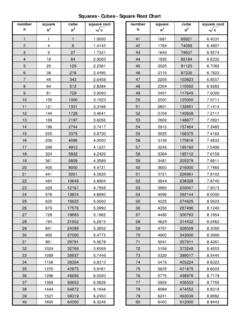
6 Now, Using the calculator: Find 31 _____ Find 72 _____ Find 110 _____ Compare your answers to questions I and J. What do you notice? _____ _____ K. Information point to students: Whenever you take the square root of a number and get an answer that is a whole number the original number was a perfect square . If your answer is not a whole number then your original number was not a perfect square . List several perfect squares: _____, _____, _____ L. Use the calculator and fill in the table below. Round your answer to the hundredths place.
7 Before you start fill in any answers you can without Using the calculator. n n 1 2 3 4 5 6 7 8 9 10 11 12 13 14 15 16 Project AMP Dr. Antonio R. Quesada Director, Project AMP M. What do you notice about your answers between the perfect squares? _____ _____ N. Put away your calculator. Estimate the value of and then place the value in the correct place on the number line. Label each point on the number line. 6 _____ 14 _____ 27 _____ 45 _____ _____ 0 1 2 3 4 5 6 7 P.
8 Between which two perfect squares did you place each value? 6 _____ 14 _____ 27 _____ 45 _____ Q. Explain how you determined where to place your points. _____ _____ R. Between which two perfect squares would you find 65? _____ Between which two perfect squares would you find 65? _____ What is the approximate value of 65? _____ Explain your thinking. _____ _____ S. Repeat what you did in question R to find: 12 _____ 38 _____ 115 _____ Project AMP Dr. Antonio R. Quesada Director, Project AMP T. Write instructions on how to estimate the square root of a number that is not a perfect square .
9 _____ _____ _____ _____ Extension Problems: 1. Using your calculator type in 9. Why do you think you get an error? [Hint: What numbers can you multiply together to get 9?] 2. Describe a way that we could get a negative answer to a square root problem. 3. Make a table of values for the equation y=x and graph the results. a. In which quadrant does the graph lie? Is this what you would expect? Explain. Project AMP Dr. Antonio R. Quesada Director, Project AMPPart II: Answers 1. lesson Title: square Roots 2. Katie Jones, Joyce Soranno, Jackie Wolf, Pat Canterbury File name: square Roots 3.
10 lesson Goal: Students will recognize and calculate the value of numbers that are perfect squares and estimate the value of numbers that are not perfect squares. 4. Investigation: Review of previous knowledge: A. What is the value of 22, 32, 52, 72 ? ____4____, ____9___, ____25___, ___49___ B. Find the area of the squares shown below. 3 5 Area = _9 sq. units_____ Area = 25 sq. units C. Find the area of a square that has a side length of 4. _16 sq. units _ D. Find the area of a square that has a side length of n. _n2 sq. units _ E.