Transcription of Using the Functional Listening Index following Cochlear ...
1 Using the Functional Listening Index following Cochlear Implantation in Young Children: The Precursor to Speech and LanguageCI 2015 SymposiumOctober, 2015 Washington, DCAleisha DAVIS, Katie NEAL, Yetta ABRAHAMS, Alyshia HANSENT hursday, October 15th, Disclosures 45 years of service to >2000 children Focus on Listening and Spoken Language Family-centredTransdisciplinary Integrated Implant and Early Intervention Program Families from diverse cultural and linguistic background Individual, Group and Teleintervention Programs 5 Centres with services across ACT NSW Tasmania Children with all range of needs, all levels and types of hearing, all devices options Currently 250 children 0-6yrs, 135 children 7yrs plusIdentification, Amplification.
2 Intervention UHNS referredEHDI Guidelines(Modified from CDC Early Hearing Detection & Intervention) Bilateral HL (median)Unilateral HL (median)Identification 1mth 1mth (range 0-13mths)1mth (range 0-4mths) Amplification 3mths4mths(range 3-61mths) 31mths(range 3-74mths)Intervention 6mths5mths(range0-55mths)18mths (range3-46mths) Cochlear Implant 7mths(range4-13mths) (range 3-11yrs) Staying in the average range, from birth10254055708510011513014501224364860 721. Early to EI, Fit and Implant < 12 months2. Implant > 12 monthsStandard Language Score Age of Implant in months DetectionDiscriminationIdentificationCom prehensionHow do we measure transition from one level to the next?Understanding detection in the landscape of comprehension IdentificationDetectionUNHS (AABR) ABR Diagnsotic, ASSR, DPOAE s, +CM, Reflexes, Tympanometry Estimated thresholds form the basis of device fitting CAEPs -Verification of device fitting for infants DiscriminationDiscrimination CAEPs ComprehensionSpeech Perception, Standard Speech & Language Assessments Functional (Real world Listening skills) what children can DO with the sounds they can detect and perceive How can we identify progress before it shows in speech and language outcomes?
3 Although children make use of visual cues when learning language, audition is of primary importance for language acquisition Bailey & Snowling, (2002), Yoshinaga-Itano, C. (1998) Geers, A., Brenner, C., & Davidson, L. (2003). Functional Listening What starts as a DETECTION response, swiftly becomes DISCRIMINATIONand IDENTIFICTION responses so COMPREHENSION responses become possible Began with formative tools we rely upon Ling 6 (Ling & Ling 1978) The Phonetic-Phonologic Speech evaluation Record: A Manual (Ling, D. 1991) Categories of Auditory Performance (CAP) / CAP -Revised Cole, E. B., & Flexer, C. A. (2007). Children with hearing loss: developing Listening and talking birth to six Estabrooks, W.
4 (1998). Cochlear implants for kids Supplement to the JCIH 2007 Position Statement: Principles and Guidelines for Early Intervention After Confirmation That a Child Is Deaf or Hard of Hearing. St. Gabriel s Curriculum for the Development of Audition, Language, Speech, Cognition, (Tuohy, J., Brown, J. and Mercer-Mosely, C., 2001) Integrated Scales of Development, Cochlear Limited Auditory Skills Checklist, (1992). Cottage Acquisition Scales for Listening , Language and Speech. Simple Sentence Level (Wilkes, 1999) Auditory Learning Guide, Beth Walker, (2009) Pollack, D., Goldberg, D. M., & Caleffe-Schenck, N. (1997). Educational audiology for the limited-hearing infant and preschooler: An auditory-verbal program.
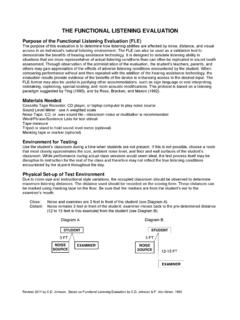
5 Charles C Thomas Pub outside the boxFunctional Listening Index 6 Phases/60 Sound with Simple Spoken Language in Different Listening Through Discourse and Open Listening SetThinking outside the boxFunctional Listening Index 6 Phases/60 Sound with Simple Spoken Language in Different Listening Through Discourse and Open Listening SetDemographics310 children 0-7yrs937 Data pointsAll levels of hearing loss56 Children with CI104 devices CI <12mths children with significant residual hearing UHL ANSD Simultaneous and SequentialIncluding CI Group Listening Index for whole group n=3100102030405060012243648607284 Listening skills observed (from checklist of 60 items)Age in MonthsNumber of Observed Listening Skills by Age of ChildNormal Hearing Auditory progress following Early implantationAll have had speech and language in the typical range from birthNormal Hearing Standard language score by HA fitting (early/late) age of implant and entry into EI Early EI & HA fitting (CI < 6 Months) Early EI & HA fitting (CI 6-12 Months) Early EI & HA fitting (CI > 12 Months) Early EI & Late HA fitting (CI > 12 Months) Late EI & HA fitting (CI >12 Months) Median Total Language Score n=98 Age Grouping for Intervention, fitting and CI Evidence for early implantation, but how can it guide evaluation and intervention?
6 How does Functional Listening compare?HA mod & mod/sevlossNormal Hearing 5 children with 4FA 55-64dBHL Using HAs with poorer Functional Listening than normal hearing childrenDirect impact on auditory progress following implantationNormal Hearing Functional Listening for all childrenThe best listeners have CI under 12 months in either profound or residual hearing group: TIMING STILL MATTERS0102030405060012243648607284 Number of Observed Listening SkillsAge in MonthsProfound (CI <= 12 months)Profound (CI > 12 months)Residual (CI now, pre-CI score)Residual (CI <= 12 months, post CIscore)Normal Hearing Not waiting to dip outAccess to soundPLS4 Total Language scoreScores not dropping out of the normal range, decision made before they fail & based on Functional accessChronological AgeBenefits beyond Outcomes.
7 Supporting complex families 0102030405060061218243036424854606672788 4 Progress on the Functional Listening IndexExpected Typical Hearing Trajectory50th Percentile TSC ProgramChildChild 2 Normal Hearing ANSDN ormal Hearing Bilateral vs UHL0102030405060012243648607284 Number of Observed Listening SkillsAge in MonthsNumber of Observed Listening Skills by Age: no diagnosed additional needs (n = 244)BilateralUnilateralExpected trajectory for typically Normal Hearing Impacts on practice Children with more hearing implanted earlier Not having to catch up from out of normal range of speech and language Tracks through discrimination and identification necessary for higher level comprehension Shifting our focus to broader communication skills Practice changing from 1-1 rehabilitation in quiet with adults to Functional real world practice Listening environments from the earliest ageThe Shepherd Centre you to the children and families that share their journey with d also like to acknowledge past TSC staff members who have contributed to the design and implementation of
8 Our Theory of Mind research ReferencesArchbold, S., Lutman, M. E., & Marshall, D. H. (1995). Categories of Auditory Performance. Annals of otology, rhinology & laryngology. Supplement, 166, Skills Checklist, (2004) Adapted by Karen Anderson, from Auditory Skills Checklist by Nancy S. Caleffe-Schneck, , CCC-A (1992).Auditory Learning Guide, Beth Walker, (2009) Bailey, P. J., & Snowling, M. J. (2002). Auditory processing and the development of language and literacy. British Medical Bulletin, 63(1), 135-146 Cole, E. B., & Flexer, C. A. (2007). Children with hearing loss: developing Listening and talking birth to six: Plural , W. (1998). Cochlear implants for kids: Alexander Graham Bell Association for the YEARS (Training Program University of North Carolina), Geers, A.
9 , Brenner, C., & Davidson, L. (2003). Factors Associated with Development of Speech Perception Skills in Children Implanted by Age Five. Ear & Hearing, 24(1)(Supplement), Scales of Development, Cochlear LimitedMorrow, L. M. (2001). Literacy development in the early years. Needham Heights, , C., Harrison, J., Yoshinaga-Itano, C., Grimes, A., Brookhouser, P., E., Martin, B. (2013). Supplement to the JCIH 2007 Position Statement: Principles and Guidelines for Early Intervention After Confirmation That a Child Is Deaf or Hard of Hearing. Pediatrics, 131(4)Paul, R. (2007). Language disorders from infancy through adolescence: Assessment & intervention: Elsevier Health Gabriel s Curriculum for the Development of Audition, Language, Speech, Cognition, Second Edition (2005).
10 Compiled by J. Tuohy, J. Brown, & C. Mercer-MoseleyYoshinaga-Itano, C. (1998). Development of audition and speech: implications for early intervention with infants who are deaf or hard of hearing. Volta Review, 100(5), 213-234. Whitehurst, G. J., & Lonigan, C. J. (2001). Emergent literacy: Development from prereadersto readers. Handbook of early literacy research, 1, 11-29.