Transcription of Value of Peers, 2017
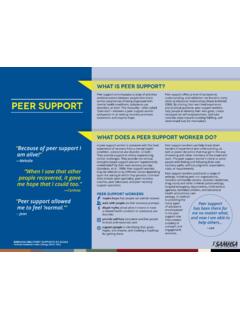
1 Peer Support Peers Supporting Recovery from Substance Use Disorders Peers Supporting Recovery from Mental Health Conditions Value of Peers, 2017 Family, Parent and Caregiver Peer Support in Behavioral Health Value of Peers, 2017 Peer Support Because of peer support I am alive! Melodie PEER SUPPORT What is Peer Support? Peer support encompasses a range of acNviNes and interacNons between people who share similar experiences of being diagnosed with mental health condiNons, substance use disorders, or both.
2 This mutuality o>en called peerness between a peer support worker and person in or seeking recovery promotes connecNon and inspires hope. Peer support offers a level of acceptance, understanding, and validaNon not found in many other professional relaNonships (Mead & McNeil, 2006). By sharing their own lived experience and pracNcal guidance, peer support workers help people to develop their own goals, create strategies for self- empowerment, and take concrete steps towards building fulfilling, self- determined lives for themselves. What Does A Peer Support Worker Do? A peer support worker is someone with the lived experience of recovery from a mental health condiNon, substance use disorder, or both.
3 They provide support to others experiencing similar challenges. They provide non- clinical, strengths- based support and are experienNally credenNaled by their own recovery journey (Davidson, et al., 1999). Peer support workers may be referred to by different names depending upon the sePng in which they pracNce. Common Ntles include: peer specialists, peer recovery coaches, peer advocates, and peer recovery support specialists. What Does A Peer Support Worker Do? cont. Peer support workers inspire hope that people can and do recover; walk with people on their recovery journeys; dispel myths about what it means to have a mental health condiNon or substance use disorder; provide self- help educaNon and link people to tools and resources; and support people in idenNfying their goals, hopes, and dreams, and creaNng a roadmap for gePng there.
4 What Does A Peer Support Worker Do? cont. Peer support workers can help break down barriers of experience and understanding, as well as power dynamics that may get in the way of working with other members of the treatment team. The peer support worker s role is to assist people with finding and following their own recovery paths, without judgment, expectaNon, rules, or requirements. Peer support workers pracNce in a range of sePngs, including peer- run organizaNons, recovery community centers, recovery residences, drug courts and other criminal jusNce sePngs, hospital emergency departments, child welfare agencies, homeless shelters, and behavioral health and primary care sePngs.
5 In addiNon to providing the many types of assistance encompassed in the peer support role, they conduct a variety of outreach and engagement acNviNes. Peer support has been there for me no ma8er what, and now I am able to help Liza How Does Peer Support Help? The role of a peer support worker complements, but does not duplicate or replace the roles of therapists, case managers, and other members of a treatment team. Peer support workers bring their own personal knowledge of what it is like to live and thrive with mental health condiNons and substance use disorders.
6 They support people s progress towards recovery and self- determined lives by sharing vital experienNal informaNon and real examples of the power of recovery. The sense of mutuality created through thoughMul sharing of experience is influenNal in modeling recovery and offering hope (Davidson, Bellamy, Guy, & Miller, 2012). When I saw that other people recovered, it gave me hope that I could too. Corinna Does Peer Support Make A Difference? Emerging research shows that peer support is effecNve for supporNng recovery from behavioral health condiNons. Benefits of peer support may include: Increased self- esteem and confidence (Davidson, et al.)
7 , 1999; Salzer, 2002) Increased sense of control and ability to bring about changes in their lives (Davidson, et al., 2012)Raised empowerment scores (Davidson, et al., 1999; Dumont & Jones, 2002; Ochoka, nelson , Janzen, & Trainor, 2006; Resnick & Rosenheck, 2008)Increased sense that treatment is responsive and inclusive of needs (Davidson, et al., 2012) Does Peer Support Make A Difference? cont. Emerging research shows that peer support is effecNve for supporNng recovery from behavioral health condiNons. Benefits of peer support may include: Increased sense of hope and inspiraNon (Davidson, et al.
8 , 2006; Ratzlaff, McDiarmid, Marty, & Rapp, 2006)Increased empathy and acceptance (camaraderie) (Coatswortha Puspokey, Forchuk, & Warda Griffin, 2006; Davidson, et al., 1999)Increased engagement in selfa care and wellness (Davidson, et al., 2012)Increased social support and social funcNoning (Kurtz, 1990; nelson , Ochocka, Janzen, & Trainor, 2006; Ochoka et al., 2006; Trainor, Shepherd, Boydell, Leff, & Crawford, 1997; Yanos, Primavera, & Knight, 2001) Does Peer Support Make A Difference? cont. Emerging research shows that peer support is effecNve for supporNng recovery from behavioral health condiNons. Benefits of peer support may include: Decreased psychoNc symptoms (Davidson, et al.
9 , 2012)Reduced hospital admission rates and longer community tenure (Chinman, Weingarten, Stayner, & Davidson, 2001; Davidson, et al., 2012; Forchuk, MarNn, Chan, & Jenson, 2005; Min, Whitecra>, Rothbard, Salzer, 2007) Decreased substance use and depression (Davidson, et al., 2012) Peer support allowed me to feel normal. Jean REFERENCES Chinman, M.
10 J., Weingarten, R., Stayner, D., & Davidson, L. (2001). Chronicity reconsidered: improving person- environment fit through a consumer- run service. Community mental health journal, 37(3), 215- Puspoky, R., Forchuk, C., & Ward- Griffin, C. (2006). Peer support relaNonships: an unexplored interpersonal process in mental health. Journal ofpsychiatric and mental health nursing, 13(5), 490- , L., Bellamy, C., Guy, K., & Miller, R. (2012). Peer support among persons with severe mental illnesses: a review of evidence and experience. WorldPsychiatry, 11(2), 123- , L., Chinman, M., Kloos, B., Weingarten, R., Stayner, D., & Tebes, J. K. (1999). Peer support among individuals with severe mental illness: A review of the evidence. Clinical psychology: Science and prac;ce, 6(2), 165- , J., & Jones, K. (2002). Findings from a consumer/survivor defined alternaNve to psychiatric hospitalizaNon.