Transcription of Walking the Path Together Tools: Danger Assessment
1 Walking the path Together Tools: Danger Assessment Developed as part of Phase I of Walking the path Together In consultation with Dr. Jacquelyn Campbell Copyright, 2012 by The Alberta Council of Women s SheltersMaterials may not be reproduced without the prior written consent of # 978-1-927125-07-6 ACRONYMS & ABBREVIATIONS: ACWS Alberta Council of Women s SheltersAI Appreciative InquiryCCFJS Centre for Children and Families in the Justice SystemDA Danger AssessmentDV Domestic ViolenceEFW Eagle Feather WorkerPGC Project Guidance CircleSROI Social Return on InvestmentWTPT Walking the path Together 4 CONTENTS Acknowledgements.
2 566798131315161617181923252628 Overview of Walking the path Together ..The Danger Assessment ..Alberta Council of Women s Shelters and the Danger Assessment .. Walking the path Together and the Danger Assessment ..The Circle ..Implementing the WTPT Danger Assessment .. The WTPT Seasonal Calendar .. WTPT DA Circle and Questionnaire .. WTPT Danger Assessment Caregiver Questionnaire ..Creating Safety .. POP TARTS Has 3 Steps ..Conclusion ..Appendix A WTPT DA Seasonal Calendars ..Appendix B WTPT DA Questionnaire ..Appendix C WTPT DA Circle.
3 Appendix D WTPT DA Caregiver Questionnaire ..Appendix E WTPT DA Instructions for Use .. 5 This project has been funded thanks to the support of the Government of Alberta s Safe Communities Innovation Fund. Funding was provided to measure the level of risk to the mother/primary caregiver, and to improve upon the Danger Assessment Circle s cross-cultural applicationand strengthen safety the path Together was partially funded by the Government of Canada s National Crime Prevention Strategy. The views and opinions expressed in this report are those of the authors and do not necessarily represent the views of the National Crime Prevention Centre or the Department of Public We acknowledge the work of the following people and organizations who contributed greatly to the development of this tool :Dr.
4 Jacquelyn Campbell, , PhD, RN is the Anna D. Wolf Chair and a Professor in the Johns Hopkins University School of Nursing and the creator of the Danger Assessment tool ,Eagle Feather Workers Teresa Snow, Eagle s Nest Stoney Family Shelter and Lillian Bigstone, Bigstone Cree Nation Women s Emergency Shelter for developing a culturally appropriate approach with the Danger Assessment with the advice and support of Joan Wolfe, Ermineskin Women s Shelter Society; Rita Vermillion, Paspew House Mikisew Cree Nation.
5 And Melanie Heroux, Sucker Creek Women s Emergency Shelter Executive DirectorsJanet Gladue, Bigstone Cree Nation Women s Emergency Shelter; Nora-Lee Rear, Eagle s Nest Stoney Family Shelter Ermineskin Women s Shelter Society; Mary Simpson, Mikisew Cree Nation; and Darlene Lightning-Mattson, Sucker Creek Women s Emergency ShelterDorothy Sam, Project Manager, Walking the path Together , Alberta Council of Women s SheltersStudents with Alberta Council of Women Shelters for assisting with diagrams and editing: Randi Candline, Heidi Eger, Tasha Olivieri and Melissa Cloutier.
6 6 Overview of Walking the path Together Walking the path Together (WTPT) is a collaborative learning project initially comprised of eight organizations passionately dedicated to meeting the needs of children living on-reserve who have been exposed to domestic violence. The following organizations contributed to the development of the project by sharing their rich expertise: five on-reserve shelters (Bigstone Cree Nation Emergency Women s Shelter in Wabasca, Eagle s Nest Family Shelter in Morley, Ermineskin Women s Shelter Society in Hobbema, Paspew House in Fort Chipewyan, and Sucker Creek Emergency Women s Shelter in Enilda), the Alberta Council of Women s Shelters, the Centre for Children and Families in the Justice System and Dr.
7 Jacquelyn Campbell. Using a holistic approach, Eagle Feather Workers (EFW) from the five participating on-reserve women s shelters provided one-on-one support to children who experienced domestic violence. The EFWs worked with the children s families, schools and community supports to create safer environments for the children and also to support healing within the greater detail about interventions developed by WTPT, please see the Walk Proud, Dance Proud: Footprints on a Healing Journey A Draft Discussion Guide to Walking the path Together to Reclaim the Teachings for our First Nations Children (2012).
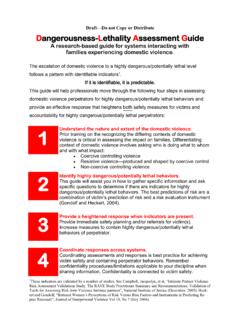
8 1 Walking the path Together was made possible through funding from the Alberta Government Safe Communities Innovation Fund and the National Crime Prevention Centre with the Government of Danger AssessmentThe Danger Assessment (DA) is a tool for predicting a woman s risk of being killed or almost killed by an intimate partner. The tool was developed by Dr. Jacquelyn Campbell (1986) with consultation and content validity support from abused women, shelter workers, law enforcement officials and other clinical experts on abuse.
9 There are two parts to the tool : a Calendar and a 20-item Questionnaire. 1 Written for WTPT by the Centre for Children and Families in the Justice System7 The Calendar helps to assess severity and frequency of abuse during the past year. The woman is asked to mark the approximate days when physically abusive incidents occurred, and to rank the severity of the incident using a 1 to 5 scale (1=slap, pushing, no injuries and/or lasting pain through 5=use of weapon, wounds from weapon). The Calendar acts as a tool to raise the consciousness of women and reduce the denial and minimization of the abuse in their lives (Campbell, 1995; Ferraro et al.)
10 , 1983). Identifying incidents of abuse with the calendar also aids the safety planning process. Often women are able to identify patterns when the abuse is most likely to occur, and therefore make safety plans specific to their own situations. Results of research conducted by Dr. J. Campbell in the United States indicated that one third of women who participated in the study changed their response to the first question on the 20-item questionnaire Did the abuse increase in severity or frequency over the past year? to a positive response after completing the calendar portion of the tool .