Transcription of Warning: Fraudulent Emails
1 Warning: Fraudulent Emails This document provides information to users of IATA products and services ( airlines, agents, other companies and individuals) so that they may avoid becoming victims of email fraud attempts. Please read this information carefully and share it with your colleagues. If you have any questions regarding the contents of this document, please send them to Contents 1) email Fraud Techniques 2) Examples of Fraudulent Emails 3) Examples of Fake Invoices, Bank Notices, and Letters 4) Reporting Fraud 5) Protecting Your Company 6) Frequently Asked Questions 7) General Security Guidelines email Fraud Techniques email , due to its inexpensive nature and ease of use, is a popular method for distributing Fraudulent messages to potential victims.
2 Approximately 90% of all Emails sent worldwide consist of spam , spoofed messages, or phishing attempts. Some of the most common Fraudulent messages are non-monetary hoaxes or chain mail. You should treat these like any other spam messages put them in your spam filter or simply delete. phishing Emails can be more serious. These might ask for payment, for personal information, or even contain malicious links aimed at harvesting your personal information. These phishing attempts have been directed at users of IATA products and services, usually in an attempt to misdirect your payments to the fraudsters. You can avoid being harmed by phishing if you follow these easy precautions: Do not click on any links in Emails you are not sure are genuine.
3 Do not download or open attachments unless you are sure they are genuine. Do not reply to text messages or Emails requesting personal information, unless you can validate that these are from IATA. Do not give out any private information. Delete Fraudulent Emails and block the sender. If you are not sure if an email is a genuine IATA communication, you can always check the IATA website ( ) or email Fraudulent Emails in the last twelve months have often come from the following domains: IATA does not communicate using these domains. Check our website for an up-to- date list ( ). Remember: we see new fraud email accounts every week, so this list is not exhaustive.
4 Read on for more signs of Fraudulent Emails . Fraudsters often use some or all of the following methods: 1) The fraudster contacts users under a false name, sometimes imitating the names of IATA officials, seeking payment for products or services and/or claiming payments for outstanding amounts due. 2) The fraudster uses a technique which allows the true sender of an email to be masked, so that the email appears to have been sent from a valid IATA address like This is called spoofing. In such cases, the fraudster asks the recipient to click a link or reply-to another email address, such as a Gmail address. If the email address changes when you click the reply button, this is a warning sign of potential fraud!
5 3) The fraudster may use the IATA logo and formatting in an attempt to replicate IATA documents. Some of these look close to IATA documents but if there is a changed bank account or the expected reference number doesn t match, make sure to contact us for clarification or go straight to the Customer Portal. 4) The fraudster s email may suggest clicking on a link. After clicking on the link, you may be forced to download a file or be taken to a fake IATA website that requests your login details. The purpose of this is to steal your login credentials. 5) Fraudsters call IATA customers and impersonate IATA staff. Although telephone numbers may seem correct based on location, please remember that with Internet phones, the fraudster can call from anywhere.
6 Caller ID can be spoofed in the same way email can! Fraudulently used information, including logos, phone numbers, invoices, and names of IATA employees in email signatures, are often obtained when recipients of a Fraudulent email provide copies of previous correspondence with IATA. You should avoid any communication with the fraudster or providing any details to them. Fraudsters sometimes use phone numbers in email signatures. These may be invalid numbers, a working number that redirects to the fraudster, or even a genuine IATA number designed to make the email seem more legitimate. EXAMPLE: Fraudster calling IATA customer Company C received a Fraudulent email offering a discounted Strategic Partnership membership renewal for the following year.
7 After responding to the fraudster with a request to proceed, the Company C received an email with a fake IATA invoice attached. The invoice included bank account details in Indonesia. The email requested that Company C send confirmation of payment via email . Fortunately, Company C was skeptical about the new banking instructions and contacted IATA directly to verify rather than responding to the fraudster. IATA was able to warn Company C that the email and invoice were Fraudulent . However, Company C received calls from individuals purporting to be from IATA, asking for payment status. Because IATA was able to warn Company C, these calls were ignored and the fraudster did not receive payment.
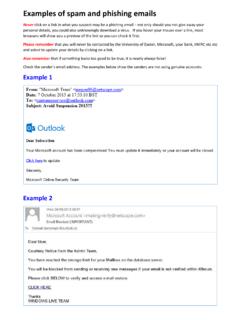
8 Legitimate IATA Emails end in the domain. IATA may also use the following: Although IATA is actively working to implement anti-spoofing measures, any email address can be spoofed to look like another. If in doubt, please contact Examples of Fraudulent Emails Fraudsters usually, but not always, follow a standard method. The first contact will be a generic email often sent to dozens or hundreds of contacts designed to elicit a response from you. It may say that your invoices are overdue and tell you to check your records, but won t mention a specific invoice or amount. If you respond to the first email , they may send a more detailed request.
9 This request may use language copied from our website. Sometimes phishing and fraud Emails will be targeted specifically to your organization after careful research by the fraudster. These fakes can be hard to spot. Your organization should have internal controls to verify payments before they are made. Example #1 The above example creates a sense of urgency by demanding a reply right away. Example #2 This example notes that there is updated bank account information, to try and stop you paying into your usual IATA account. It pressures you to check your invoices and threatens you with eventual sanctions in case the e-mail gets ignored. In the above case, sometimes customers will respond with a list of their previous invoices, some of which may already have been legitimately paid to IATA.
10 The fraudster will then make an excuse saying that payments have not been received and request that you pay into a new account. Fraudsters are often able to make invoices look reasonably authentic. Do not send your invoices if you receive an email like the above fraudsters use these to update their techniques and victimize other customers! Fraudulent invoices in the past have included charges related to IATA Ground Handling Council fees, designator fees, discounted IATA Strategic Partnership memberships, and prefix code retainer or administration fees. Example #3 Sometimes fraudsters will tell you to click on a link. You may then be asked to enter a username and password, enter personal information, or download an invoice.