Transcription of WARRIOR with ZEON TECHNOLOGY™
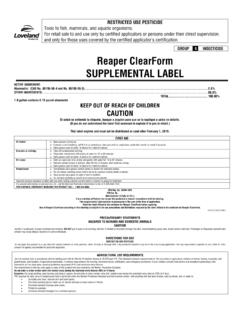
1 RESTRICTED USE PESTICIDE. Due to Toxicity to Fish and Aquatic Organisms Toxic to fish and aquatic organisms. For retail sale to and use only by Certified Applicators, or persons under their direct supervision, and only for those uses covered by the Certified Applicator's Certification WARRIOR with ZEON TECHNOLOGY . EPA Reg. No. 100-1112. EPA SLN No. OR-030002. FOR DISTRIBUTION AND USE ONLY WITHIN THE STATE OF OREGON. FOR SUPPRESSION OF LYGUS BUG IN CARROT, DILL, PARSLEY, AND PARSNIP GROWN. FOR SEED. This label valid until December 31, 2014 or until otherwise amended, withdrawn, cancelled, or suspended. Active Ingredient: Lambda-cyhalothrin1. [1 (S*),3 (Z)]-( )-cyano-(3-phenoxyphenyl)methyl- 3-(2-chloro-3,3,3-trifluoro-1-propenyl)- 2,2- dimethylcyclopropanecarboxylate Other Ingredients: Total: 1. Synthetic pyrethroid KEEP OUT OF REACH OF CHILDREN.
2 SHAKE WELL BEFORE USING. WARNING/AVISO. Si usted no entiende la etiqueta, busque a alguien para que se la explique a usted en detalle. (If you do not understand the label, find someone to explain it to you in detail.). Page 1 of 6. Environmental Hazards This pesticide is extremely toxic to fish and aquatic organisms and toxic to wildlife. For terrestrial uses: do not apply directly to water or to areas where surface water is present or to intertidal areas below the mean high water mark. Do not apply when weather conditions favor drift from treated areas. Drift and runoff from treated areas may be hazardous to aquatic organisms in neighboring areas. Do not contaminate water when disposing of equipment washwater. This product is highly toxic to bees exposed to direct treatment or residues on blooming crops or weeds. Do not apply this product or allow it to drift to blooming crops or weeds if bees are visiting the treatment area.
3 DIRECTIONS FOR USE. Restricted Use Pesticide It is a violation of Federal law to use this product in a manner inconsistent with its labeling. SHAKE WELL BEFORE USING. Do not apply this product in a way that will contact workers or other persons, either directly or through drift. Only protected handlers may be in the area during application. For any requirements specific to your State or Tribe, consult the agency responsible for pesticide regulation. This labeling must be in the possession of the user at the time of application. AGRICULTURAL USE REQUIREMENTS. Use this product only in accordance with its labeling and with the Worker Protection Standard, 40. CFR part 170. This Standard contains requirements for the protection of agricultural workers on farms, forests, nurseries, and greenhouses, and handlers of agricultural pesticides. It contains requirements for training, decontamination, notification, and emergency assistance.
4 It also contains specific instructions and exceptions pertaining to the statements on this label about personal protective equipment (PPE) and restricted-entry interval. The requirements in this box only apply to uses of this product that are covered by the Worker Protection Standard. Do not enter or allow worker entry into treated areas during the restricted entry interval (REI). of 24 hours. PPE required for early entry to treated areas that is permitted under the Worker Protection Standard and that involves contact with anything that has been treated, such as plants, soil, or water, is: Coveralls Chemical-resistant gloves, Category F, such as barrier laminate, butyl rubber, nitrile rubber, or viton 14 mils Shoes plus socks Page 2 of 6. GENERAL DIRECTIONS FOR USE. Resistance WARRIOR Insecticide with Zeon Technology is a Group 3 Insecticide (contains the active ingredient lambda-cyhalothrin).
5 Some insects are known to develop resistance to products used repeatedly for control. Because the development of resistance cannot be predicted, the use of this product should conform to resistance management strategies established for the use area. Consult your local or state agricultural authorities for details. If resistance to this product develops in your area, this product, or other products with a similar mode of action, may not provide adequate control. If poor performance cannot be attributed to improper application or extreme weather conditions, a resistant strain of insect may be present. If you experience difficulty with control and resistance is a reasonable cause, immediately consult your local company representative or agricultural advisor for the best alternative method of control for your area. SPRAY DRIFT PRECAUTIONS.
6 BUFFER zones . Vegetative Buffer Strip Construct and maintain a minimum 10-foot-wide vegetative filter strip of grass or other permanent vegetation between the field edge and down gradient aquatic habitat (such as, but not limited to, lakes; reservoirs; rivers; permanent streams; marshes or natural ponds; estuaries; and commercial fish farm ponds). Only apply products containing WARRIOR Insecticide with Zeon Technology onto fields where a maintained vegetative buffer strip of at least 10 feet exists between the field and down gradient aquatic habitat. For guidance, refer to the following publication for information on constructing and maintaining effective buffers: Conservation Buffers to Reduce Pesticide Losses. Natural Resources Conservation Services. USDA, NRCS. 2000. Fort Worth, Texas. 21 pp. Buffer Zone for Ground Application (groundboom, overhead chemigation, or airblast).
7 Do not apply within 25 feet of aquatic habitats (such as, but not limited to, lakes; reservoirs; rivers;. permanent streams; marshes; natural ponds; estuaries; and commercial fish ponds). Buffer Zone for ULV Aerial Application Do not apply within 450 feet of aquatic habitats (such as, but not limited to, lakes; reservoirs; rivers;. permanent streams; marshes; natural ponds; estuaries; and commercial fish ponds). Page 3 of 6. Buffer Zone for Non-ULV Aerial Application Do not apply within 150 feet of aquatic habitats (such as, but not limited to, lakes; reservoirs; rivers;. permanent streams; marshes; natural ponds; estuaries; and commercial fish ponds). SPRAY DRIFT REQUIREMENTS. Wind Direction and Speed Only apply this product if the wind direction favors on-target deposition. Do not apply when the wind velocity exceeds 15 mph. Temperature Inversion Do not make aerial or ground applications into temperature inversions.
8 Inversions are characterized by stable air and increasing temperatures with height above the ground. Mist or fog may indicate the presence of an inversion in humid areas. The applicator may detect the presence of an inversion by producing smoke and observing a smoke layer near the ground surface. Droplet Size Use only medium or coarser spray nozzles (for ground and non-ULV aerial application) according to ASAE (S572) definition for standard nozzles. In conditions of low humidity and high temperatures, applicators should use a coarser droplet size. Additional Requirements for Ground Applications Wind speed must be measured adjacent to the application site on the upwind side, immediately prior to application. For ground boom applications, apply using a nozzle height of no more than 4 feet above the ground or crop canopy. For airblast applications, turn off outward pointing nozzles at row ends and when spraying the outer two rows.
9 To minimize spray loss over the top in orchard applications, spray must be directed into the canopy. Additional Requirements for Aerial Applications The spray boom should be mounted on the aircraft as to minimize drift caused by wingtip or rotor vortices. The minimum practical boom length should be used and must not exceed 75% of the wing span or 80% rotor diameter. Flight speed and nozzle orientation must be considered in determining droplet size. Spray must be released at the lowest height consistent with pest control and flight safety. Do not release spray at a height greater than 10 feet above the crop canopy unless a greater height is required for aircraft safety. When applications are made with a cross-wind, the swath will be displaced downward. The applicator must compensate for this displacement at the downwind edge of the application area by adjusting the path of the aircraft upwind.
10 Page 4 of 6. RATE. Fl. CROP INSECT (lb ai/A) COMMENTS. Seed Dill Lygus Bug Apply with ground or air equipment using sufficient water to Seed Carrot ( ) obtain full coverage of foliage. Apply in a minimum of 2. Seed Parsley gallons per acre by air or 10 gallons per acre by ground. Seed Parsnip When foliage is dense and/or pest populations are high 5-10. gallons per acre by air or 20 gallons per acre by ground and higher use rates are recommended. Use higher rates for increased residual control, such as prior to crop blooming. If application is made during bloom, use the lower rate of application. This product is highly toxic to bees exposed to direct treatment or residues on blooming crops or broadleaf weeds. Do not apply the oz/acre ( lb ai/acre) rate of this product to blooming seed crops. Apply the oz/acre ( lb ai/acre) rate as a pre-bloom or post-bloom spray only.