Transcription of Water Analysis Handbook - SCP SCIENCE
1 SCP SCIENCEW ater Analysis Handbook BODCODTOCCONDUCTIVITYpHMETALSANIONSTOTAL PHOSPHORUSTOTAL KJELDAHL NITROGENVol. 2 chemical oxygen demand (SM# 5220) .. DigiPREP CUBE Digestion AccuSPEC COD Tubes, Organic Carbon (SM# 5310) ..Biological oxygen demand (SM# 5210) ..Total Dissolved Solids (SM# 2540) ..Anion (Inorganic Nonmetallic) Analysis (SM# 4110 & 4500) .. Anion Calibration Ion Chromatography Ion Selective Electrode (Metal) Analysis (SM# 3000) .. DigiPREP Classic Digestion DigiPREP Jr. Digestion Calibration Standards for Cations (Metals)..Acidity, Alkalinity & pH (SM# 2310, 2320, & 4500 H+) .. pH Electrode (SM# 2340) ..Conductivity (SM# 2510) ..Total Phosphorus (SM# 4500 P) ..Total Kjeldahl Nitrogen (SM# 4500 Norg).
2 DigiPREP HT Digestion Evaluation Certified Reference DigiPREP HP Digestion 1page 1page 1,2page 2page 3page 3page 4page 4page 5page 5page 6page 6page 6page 7page 8page 9page 9page 10page 10page 11page 11page 12page 13page 13 For over 10 years, SCP SCIENCE has been manufacturing quality analytical standards, reagents and instrumentation for inorganic Analysis . This Water Analysis Handbook is a sampling of the products available for the Water /Wastewater Professionals. Additional products can be found in our two catalogs: "Standards and Reagents" and "Instruments and Supplies". "Standard Methods for the Examination of Water & Wastewater", 20th EditionSM # ** refer to analytical methods detailed in Table of ContentsIntroductionChemical oxygen DemandDigiPREP CUBE Digestion SystemAccuSPEC Pre-Filled COD Digestion TubesAccuSPEC COD Digestion Tubes, designed to work with 16 mm well diameter COD Reactor Systems, minimize contact with hazardous chemicals and reduce the amount of hazardous waste.
3 Contain HgSO4 to remove up to 2000 ppm Cl- interference. Fully consistent with Standard Methods and EPA procedures. Each package of AccuSPEC COD Tubes includes a free Performance Evaluation Standard (certifi ed through round-robin) for Laboratory COD Quality Range (ppm)QuantityCatalog Number0 - 150 25 + 1 QC250-130-0060 - 1500 25 + 1 QC 250-130-0160 - 15000 25 + 1 QC 250-130-026 Available in packages of 25 Purchase 4 boxesand receive a discount !1 Standard Method # 5220. The determination of chemical oxygen demand (COD) is widely used in municipal and industrial laboratories to measure the overall level of organic contamination in wastewater. The contamination level is determined by measuring the equivalent amount of oxygen required to oxidize organic matter in the sample.
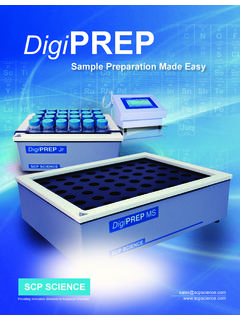
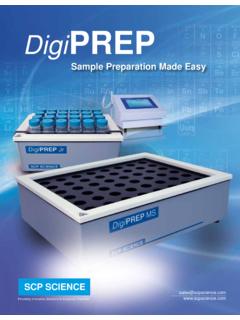
4 COD differs from BOD in that it measures the oxygen demand to digest all organic content, not just that portion which could be consumed by biological processes. Perform your COD Analysis using the DigiPREP CUBE Digestion System and AccuSPEC Pre-fi lled COD Tubes. Standards and reagents are available as Information010-510-003010-510-00425 Tubes15, 60, 90, & 120 minutes250 WPre-set 100 C / 150 CYe sTefl on Coated GraphiteBuilt-inCE/UL/CSAC atalog Number (115V) Catalog Number (230V)CapacityTimerPowerTemperatureOver- Temp ProtectionHeating BlockControllerCertifi cationDigiPREP CUBE Digestion System is an innovative, 25-position Digestion Block designed for chemical oxygen demand and other digestions employing 16 mm tubes. DigiPREP CUBE is a vertically integrated system with a built-in temperature controller, timer, and graphic display.
5 Simple operation is achieved through keypad selection of timer settings, 15, 60, 90, or 120 minutes, and pre-set temperatures of 100 and 150 C. The digestion block is Tefl on-Coated Graphite to resist corrosion and acid attack. Total Organic CarbonChemical oxygen DemandAccuSPEC COD Standards and ReagentsAccuAccuSPEC SPEC COD Standards and Reagents save valuable time by removing the need to prepare standards and reagents prior to Analysis . All products are prepared following guidelines from Standards Methods for the Examination of Water and Wastewater , 20thth Ed. and available in wide range of volumes. Solutions Concentration125 ml500 ml1 L4 L1,10-Phenanthroline, Standard100 mg/l O2250-130-550250-130-551 COD Standard1000 mg/l O2250-130-600250-130-601 COD Standard10,000 mg/l O2250-130-650250-130-651 COD Standard Plus (contains Chloride)100 mg/l O2250-130-700250-130-701 COD Standard Plus (contains Chloride)1000 mg/l O2250-130-750250-130-751 COD Standard Plus (contains Chloride)10,000 mg/l O2250-130-800250-130-801 Ferrous Ammonium Sulfate, Fe(NH4)2(SO4) N250-130-150250-130-151250-130-152 Ferrous Ammonium Sulfate, Fe(NH4)2(SO4) N250-130-200250-130-201250-130-202 Ferrous Ammonium Sulfate, Fe(NH4)2(SO4) N250-130-250250-130-251250-130-252 Ferrous Ammonium Sulfate, Fe(NH4)2(SO4) N250-130-300250-130-301250-130-302 Ferrous Ammonium Sulfate, Fe(NH4)2(SO4) N250-130-350250-130-351250-130-352 Ferrous Ammonium Sulfate, Fe(NH4)
6 2(SO4)21 N250-130-400250-130-401250-130-402 Ferrous Ammonium Sulfate, Fe(NH4)2(SO4)220% w/v250-130-450250-130-451250-130-452 Sulfuric Acid Reagent for COD testing, H2SO4250-130-500250-130-501250-130-502*C atalog Number* indicates 5L Glass BottleCRM for COD, Low level200 ppm140-715-101**CRM for COD, High level1000 ppm140-715-102** indicates 20 ml Glass BottleSolutionsConcentration125 ml500 mlTotal Inorganic Carbon Standard (TIC)1000 g/ml250-250-000250-250-001 Total Organic Carbon Standard (TOC)1000 g/ml250-250-050250-250-051 Catalog Number2 Standard Method # 5310. Organic matter plays a major role in aquatic systems. It affects biogeochemical processes, nutrient cycling, biological availability, chemical transport and interactions. It also has direct implications in the planning of wastewater treatment and drinking Water treatment.
7 Organic matter content is typically measured as total organic carbon and dissolved organic carbon, which are essential components of the carbon cycle. AccuSPEC prepared standards for TOC and TIC reduce Analysis costs and maximize *e Biological oxygen DemandSolutionsConcentration500 ml1 L5 LBuffer pH (phosphate)250-110-100250-110-101250-110 -102 Calcium Chloride, w/v250-110-200250-110-201250-110-202 Ferric Chloride, w/v250-110-300250-110-301250-110-302 Magnesium Sulfate, w/v250-110-400250-110-401250-110-402 Catalog NumberAcid Solution, N250-060-280250-060-281250-060-282 Alkali Solution, N250-108-400250-108-401250-108-402 Total Dissolved SolidsConc. KClmg/L500 ml1 L6,000250-160-390250-160-39110,000250-16 0-410250-160-41112,000250-160-430250-160 -43118,000250-160-450250-160-45130,00025 0-160-470250-160-47140,000250-160-490250 -160-49170,000250-160-510250-160-511 Catalog NumberSee page 12 for more information on peCHECK Standards.
8 3 Standard Method # 5210. Microorganisms such as bacteria are responsible for decomposing organic waste. When organic matter such as dead plants, leaves, grass clippings, manure, sewage, or even food waste is present in a Water supply, the bacteria will begin the process of breaking down this waste. When this happens, much of the available dissolved oxygen is consumed by aerobic bacteria, robbing other aquatic organisms of the oxygen they need to live. Biological oxygen demand (BOD) is a measure of the oxygen used by microorganisms to decompose this waste. AccuSPEC prepared reagents for Biological oxygen demand are available in different volumes, to provide the maximum cost effectiveness for your Method # 2540. Total Dissolved Solids refer to the amount of physical matter dissolved in Water .
9 Determination of the solids content is important for both aesthetic and practical reasons, Drinking Water with a high solids content can have an disagreeable palatability. Water with high mineral content can cause heavy deposition and be unsuitable for many industrial prepared Total Dissolved Solids standard values are expressed as a concentration of KCl. Exact values are dependant on the aliquot taken for the Analysis . Use peCHECK Mineral Standard as a performance evaluation standard in conjunction with AccuSPEC (Inorganic Nonmetallic) Analysis125 ml500 ml125 ml500 mlAnion Standards1000 g/ml10,000 g/mlAcetateBromateBromideChlorateChlorid eFluorideFormateNitrateNitrate-NitrogenN itriteNitrite-NitrogenOxalatePerchlorate PhosphatePhosphate-PhosphorusSulfateSulf ate-Sulfur--250-221-235250-221-400250-22 1-505250-221-535250-221-595250-221-70025 0-221-236250-221-401250-221-506250-221-5 36250-221-596250-221-701-250-180-231250- 180-235CH COOBrOBrClOClFHCOONO NO as NNONO as NC OClOPOPO as PSOSO as S33-3---3-3-2-2-42 2-4-3-43-42-42-4250-220-100250-220-22025 0-220-235250-220-355250-220-370250-220-4 00250-220-415250-220-505250-220-520250-2 20-535250-220-550250-220-565250-220-5802 50-220-595250-220-610250-220-700250-220- 715250-220-101250-220-221250-220-236250- 220-356250-220-371250-220-401250-220-416 250-220-506250-220-521250-220-536250-220 -551250-220-566250-220-581250-220-596250 -220-611250-220-701250-220-716 Catalog Number1000
10 G/ml*All Anion Calibration Standards have a Water matrixElementConcentration30 g/ml20 g/ml100 g/ml150 g/ml150 g/ml Multi-Element StandardsCl-F-Br-NO3-PO4-3SO4-2NO2-Conce ntration10 g/ml10 g/ml 10 g/ml 10 g/ml 10 g/mlConcentration100 g/ml100 g/ml100 g/ml100 g/ml100 g/mlConcentration 100 g/ml 100 g/ml1000 g/ml1000 g/ml1000 g/ml1000 g/ml1000 g/ml 1000 g/ml 1000 g/mlCatalog Number125 ml500 ml140-315-001140-315-005140-315-011140-3 15-015250-225-001250-225-005250-225-1012 50-225-105 Anion Calibration StandardsCustom Multi-Element Standards for your application are of the common anions are important for monitoring Water quality prior, during and after treatment. The two common methods of Analysis are Ion Chromatography, Standard Method # 4110, and Ion Selective Electrode Analysis Standard Method Series # Anion Standards are designed for use with both methods of Analysis , Ion Chromatography and Ion Selective Electrode.