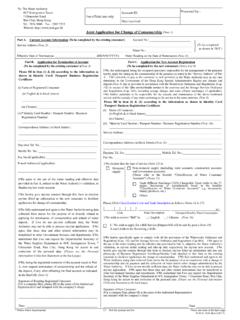
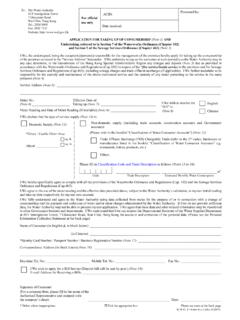
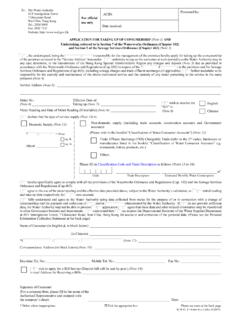
Transcription of Water Sampling Procedure
1 Water Sampling Procedure (with reference to ISO 5667 Part 5) (A) Assessment of Sampling Location Please take note of the conditions of the environment, Sampling taps and pipes at the Sampling location. If the following situation(s) is/are encountered, DO NOT TAKE SAMPLES. 1. Unsatisfactory environmental condition surroundings dusty, covered with debris, or poorly ventilated; 2. Leaking taps; 3. Taps connected to anti-splash nozzles, rubber tubings or other accessories; 4. Taps connected to heaters or Water filters (that cannot be detached); or 5.
2 Taps with sand strainers that cannot be detached. (B) Sampling Method 1. Detach sand strainer or Water filter from tap with appropriate tools; 2. Check for the correct sample bottle and label; 3. Turn on cold Water tap at maximum flow and start timing; 4. Let Water flow for 2 to 5 minutes depending on how often the tap is used (If the internal plumbing system has not been used for a long period of time, flush the system thoroughly before Sampling ); 5. After flushing, open cap of the sample bottle; 6. Keep holding the sample bottle cap in one hand while sample is being collected to ensure it does not come into contact with anything to avoid contamination; 7.
3 Fill the sample bottle carefully to prevent overfill (Figure 1); 8. Carefully put the cap back on the sample bottle; 9. The following should be noted during Sampling : i. Never rinse the bottle; the Sampling bottle shall be so held that the Water does not come in contact with the hand before entering into the bottle; ii. Make sure that all samples are correctly labeled ( Sampling point, date and flushing time) (Figure 2); iii. Reinstall tap sand strainer or Water filter with tools; iv. Store Water samples in ice-boxes with freezer packs and deliver to laboratory on the same day.
4 1 (Figure 1) Fill the Sampling bottle carefully to prevent overfill. (Figure 2) Make sure that all samples are correctly labeled ( Sampling point, date and flushing time) [Date of Sampling ] [Time of Sampling ] [Address of Sampling Location] [Specific Location of Sampling ( Water Tap (Kitchen Basin))] 2 Cleaning Procedure for Sampling Bottles Please follow the Procedure below for cleaning polyethylene bottles (250 ml) and caps: 1. Rinse bottles and caps once with tap Water . 2.
5 Fill bottles to just overflowing with diluted Decon 90 (5%) and put caps on bottles. 3. Shake bottles slightly and let them stand for at least 2 hours. 4. Remove caps and empty bottles. 5. Rinse bottles and caps in flowing tap Water until no foam is observed. 6. Rinse bottles and caps once with deionised Water . 7. Fill up bottles with 1:1 nitric acid (HNO3) and put caps on bottles. 8. Shake bottles slightly and let them stand for at least 2 hours. 9. Remove caps and empty bottles. 10. Rinse bottles and caps 3 times with deionised Water .
6 11. Dry bottles and caps in oven at 50 oC.