Transcription of Waves - cstephenmurray.com
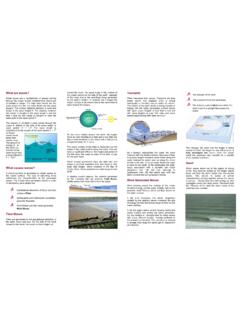
1 Ch 11:2 Name: _____ Period: _____ Copyright 2004, C. Stephen Murray Waves If you were to drop a rock in water you would make Waves . You know that the Waves move away from where you dropped the rock (linear motion), but when the Waves pass, the water moves up and down (harmonic motion). Restoring force: To be harmonic motion, the Waves have to have a restoring force. In water Waves it is the water molecules. The water is compressed and expanded to cause the up and down (oscillating) motion. All Waves do this with molecules they travel through. Two Types of Waves Speed and Wavelength Waves can go through things: Waves go through water; light Waves can go through your skin; sound Waves can goes through walls.
2 If it can go through something, it is a wave. Waves combine harmonic motion and linear motion. Ocean Waves oscillate (move up and down): this is Harmonic Motion Ocean Waves travel: this is Linear Motion Transverse Waves (slinky moving side to side or up and down) moves perpendicular to the direction of the wave. Ocean Waves are trans-verse Waves , moving forward, but the oscillat-ing up and down. Longitudinal Waves (also called compression Waves a slinky pushed and pulled) moves paral-lel (same direction) to the wave motion. Sound Waves are longitudinal Waves the sound moves forward and the oscillations move back and forth. Transverse Wave (Perpendicular to direction of wave) Longitudinal Wave (Parallel to direction of wave) Earthquakes are made up of both transverse and longitudinal Waves .
3 The transverse Waves do the most damage. Different Waves have different speeds and different wavelengths. (m)Displacement (m)Amplitude = 4 m Amplitude = 4 cm Wavelength = 1 m = ( m m) End of 1st cycle End of 2nd cycle Crest Trough Wavelength ( ) the length of one cycle of the wave. Crest top peak Trough bottom peak New Terms: The Speed (velocity) of a Wave v = v = f T wavelength (m) period (sec) wavelength (m) frequency (Hz) velocity (m/sec) Ex. Find the speed of a 20 Hz wave that has a 5 meter wavelength. f = 20 Hz = 5 m v = ? v = f v = (20 Hz) x (5 m) v = 100 m/s Ch 11:2 Name: _____ Period: _____ Copyright 2004, C.
4 Stephen Murray 1. Transverse wave 2. Longitudinal wave 3. Crest 4. Trough 5. Wavelength A. A wave where the oscillation is perpen-dicular to the direction of motion. B. The bottom of a wave. C. The top of a wave. D. A wave where the oscillation is in the same direction (parallel) as the motion. E. The length of one wave cycle. FM radio: _____ A car going 70 m/s: _____ Clock pendulum: _____ Ocean Waves : _____ Music: _____ A bulldozer: _____ Earthquakes: _____ Cellphones: _____ Wave Motion, Yes or No? Pendulum A is 20 cm long and has a 5 g mass on it. Pendulum B is 30 cm long and has a 10 g mass on it.
5 Which one has a faster period? A wave has a wavelength of 2 meters and a frequency of Hz. What is its speed? A wave is 8 meters long and has a frequency of 3 Hz. Find speed. A wave has a period of 4 seconds. Find its frequency. A wave has a frequency of 2 Hz. Find its period. A wave has a speed of 50 m/sec. If its frequency is 100 Hz, what is its wavelength? Mark 1 cycle of the wave. Starting at 1 m, where does the next cycle end: How many wavelengths long is the graph? Wavelength: Amplitude: If f = Hz, find speed: Mark 1 cycle of the wave. Starting at m, where does the 2nd cycle end: Number of complete cycles: Wavelength: Amplitude: If f = 4 Hz, find speed: Mark 1 cycle of the harmonic motion.
6 Starting at secs, when does half a cycle end: Number of complete cycles: Period: Frequency: Amplitude: Pos ition vs . Tim e (sec)Position (cm)Dis place m e nt vs . Pos (m)Displacement (m)Dis place m e nt vs . Pos ition (m )Displacement (m)