Transcription of What about two traits?
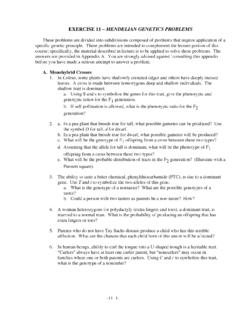
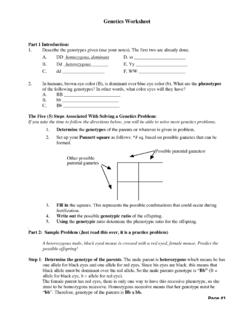
1 What about two traits? dihybrid Crosses!Consider two traits for pea: Color: Y (yellow) and y (green) Shape: R (round) and r (wrinkled)!Each dihybrid plant produces 4 gamete types ofequal frequency. YyRr (adult)" four gamete types: YR, Yr, yR or yrDihybrid crosses reveal the law ofindependent assortment A dihybrid is an individual that is heterozygous at twogenes (YyRr) Mendel designed experiments to determine if two genessegregate independently of one another in dihybrids First constructed true breeding lines for both traits (YYRR & yyrr) crossed them to produce dihybrid offspring (YyRr) examined the F2 for parental or recombinant types (newcombinations not present in the parents)Tracking Two Genes Pure-breeding parentals F1 are all RrYy Self or cross F1 Observe 9:3:3:1 ratio Note that the round green andwrinkled yellow phenotypiccombinations observed in theparents did not stay togetherin the of Mendel s dihybrid crosses F2 generation contained both parental types and recombinant types F2 showed 4 different phenotypes: the round and yellow traits did notstay linked to each other.
2 Ratios for each trait corresponds to what one would expect frommonohybrid crosses. Alleles of genes assort independently, and can thus appear in anycombination in the offspring Shuffling of traits occurs before they realign in every round yellow108 round green101 wrinkled yellow 32 wrinkled green9331R-Y-R-yyrrY-rryyWhat ratios wereproduced per trait?How can the F2 proportions be explained? round : wrinkled315+108 : 101+32 423 : : 1 Shape yellow : green315+101 : 108+32 416 : 140 3 : 1 Color Each F1 produces fourdifferent types of gametes inequal proportions These gametes cometogether randomly to form azygote Each single trait still gives3:1 ratio Combined, the overall ratio is9:3:3:1A Punnett square ofdihybrid cross Each F1 produces fourdifferent types of gametes inequal proportions These gametes cometogether randomly to form azygote Each single trait still gives3:1 ratio Combined, the overall ratio is9:3:3:1A Punnett square ofdihybrid crossDihybrid cross produces apredictable ratio of phenotypesHints for dihybrid Crosses Look at all combinations of gametes Remember only one allele per gene is represented Not all squares are 4 by 4 s TTPp X Ttpp What would square sides look like?
3 TP and Tp on one side Tp and tp on the other Need to clearly state phenotype and genotype ratiosfor full credit on exams! dihybrid CrossesTpTPTptpTTPp X TtppDihybrid CrossesTpTPTptpTTPp X TtppTTppTTPpTtppTtPpDihybrid CrossesTpTPTptpTTPp X TtppTTppTTPpTtppTtPpGenotype ratio: 1 TTpp: 1 TTPp : 1 Ttpp : 1 TtPpPhenotype ratio: 1 tall, purple: 1 tall, whiteMendel s Second Law Law of independent assortment: Segregation of alleles of two different genes are independent of oneanother in the production of gametes For example: no bias toward YR or Yrin gametes Random fertilizationof ovules by pollen no bias of gametes forfertilizationLaw of Segregation: Two alleles for each trait separate(segregate) during gamete formation,and then unite at random,one from each parent, at fertilizationMendel s Monastery in BrnoThe law of independent assortment During gamete formation different pairs of alleles segregateindependently of each otherDihybrid TestcrossYyRr - yellow round31 Yyrr- yellow wrinkled27yyRr- green round26yyrr- green wrinkled26 The dihybrid shouldmake four types ofgametes, in equalnumbersThis is a ratio of 1:1:1:1 Test cross confirms independent assortment of X YyRr yyrr round wrinkled yellow greenPatterns of Segregation!
4 One gene (one trait, two phenotypes) 3:1 (F2) phenotypic ratio 1:2:1 (F2) genotypic ratio 1:1 (or 1:0) phenotypic ratio in test cross of F1!Two genes (two traits, four total phenotypes) 9:3:3:1 (F2) phenotypic ratio 1:1:1:1 phenotypic ratio in test cross of F1 Mendel s LawsLaw of Dominance: In a cross of parents that are pure for differenttraits, only one form of the trait will appear in the next that have a hybrid genotype will only exhibit the dominant of Segregation: During the formation of gametes (eggs orsperm), the two alleles responsible for a trait separate from each otherduring a process called meiosis. Alleles for a trait are then "recombined"at fertilization, producing the genotype for the traits of the of Independent Assortment: Alleles for different traitsare distributed to eggs or sperm (& offspring) independently of oneanother.
5 (These assortments can be determined by performing a dihybridcross)Probabilities and more Mendelian Analysis# Review of probability# Application of probability to Mendelian geneticsProbability(expected frequency)probability ofan outcome# of times event is expected to happen# of opportunities (trials)= The sum of all the probabilities of all possible events = 1 (100%)Probability25 60 red gum balls 40 green gum balls! If you buy one gum ball, the probability of getting a red one is:# of red gum ballsTotal # of gum balls= 60100= x 100% = 60%Product RuleThe probability of independent events occuringtogether is the product of the probabilities ofthe individual (A and B) = p(A)p(B) If I roll two dice, what is the chance of getting two5 s? " a 5 on 1st die and a 5 on 2nd die?andProduct RuleNote: the probability of getting a 5 on the second die is independent of what thefirst die events:--probability of a 5 on the 1st die"--probability of a 5 on the 2nd die"a 5 on a face6 faces total16=a 5 on a face6 faces total16=$ Prob.
6 Of a 5 on the 1st die and a 5 on the 2nd die =16=16X136~ RuleThe probability of either of two mutuallyexclusive events occurring is the sum of theirindividual (A or B) = p(A) + p(B) If roll two dice, what is the chance of getting two 5 s or two 6 s? " a 5 on 1st die and a 5 on 2nd die or a 6 on 1st die and a 6 on 2nd die?or--probability of getting two 5 s = 1/36--probability of getting two 6 s = 1/36 Sum Rule$ The prob. of getting either two 5 s or two 6 s =136136118=+~ This can happen intwo ways: green firstthen red, or red firstthen green. When not specifyingorder, we must figureout each way of gettingthe 60 red gum balls40 green gum balls25 25 25 25 What is the probability of getting one green and one red gum ball if we have two quarters?Probabilityp(green, then red) = p(green) X p(red) " product rule= X = or --p(red, then green) = p(red) X p(green) " product rule= X = $ Thus, the probability of getting one red and one green gum ball isp(green, then red) + p(red, then green) = + = " sum ruleProbabilityThe Punnett Square is a way of depicting the product Mendel s law of segregation, we know that bothalleles are equally likely to occur.
7 So for a cross:RR1/4Rr1/4Rr1/4rr1/4F1 male gametes 1/2 R 1/2 rF1femalegametes1/2 R 1/2 r1/4 RR + 1/2 Rr + 1/4 rr 1 : 2 : 1monohybridcross(one gene)Rr x RrQuestion What are chances of two heads in a row with a faircoin? 1) 100% 2) 50% 3) 25% 4) 0%Question What are chances of rolling a one or a two with adie? 1) 1/6 2) 2/6 3) 1/12 4) 1/2 Question If the parents of a family already have two boys,what is the probability that the next two offspringwill be girls? 1. 1 2. 1/2 3. 1/3 4. 1/4 Hint: probability of 2 events occurring togetherDihybrid Cross: Two Genes! Consider the two genes (each with two alleles):--color: Y (yellow) and y (green)--shape: R (round) and r (wrinkled)cross two pure-breeding lines:RRyyrrYYRrYy( dihybrid )xPF1 dihybrid Cross:X RrYy RrYy all possible gametes: RY Ry rY ry (from each plant)F1 (self)1 RY gamete4 gametesp(RY gamete) ==14 Punnett Square of adihybrid cross9/16 = round, yellow(R_Y_)3/16 = round, green(R_yy)3/16 = wrinkled, yellow(rrY_)1/16 = wrinkled, green(rryy)RrYy X RrYyR_Y_= !
8 X ! = 9/16 9rrY_= " X ! = 3/16 3R_yy= ! X " = 3/16 3yyrr= " X " = 1/16 1# Using the product rule, the 9:3:3:1 ratio of a dihybrid cross can be predicted because we can consider each trait RrRr rrR rRrYY YyYy yyY yYy! What is the probability of finding a zygote of RRYY genotype in the cross RrYy X RrYy?1. What is the probability of getting RR?2. What is the probability of getting YY?Thus, the probability of RRYY (RR and YY) =RR RrRr rrR rRrYY YyYy yyY yYy1/41/41/4 X 1/4 = 1/16 ! What is the probability of obtaining a round, green seed from a dihybrid (RrYy) cross? Genotype can be either RRyy or RryyRR RrRr rrR rRrYY YyYy yyY yYy" R_yy= ! X " = 3/16 R_yy$ p(R_ and yy) = p(R_) and p(yy)(product rule)!
9 "! What fraction of the progeny from the following cross will have large, smooth, purple fruit?LlSsPp x LlssPP$ large, smooth, purple: p(L_S_P_)1/2all = 1= 3/4= ! X 1 X " = 3/8smooth: p(Ss) =Ss Ssss sss sSspurple: p(Pp or PP) =PP PPPp PpP PPplarge: p(LL or Ll)LL LlLl llL lLlTextureS - smooths - roughColorP purplep pinkSizeL largel small= 1/4 + 2/4F1 RrYyTtSs ! RrYyTtSsWhat is the probability of obtaining the genotype RrYyTtss?P RRYYTTSS ! rryyttssRr ! Rr1RR:2Rr:1rr2/4 RrYy X Yy1YY:2Yy:1yy2/4 YyTt ! Tt1TT:2Tt:1tt2/4 TtSs ! Ss1SS:2Ss:1ss1/4 ssProbability of obtaining individual with Rr and Yy and Tt and ss.(probability of events occurring together)2/4 ! 2/4 ! 2/4 ! 1/4 = 8/256 (or 1/32)Laws of probability for multiple genesF1 RrYyTtSs ! RrYyTtSsP RRYYTTSS !
10 RryyttssWhat is the probability of obtaining a completely homozygousgenotype? (probability of either/or events occurring)Genotype could be RRYYTTSS or rryyttssRr ! Rr1RR:2Rr:1rr1/4 RR1/4 rrYy ! Yy1YY:2Yy:1yy1/4 YY1/4 yyTt ! Tt1TT:2Tt:1tt1/4 TT1/4 ttSs ! Ss1SS:2Ss:1ss1/4 SS1/4 ss(1/4 ! 1/4 ! 1/4 ! 1/4) + (1/4 ! 1/4 ! 1/4 ! 1/4) = 2/256 Probability of homo Dom + probability of homo Rec)Laws of probability for multiple genes If we cross RrYyTtSs ! RrYyTtSs, what is theprobability of obtaining the genotype RRYyTtss? 1) 1/16 2) 1/32 3) 1/64 4) 1/128 Question If we cross RrYyTtSs ! RrYyTtSs, what is theprobability of obtaining the genotype RRYyTtss orRRYyTtSS? 1) 1/16 2) 1/32 3) 1/64 4) 1/128 QuestionProbability -- conclusions#Probability can be used to predict the types of progeny that will resultfrom a monohybrid or dihybrid cross#The Punnett square is a graphical representation of these possibleoutcomes#Phenotypes are the result of the genotype of an organism# more than one genotype may result in the same phenotype#Distinct segregation patterns result from monohybrid, dihybrid , and test-crossesHomework Problems Chapter 2 # 2, 12, 16, 17, 21 DON T forget to submit the iActivity Tribble Traits