Transcription of What Fun! It's Practice with Scientific Notation!
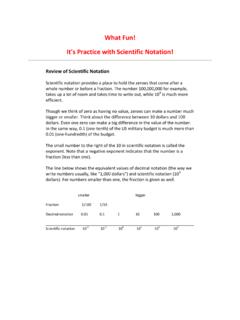
1 What Fun! It's Practice with Scientific notation ! Review of Scientific notation Scientific notation provides a place to hold the zeroes that come after a whole number or before a fraction. The number 100,000,000 for example, takes up a lot of room and takes time to write out, while 108 is much more efficient. Though we think of zero as having no value, zeroes can make a number much bigger or smaller. Think about the difference between 10 dollars and 100 dollars. Even one zero can make a big difference in the value of the number. In the same way, (one-tenth) of the US military budget is much more than (one-hundredth) of the budget. The small number to the right of the 10 in Scientific notation is called the exponent.
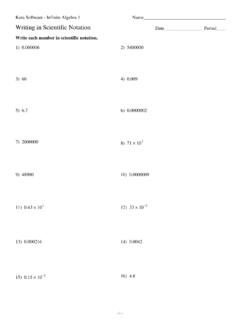
2 Note that a negative exponent indicates that the number is a fraction (less than one). The line below shows the equivalent values of decimal notation (the way we write numbers usually, like "1,000 dollars") and Scientific notation (103 dollars). For numbers smaller than one, the fraction is given as well. smaller bigger Fraction 1/100 1/10 Decimal notation 1 10 100 1,000 _____ Scientific notation 10-2 10-1 100 101 102 103 Practice With Scientific notation Write out the decimal equivalent (regular form) of the following numbers that are in Scientific notation . Section A: Model: 101 = 10 1) 102 = _____ 4) 10-2 = _____ 2) 104 = _____ 5) 10-5 = _____ 3) 107 = _____ 6) 100 = _____ Section B: Model: 2 x 102 = 200 7) 3 x 102 = _____ 10) 6 x 10-3 = _____ 8) 7 x 104 = _____ 11) 900 x 10-2 = _____ 9) x 103 = _____ 12) 4 x 10-6 = _____ Section C: Now convert from decimal form into Scientific notation .
3 Model: 1,000 = 103 13) 10 = _____ 16) = _____ 14) 100 = _____ 17) = _____ 15) 100,000,000 = _____ 18) 1 = _____ Section D: Model: 2,000 = 2 x 10³ 19) 400 = _____ 22) = _____ 20) 60,000 = _____ 23) = _____ 21) 750,000 = _____ 24) = _____ More Practice With Scientific notation Perform the following operations in Scientific notation . Refer to the introduction if you need help. Section E: Multiplication (the "easy" operation - remember that you just need to multiply the main numbers and add the exponents). Model: (2 x 102) x (6 x 103) = 12 x 105 = x 106 Remember that your answer should be expressed in two parts, as in the model above.
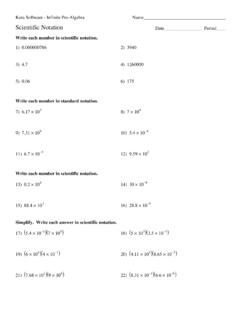
4 The first part should be a number less than 10 (eg: ) and the second part should be a power of 10 (eg: 106). If the first part is a number greater than ten, you will have to convert the first part. In the above example, you would convert your first answer (12 x 105) to the second answer, which has the first part less than ten ( x 106). For extra Practice , convert your answer to decimal notation . In the above example, the decimal answer would be 1,200,000 Scientific notation decimal notation 25) (1 x 103) x (3 x 101) = _____ _____ 26) (3 x 104) x (2 x 103) = _____ _____ 27) (5 x 10-5) x (11 x 104) = _____ _____ 28) (2 x 10-4) x (4 x 103) = _____ _____ Section F: Division (a little harder - we basically solve the problem as we did above, using multiplication.
5 But we need to "move" the bottom (denominator) to the top of the fraction. We do this by writing the negative value of the exponent. Next divide the first part of each number. Finally, add the exponents). (12 x 103) Model: ----------- = 2 x (103 x 10-2) = 2 x 101 = 20 (6 x 10²) Write your answer as in the model; first convert to a multiplication problem, then solve the problem. multiplication problem final answer (in sci. not.) 29) (8 x 10⁶) / (4 x 10³) = _____ _____ 30) ( x 108) / ( x 104) = _____ _____ 31) (4 x 10³) / (8 x 10⁵) = _____ _____ 32) (9 x 10²¹) / (3 x 10¹⁹) = _____ _____ Section G: Addition The first step is to make sure the exponents are the same.
6 We do this by changing the main number (making it bigger or smaller) so that the exponent can change (get bigger or smaller). Then we can add the main numbers and keep the exponents the same. Model: (3 x 10⁴) + (2 x 10³) = (3 x 10⁴) + ( x 104) = x 104 (same exponent) = 32,000 (final answer) First express the problem with the exponents in the same form, then solve the problem. same exponent final answer 33) (4 x 10³) + (3 x 10²) = _____ 34) (9 x 10²) + (1 x 10⁴) = _____ 35) (8 x 10⁶) + ( x 107) = _____ 36) ( x 10-3) + ( x 10-4) = _____ Section H: Subtraction Just like addition, the first step is to make the exponents the same.
7 Instead of adding the main numbers, they are subtracted. Try to convert so that you will not get a negative answer. Model: (3 x 10⁴) - (2 x 10³) = (30 x 103) - (2 x 10³) = 28 x 103 (same exponent) = x 104 (final answer) same exponent final answer 37) (2 x 10²) - (4 x 101) = _____ _____ 38) (3 x 10⁻⁶) - (5 x 10⁻⁷) = _____ _____ 39) (9 x 10¹²) - ( x 109) = _____ _____ 40) ( x 10-4) - (3 x 10²) = _____ _____ And Even MORE Practice with Scientific notation (Boy, are you going to be good at this!) Positively positives! 41) What is the number of your street address in Scientific notation ? 42) x 103 is what?
8 Combine this number with Pennsylvania Avenue and what famous residence do you have? Necessarily negatives! 43) What is x 10-1? Is this the same as 125 thousandths? 44) is what in Scientific notation ? Operations without anesthesia! 45) (2 x 10³) + (3 x 10²) = 46) (2 x 10³) - (3 x 10²) = 47) (32 x 104) x (2 x 10-3) = 48) ( x 104) / ( x 102) = Food for some BIG numbers 49) The cumulative national debt is on the order of $4 trillion. The cumulative amount of high-level waste at the Savannah River Site, Idaho Chemical Processing Plant, Hanford Nuclear Reservation, and the West Valley Demonstration Project is about 25 billion curies. If the entire amount of money associated with the national debt was applied to cleanup of those curies, how many dollars per curie would be spent?
9 Answers: 1) 100 2) 10,000 3) 10,000,000 4) 5) 6) 1 7) 300 8) 70,000 9) 2,400 10) 11) 9 12) 13) 101 14) 102 15) 108 16) 10-1 17) 10-4 18) 100 19) 4x10² 20) 6X10⁴ 21) 22) 5x10⁻³ 23) 24) 25a) 3x10⁴ 25b) 30,000 26a) 6x10⁷ 26b) 60,000,000 27a) 27b) 28a) 8x10⁻¹ 28b) 29) 2x10³ 30) 3x10⁴ 31) 5x10⁻³ 32) 3x10² 33) 34) 35) 4x10⁷ 36) 37) 38) 39) 40) 41) Depends 42) 1600 43) , Yes 44) 45) 46) 47) 48) 3x10² 49) 160 dollars/curie