Transcription of What is Assessing Clinical Competencies? PRACTICE ...
1 NURSING Clinical Competencies: Assessing PRACTICE &. SKILL What is Assessing Clinical Competencies? Assessing Clinical competencies involves the utilization of competency assessment tools to determine if a nurse possesses the ability to perform specific tasks in the Clinical setting What: Clinical competency assessment (CCA) can be defined as the evaluation of a nurse's ability to perform a task based on Clinical skills, knowledge, education , and experience. Current recommendations highlight the importance of using more than one assessment tool to produce the most accurate assessment results possible How: Ideally, CCAs are conducted on an ongoing basis.
2 Healthcare organizations are expected to continually assess, monitor, maintain, and improve their nurses' Clinical competencies as part of their effort to achieve the best patient care outcomes. Multiple CCA tools exist, including peer review, direct observation by a superior/supervisor, and observation of skill performance in simulated settings. Organizational factors, including financial resources and hierarchical structure, influence the competency assessment methods used in a specific healthcare organization Where: CCA is an essential component of nurse education and training across Clinical settings, including acute and long-term care facilities, outpatient facilities, home care, schools, ambulatory care settings, and occupational healthcare settings Who: Depending on the structure of the healthcare organization, CCAs might be conducted by Clinical nurse specialists (CNSs.)
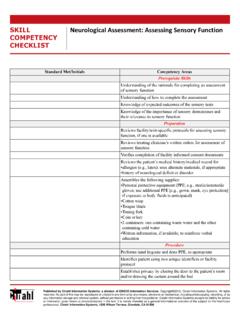
3 Advanced PRACTICE registered nurses who function as point-of-carenurse experts, facilitators of evidence-based nursing PRACTICE , and mentors to Clinical nursing staff members), nurse managers, nurse educators, and/or senior nurses with demonstrated proficiency in Clinical task performance and application of critical thinking skills. It is typically the responsibility of nurse managers to maintain records of nurses' competencies (Figure 1). Authors Eliza Schub, RN, BSN. Cinahl Information Systems, Glendale, CA. Helle Heering, RN, CRRN. Cinahl Information Systems, Glendale, CA.
4 Reviewers Dawn Stone, PhD(c), RN, ANP, COHN-S. Kathleen Walsh, RN, MSN, CCRN. Cinahl Information Systems, Glendale, CA. Nursing Executive PRACTICE Council Glendale Adventist Medical Center, Glendale, CA. Figure 1: Evaluating the Clinical competency of a professional nurse is Editor a continuous process. Copyright 2014, EBSCO Information Services Diane Pravikoff, RN, PhD, FAAN. Cinahl Information Systems, Glendale, CA. June 24, 2016. Published by Cinahl Information Systems, a division of EBSCO Information Services. Copyright 2016, Cinahl Information Systems.
5 All rights reserved. No part of this may be reproduced or utilized in any form or by any means, electronic or mechanical, including photocopying, recording, or by any information storage and retrieval system, without permission in writing from the publisher. Cinahl Information Systems accepts no liability for advice or information given herein or errors/omissions in the text. It is merely intended as a general informational overview of the subject for the healthcare professional. Cinahl Information Systems, 1509 Wilson Terrace, Glendale, CA 91206.
6 What is the Desired Outcome of Assessing Clinical Competencies? The desired outcome of CCA is to gain a realistic view of whether a nurse has the necessary skills and knowledge to consistently perform Clinical tasks that are within his or her expected scope of PRACTICE Why is Assessing Clinical Competencies Important? Assessment of Clinical competencies is an essential component of undergraduate and graduate nursing education , advancement beyond the orientation phase of employment, and routine performance appraisals in the Clinical setting (see Nursing PRACTICE & Skill Employee Performance Appraisals: Conducting ).
7 CCAs provide information about potential knowledge deficits that interfere with successful performance of patient care skills If knowledge deficits exist, the CCA can be instrumental in identifying specific areas of weakness and developing individualized enrichment programs to address those areas, strengthen the nurse's knowledge base, and enhance Clinical task performance Alternatively, the CCA can provide evidence of proficiencies that qualify certain nurses as mentors, teachers, and/or leaders in the Clinical setting Facts and Figures It is widely recommended that CCAs utilize a combination of assessment methods ( , not just direct observation) to obtain the most accurate information possible (Clarke et al.)
8 , 2011;Wilkinson, 2013). What You Need to Know Before Assessing Clinical Competencies The Joint Commission requires that accredited institutions assess their employees' competencies. The Elements of Performance related to Joint Commission Standard , which requires hospitals and long-term care organizations to compile and analyze data, states: When the (HAP: hospital); (LTC: organization) identifies undesirable patterns, trends, or variations in its performance related to the safety or quality of care (for example, as identified in the analysis of data or a single undesirable event), it includes the adequacy of staffing, including nurse staffing, in its analysis of possible causes.
9 Adequacy of staffing includes the number, skill mix, and competency of all staff. In their analysis, [hospitals and long term care organizations] may also wish to examine issues such as processes related to work flow; competency assessment;. credentialing; supervision of staff; and orientation, training, and education (Joint Commission, 2016). Clinical competency is an important part of safe patient care. One study in Korea asked 335 nurses to complete a questionnaire about their professional quality of life, their Clinical competency, and personal characteristics ( , demographics).
10 The result showed that nurses who had high Clinical competence also scored high in compassion and satisfaction, and low in professional burnout (Kim et al., 2015). Registered nurses in the United States are expected to function competently within their scope of PRACTICE through the consistent application of sound Clinical and critical thinking skills in accordance with the facility's policies and procedures, the Nurse PRACTICE Act enacted by the legislature of the state in which the nurse is licensed, and the Scope and Standards of PRACTICE published by the American Nurses Association (ANA).