Transcription of WHAT IS CLIMATE CHANGE? - WWF
1 SHAPING OUR FUTURE: THE CLIMATE CHALLENGEKS2 LESSON 1 TEACHER GUIDEWHAT IS CLIMATE CHANGE? 2 SHAPING OUR FUTURE: THE CLIMATE CHALLENGE KS2 LESSON 1 TEACHER GUIDEKS2 LESSON 1 TEACHER GUIDEL earning objective: To understand the terms weather and CLIMATE , and explore some of the factors which affect links:Science and geographyThis lesson will provide the opportunity for pupils to develop an understanding of key terms, such as weather and CLIMATE , and discuss the causes and impact of CLIMATE change. You can then choose from four practical experiments and a research task to investigate the weather. Some of these involve making or setting up apparatus and measuring changes over time, so you may want to complete these over multiple sessions. Alternatively, you could split the class into five different groups and ask each group to complete a different experiment or task. Afterwards each group could present back to the rest of the class, encouraging discussion and IS CLIMATE CHANGE?
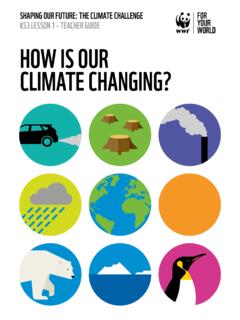
2 3 SHAPING OUR FUTURE: THE CLIMATE CHALLENGE KS2 LESSON 1 TEACHER GUIDEPENGUINS AND POLAR BEARSC limate change is almost certainly a term that your class will be familiar with, but do they really understand what CLIMATE change is? And more importantly, do they appreciate that CLIMATE change relates to them? Use this slide to launch the topic. Is CLIMATE change just about melting ice caps, penguins and polar bears? Elicit and briefly discuss pupils knowledge and understanding before playing the animation embedded on the S START FROM THE WEATHERW eather is the day to day localised conditions, which have great variability (especially here in the UK). The word CLIMATE is the collective term used to describe long-term weather patterns for a particular area. Use the slide visuals to explore the different types of weather and what pupils already know about how they are formed. CLIMATEUse the slide visual to explore the CLIMATE areas, and together with a world map or globe identify countries from each of the areas featured.
3 For example:Polar Norway, Sweden, Finland, Russia, Greenland, Antarctica, IcelandTemperate Parts of the United States of America, parts of Europe, the UK, Japan and New ZealandMediterranean France, Greece, Italy, Spain, Turkey, parts of Australia and CaliforniaDesert Afghanistan, parts of Africa, Saudi Arabia, Iraq, Egypt and Brazil, parts of India, parts of Australia, central Africa, the Caribbean Islands, Thailand and south east : Move across the CLIMATE areas given at the bottom of the slide to display the different 1 2 SLIDE 3 SLIDE 4 FRITZ P LKING / WWF4 SHAPING OUR FUTURE: THE CLIMATE CHALLENGE KS2 LESSON 1 TEACHER GUIDEWEATHER WATCHINGThe slide presents the four main ways in which the weather changes. Each of these are linked to an experiment explained at the end of this guide which allows pupils to explore the weather in practical way.
4 You could select one to set up during this session and then check it over the course of the week, and complete the others over multiple sessions, or split the class into groups for them to complete a different one each. Movement Winds blow from all directions. Knowing which way the wind is blowing can help predict the watcher linked experiments: make and use a weathervane to determine wind direction make and use a simple anemometer to measure wind speedMoisture The moisture content of the air causes mists and fogs and of course rain and frost if it s watcher linked experiment: understanding evaporation and condensation in relation to the water cyclePressure Pressure affects whether we have clear, cloudless days or thunder and lightning watcher linked experiment: make and use a simple barometerTemperature Temperature is influenced by all of the above, as well as how much sunshine reaches the watcher linked experiment: measuring temperature changesCLIMATE CHANGEG lobal temperatures have been rising for over a century, accelerating in the past 30 years, and are now the highest on record.
5 Human activity is releasing greenhouse gases into the atmosphere. These gases are carbon dioxide, surface level ozone, water vapour, methane, nitrous gases, and CFCs. The biggest contributor to the warming effect is carbon dioxide, which is released by burning fossil fuels for energy, farming, and destroying forests. These emissions are causing the greenhouse effect trapping heat and making the Earth warmer to an extent that can t be explained by natural factors alone. This is affecting weather patterns and habitats, plants and animals. People and wildlife often can t keep up with the changes that are happening to their the image on the slide to help pupils understand the greenhouse effect and discuss some of the reasons why this is 5-6 SLIDES 7- 8 AtmosphereGreenhouse gasesSUNS olar radiationMore heatescapes into spaceRe-radiatedheatLessre-emittedheatMo regreenhouse gasesSUNS olar radiationLess heatescapes into spaceRe-radiatedheatMorere-emittedheat5 SHAPING OUR FUTURE: THE CLIMATE CHALLENGE KS2 LESSON 1 TEACHER GUIDEWHY DOES IT MATTER?
6 Use the images to explore some of the impacts of the greenhouse effect discussed in the previous pupils to think about the different places they came up with for each of the Earth s CLIMATE zones on slide 4, and consider which of these weather extremes are likely to affect the animals and people who live in those places most. For example, they may have seen media coverage of flooding in the UK, tornadoes and hurricanes in the USA, or drought in Africa. NB: Move across the black dots shown at the bottom of the slide to display the different CHANGE AND USThis slide asks pupils to consider the impact of CLIMATE change on us, here in the UK. Reinforce the message from the start of the session, that CLIMATE change is not all about penguins and polar bears, it is about all of us and everything that shares our planet. Pupils may have experienced or witnessed flooding for example, or there s a risk of some countries where their favourite foods come from also being affected in this you are in an area that has already been affected by the weather extremes of CLIMATE change, flooding, then allow opportunity for pupils to share their experiences or concerns.
7 Display the images on the slide to remind pupils of the impact of an imbalanced weather system. Are your pupils surprised to see chocolate on the slide? Explore their ideas and remind pupils that impacts in other parts of the world might impact things we use and enjoy every day here in the UK, because many of our products come from undertaking the experiments, allow pupils time to reflect and share what they have learnt about the weather and CLIMATE change. Discuss ways in which you could extend your weather monitoring to measure CLIMATE change in your area monitor, record and compare over the academic year and keep findings for comparison with subsequent years, compare findings with Met Office information, look for other signs of CLIMATE change where you CHANGE AFFECTS US ALL!Summarise the session by showing the film embedded on the slide and discussing the class s responses: 9 SLIDE 10 SLIDE 11 WIM VAN PASSEL / WWF GLOBAL WARMING IMAGES / WWF6 SHAPING OUR FUTURE: THE CLIMATE CHALLENGE KS2 LESSON 1 TEACHER GUIDEIn this section there are four experiments and a research task.
8 The experiments provided will support pupils in finding out more about the factors which affect our weather and CLIMATE . These experiments monitor day to day changes in the weather. However, they would need to be done over decades to see how the CLIMATE has the instructions provided in this guide , pupils are able to make their own weather monitoring equipment, and measure changes. Worksheets for pupils are provided to structure the process and enable recording of each task. The experiments can either be done as a whole class or in mixed ability groups. You could consider splitting the five tasks across different groups, with each group presenting back to the rest of the class. Encourage discussion and the combined results and equipment, pupils should then be given the opportunity to monitor the weather over a period of time. Consider creating a class diary to note instrument readings and weather. This process of monitoring, recording and reflecting will help pupils appreciate how CLIMATE change is measured and also how our weather is can search for YouTube demonstrations of each experiment online.
9 GUIDANCE FOR WEATHER WATCHER LINKED EXPERIMENTS7 SHAPING OUR FUTURE: THE CLIMATE CHALLENGE KS2 LESSON 1 TEACHER GUIDEEXPLORING MOVEMENTTo give context, you could show this 4-minute clip in which Mark Thompson, Astronomer explores why the UK has always suffered from extremely windy conditions and whether this is liable to get worse. movement of the wind is measured in two ways: Using a weathervane to determine direction Using an anemometer to compare wind speed Using the instructions pupils make an anemometer and weathervane to measure wind speed and direction. Once made, the pupil worksheet provided gives an open task which challenges pupils to consider where they will measure wind speed and direction, when and how they will record their findings. Opportunity should be given to discuss and plan the project, with sufficient time for trial and error. Pupils can record how many times per minute the anemometer spins, and multiply by 60 to find out how many spins an hour.
10 They can then compare their results by taking measurements on different days or at different times. INSTRUCTIONS FOR MAKING A WEATHERVANE You will need: plasticine a plastic pot with a lid scissors a bamboo (barbecue) skewer 2 drinking straws clean used drinks carton or cardboard marker pens pins sticky tape something to weigh the weathervane down and a compass to set it up1. Stick a ball of plasticine in the middle of the inside of the lid of your Use the scissors to pierce a small hole in the middle of the bottom of your pot that s big enough for the drinking Place the lid on the table and fix the pot on Cut the skewer to a length slightly shorter than the drinking straw, then slide it Push the straw and skewer through the hole in the bottom of your pot into the plasticine Cut out a square piece from the drinks carton and using a marker, mark each corner with the point of a compass.