Transcription of What's Moving? - Smithsonian Institution
1 1 What's Moving? Summary of ActivityThis lesson is designed to help students make connections between the movements of the Sun in the sky, the Sun on the horizon, and how these apparent motions are caused by the Earth revolving around the lesson will help students understand both the geocentric perspective as well as the heliocentric perspec-tive. The geocentric or Earth-based perspective tracks the Sun s movement on the horizon as seasons change. The heliocentric or space-based perspective tracks the Earth s movement or revolution around the Sun as seasons change. Each student will role play, pretending that their head is the Earth. By mimicking the motion of the Earth around the Sun, the students will understand what they observe while on the Earth: the Sun moving along the horizon, back and forth on a yearly cycle, as the seasons change.
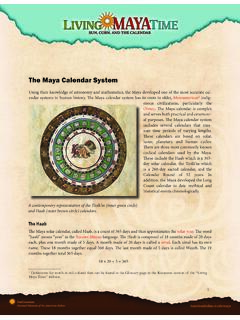
2 They will also understand what is hap-pening in space as the Earth revolves around the Maya Time Website ConnectionsThis activity provides an example of how the ancient Maya observed the movements of the Sun along the horizon using buildings and temples as markers. These observations allowed Maya astronomers to predict seasonal change and enabled them to plan their agricultural and ceremonial cycles. Today, Maya farmers still observe the movements of the Sun and use its apparent motion to plan the planting of corn and their ceremonial should watch the following resources from the Living Maya Time website ahead of time: The entire Maya Sun section Corn and Calendar Traditions in the Corn and Maya Time sectionObjectivesStudents will learn that: Most objects in the Solar System, including the Earth, are in regular and predictable motion; these mo-tions explain such phenomena as the day and the year.
3 The position of the Sun in the sky changes throughout the day. The position of sunrise and sunset along the horizon in the sky changes throughout the year. The Sun has patterns of movement that can be observed and recorded; one way is by observing and recording shadows cast by the Sun. The Sun s apparent movement reflects the Earth s daily spin on its The Earth s nearly circular yearly orbit around the Sun causes us to see the point of sunrise and sunset move back and forth along the horizon at different times of the year: The point of sunrise on the horizon is furthest north on the June solstice1, and the Sun appears to stand still, rising at the same spot on the horizon for a few days.
4 The point of sunrise on the horizon is furthest south on the December solstice, and the Sun appears to stand still, rising at the same spot on the horizon for a few days. On the equinoxes, the point of sunrise on the horizon is half way between where the Sun rises on the summer and winter solstices, and the Sun is moving fast from day to day along the horizon at this will be able to: Predict how the point of sunrise moves in the horizon as the year progresses. Predict and mimic how the Earth moves around the Sun as the year progresses. Develop an understanding of the Earth s rotational motion and identify the cause of the Sun s apparent motion in the sky.
5 Develop an understanding of the Earth s motion around the Sun (revolution) and identify the cause of the Sun s apparent motion along the horizon. Make connections between the geocentric and heliocentric perspectives in the context of ancient obser-vations of the Maya and other cultures. Identify connections between the movements of the Sun, cyclical time, and LevelGrades 6-8 National Science Education Standards Addressed Observing, measuring, and identifying properties Seeking evidence Recognizing patterns and cycles Identifying cause and effect and extending the sensesPhysical Science Position and motion of objectsEarth and Space Science Objects in the sky Changes in Earth and skyDuration of ActivityTwo 1-hour periods1 Definitions for the words in red-colored font can be found in the Glossary page in the Resources section of the Living Maya Time PrerequisitesStudents should: Have the ability to notice patterns of change.
6 Have a basic knowledge of Earth s rotation and revolution. Have a basic knowledge of the apparent motion of the Sun in the sky. Have a basic knowledge of the seasons. Explore the Living Maya Time website in advance of doing the A 100-200 watt bulb on a stand in the middle of a darkened room to serve as your Sun One Horizon Template (at the end of this document) for each student copied onto card stock paper String and tape (several packs) Scissors (several pairs) 1 Earth globe 30 color markers (10 each in red, green, and blue)Teacher Preparation Print one Horizon Template on card stock for each student Set up the room as described below Read Teacher s Notes section below Explore the Living Maya Time website in advance Room Set UpFind a room that can be darkened (a room without windows is best.)
7 Or cover the windows with dark paper). Attach the Sun (your bulb or light fixture) to a chair in the middle of the room; or use a lamp without the shade, and stand it on a chair in the middle of the room. Tape any cords down so students can not trip over them. Your students will walk around this Sun in a circle, so be sure to make space for the students by clearing any furniture, etc. to the edges of the room. Place a sign labeled North Star up high on the wall that is on the north side (or closest to the north side) of your Begin the activity by finding out your students existing knowledge of the movement of the Sun along the horizon throughout the year (geocentric perspective) and about what they might know is happening in space (heliocentric perspective).
8 Here are a few example prompting questions you might ask: How long does it take for the Earth to revolve, or orbit, around the Sun in one complete cycle? what happens to the seasons as the Earth revolves around the Sun? When it is winter in your town, where does the Sun rise or set? How is that different from summer or spring? Have you ever watched the Sun rise or set on the horizon, by standing on the same spot each day, for a period of several days or weeks? what did you notice? what do you think causes the Sun to move along the horizon back and forth as the seasons change?4 Ask your students to pair up and consider these questions, discuss them, and then ask a few pairs from the group to share with everyone.
9 2. Make the Headband Horizon Distribute one cardstock Horizon Template to each participant; ask that they work in pairs, and make string, scissors, and tape available. Have one template ready made for demonstration purposes. Give these instructions verbally to the students, as you build your template: Cut the template along solid lines. Punch a hole in the little circles. Take the ends of the two long strips and tape them in the middle to make one longer strip (leaving the little holes at either end). Pass a piece of string about 10 inches long through each hole and tie at each hole. Tie the headband vertically around the head of your partner with the string tied below the chin.
10 Take the two flaps and bend the little strips back along the dotted line. Fit each flap in front of your partner s ears, by placing the little bent strips on top of the headband and taping them in place. 3. Set up the room as instructed Ask students to stand in a circle around the Sun lamp, and turn lamp on. Leave the room lights on for now. Explain that each of them will pretend that their head is the Earth, and the white flaps are the horizon, east and Using the Earth globe, demonstrate how the Earth rotates on its axis, with the North Pole pointing to the North Star clock or fixture in your room. This demonstrates one day or a 24 hour period.